Centre for Ecology and Conservation, University of Exeter, Cornwall Campus, Penryn, UK.
Ecol Lett. 2013 Jul;16(7):921-9. doi: 10.1111/ele.12129. Epub 2013 May 23.
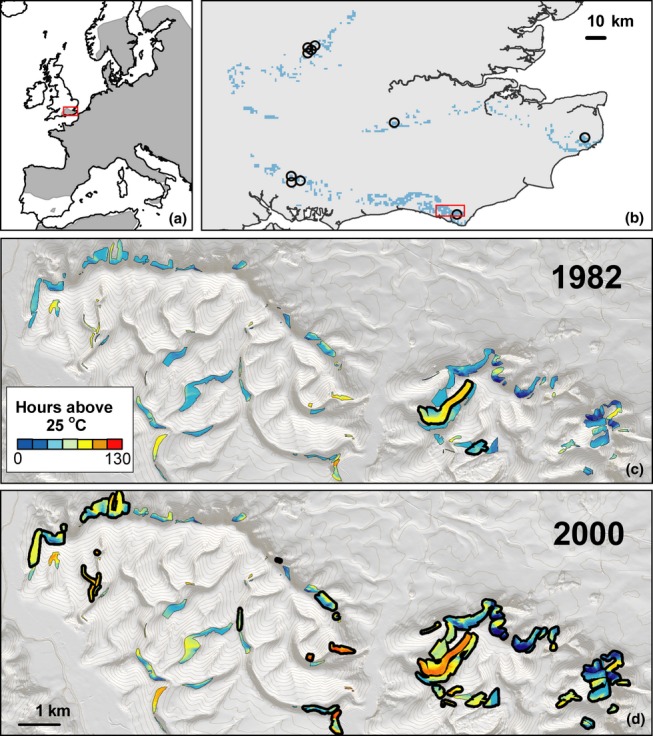
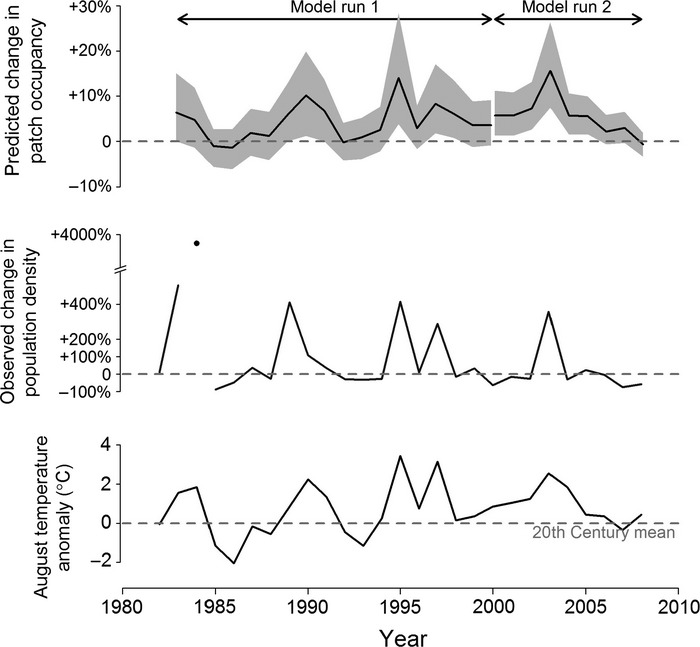
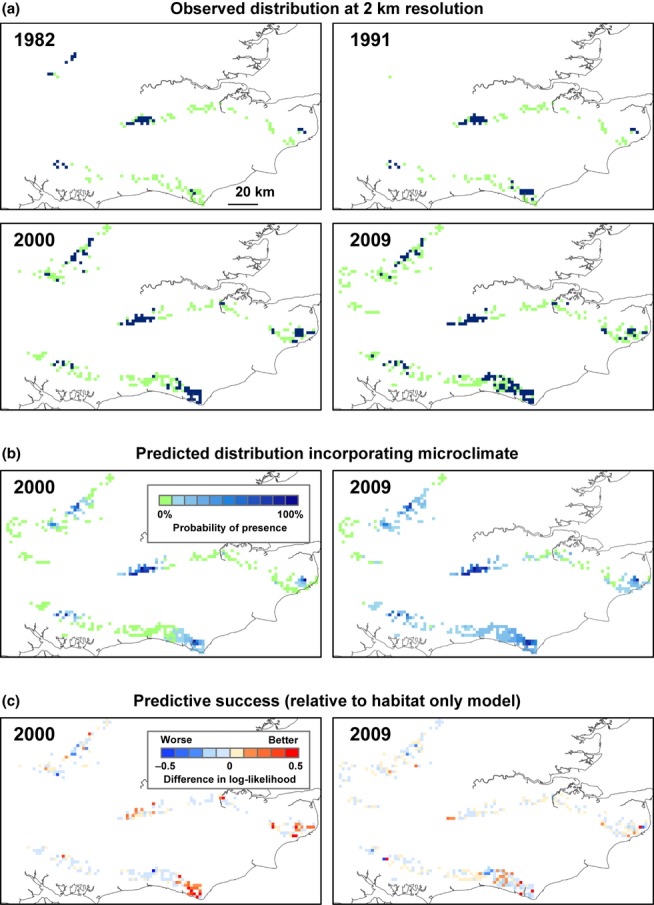
Ecological responses to climate change may depend on complex patterns of variability in weather and local microclimate that overlay global increases in mean temperature. Here, we show that high-resolution temporal and spatial variability in temperature drives the dynamics of range expansion for an exemplar species, the butterfly Hesperia comma. Using fine-resolution (5 m) models of vegetation surface microclimate, we estimate the thermal suitability of 906 habitat patches at the species' range margin for 27 years. Population and metapopulation models that incorporate this dynamic microclimate surface improve predictions of observed annual changes to population density and patch occupancy dynamics during the species' range expansion from 1982 to 2009. Our findings reveal how fine-scale, short-term environmental variability drives rates and patterns of range expansion through spatially localised, intermittent episodes of expansion and contraction. Incorporating dynamic microclimates can thus improve models of species range shifts at spatial and temporal scales relevant to conservation interventions.
气候变化的生态响应可能取决于天气和局地小气候的复杂变化模式,这些变化模式叠加在全球平均温度的升高之上。在这里,我们表明,温度的高分辨率时间和空间变化驱动了一个典型物种——蝴蝶 Hesperia comma 的分布范围扩展的动态。我们利用植被表面小气候的精细分辨率(5 米)模型,估计了 27 年来 906 个栖息地斑块在物种分布边缘的热适宜性。在 1982 年至 2009 年物种分布范围扩展期间,纳入这种动态小气候表面的种群和复合种群模型提高了对观测到的种群密度和斑块占有动态的年度变化的预测。我们的研究结果揭示了细尺度、短期环境变化如何通过空间上局部的、间歇性的扩展和收缩事件来驱动分布范围扩展的速度和模式。因此,纳入动态小气候可以提高与保护干预相关的空间和时间尺度上物种分布转移的模型。