Neuromuscular Research Laboratory, Schulthess Clinic, Zurich, Switzerland.
BMC Med. 2013 May 23;11:137. doi: 10.1186/1741-7015-11-137.
Neuromuscular electrical stimulation (NMES) therapy may be useful in early musculoskeletal rehabilitation during acute critical illness. The objective of this systematic review was to evaluate the effectiveness of NMES for preventing skeletal-muscle weakness and wasting in critically ill patients, in comparison with usual care.
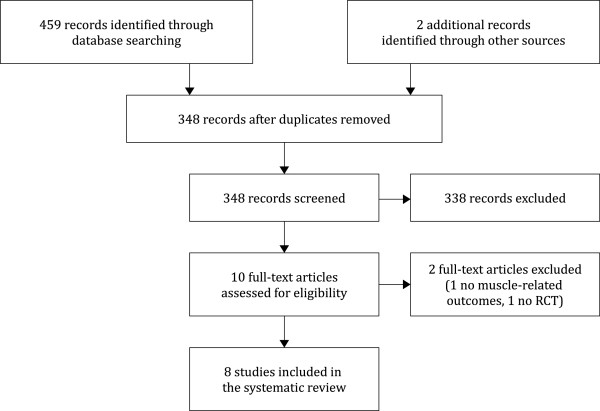
We searched PubMed, CENTRAL, CINAHL, Web of Science, and PEDro to identify randomized controlled trials exploring the effect of NMES in critically ill patients, which had a well-defined NMES protocol, provided outcomes related to skeletal-muscle strength and/or mass, and for which full text was available. Two independent reviewers extracted data on muscle-related outcomes (strength and mass), and participant and intervention characteristics, and assessed the methodological quality of the studies. Owing to the lack of means and standard deviations (SDs) in some studies, as well as the lack of baseline measurements in two studies, it was impossible to conduct a full meta-analysis. When means and SDs were provided, the effect sizes of individual outcomes were calculated, and otherwise, a qualitative analysis was performed.
The search yielded 8 eligible studies involving 172 patients. The methodological quality of the studies was moderate to high. Five studies reported an increase in strength or better preservation of strength with NMES, with one study having a large effect size. Two studies found better preservation of muscle mass with NMES, with small to moderate effect sizes, while no significant benefits were found in two other studies.
NMES added to usual care proved to be more effective than usual care alone for preventing skeletal-muscle weakness in critically ill patients. However, there is inconclusive evidence for its benefit in prevention of muscle wasting.
神经肌肉电刺激(NMES)疗法可能在急性危重病期间的早期肌肉骨骼康复中有用。本系统评价的目的是评估 NMES 预防危重病患者骨骼肌无力和消瘦的效果,与常规护理相比。
我们检索了 PubMed、CENTRAL、CINAHL、Web of Science 和 PEDro,以确定探讨 NMES 对危重病患者影响的随机对照试验,这些试验具有明确的 NMES 方案,提供与骨骼肌强度和/或质量相关的结果,并且可以获得全文。两位独立的评审员提取了与肌肉相关的结局(力量和质量)、参与者和干预措施特征的数据,并评估了研究的方法学质量。由于一些研究缺乏均值和标准差(SD),以及两项研究缺乏基线测量值,因此无法进行全面的荟萃分析。当提供均值和 SD 时,计算了个别结局的效应大小,否则进行定性分析。
搜索结果产生了 8 项涉及 172 名患者的合格研究。研究的方法学质量为中等到高度。五项研究报告 NMES 可增加力量或更好地保持力量,其中一项研究具有较大的效应大小。两项研究发现 NMES 可更好地保持肌肉质量,具有小到中等的效应大小,而另外两项研究未发现显著益处。
与常规护理相比,NMES 联合常规护理在预防危重病患者骨骼肌无力方面比常规护理更有效。然而,其在预防肌肉消瘦方面的益处尚无定论。