Chi Wen-Chang, Chen Yun-An, Hsiung Yu-Chywan, Fu Shih-Feng, Chou Chang-Hung, Trinh Ngoc Nam, Chen Ying-Chih, Huang Hao-Jen
Department of Life Sciences, National Cheng Kung University, No, 1 University Rd, 701, Tainan, Taiwan, ROC.
BMC Genomics. 2013 May 25;14:351. doi: 10.1186/1471-2164-14-351.
Autotoxicity plays an important role in regulating crop yield and quality. To help characterize the autotoxicity mechanism of rice, we performed a large-scale, transcriptomic analysis of the rice root response to ferulic acid, an autotoxin from rice straw.
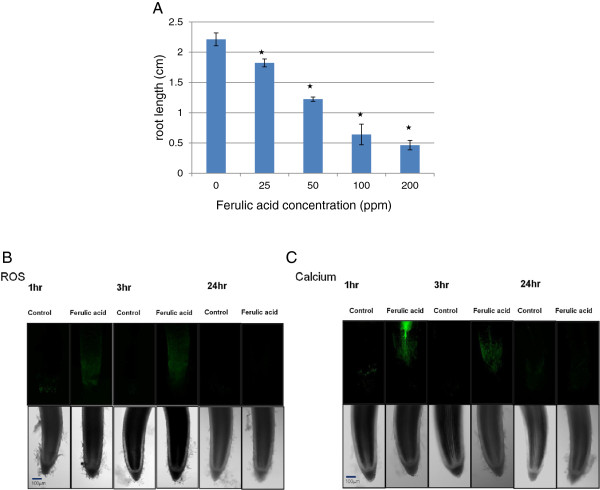
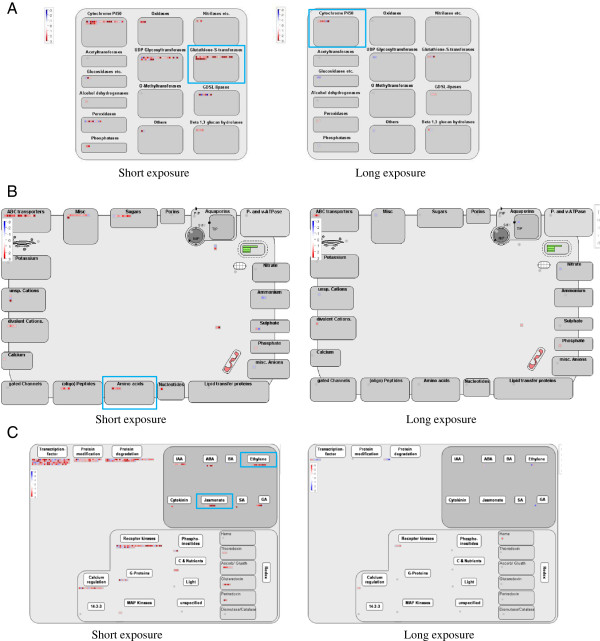
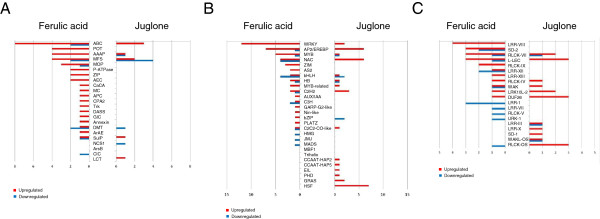
Root growth rate was decreased and reactive oxygen species, calcium content and lipoxygenase activity were increased with increasing ferulic acid concentration in roots. Transcriptome analysis revealed more transcripts responsive to short ferulic-acid exposure (1- and 3-h treatments, 1,204 genes) than long exposure (24 h, 176 genes). Induced genes were involved in cell wall formation, chemical detoxification, secondary metabolism, signal transduction, and abiotic stress response. Genes associated with signaling and biosynthesis for ethylene and jasmonic acid were upregulated with ferulic acid. Ferulic acid upregulated ATP-binding cassette and amino acid/auxin permease transporters as well as genes encoding signaling components such as leucine-rich repeat VIII and receptor-like cytoplasmic kinases VII protein kinases, APETALA2/ethylene response factor, WRKY, MYB and Zinc-finger protein expressed in inflorescence meristem transcription factors.
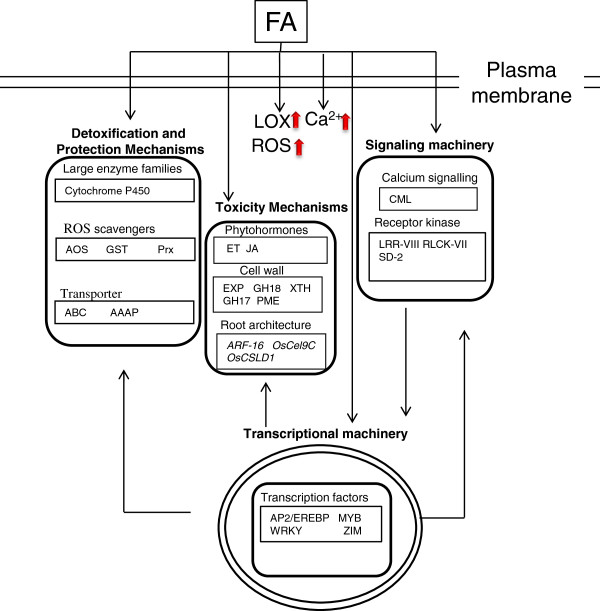
The results of a transcriptome analysis suggest the molecular mechanisms of plants in response to FA, including toxicity, detoxicification and signaling machinery. FA may have a significant effect on inhibiting rice root elongation through modulating ET and JA hormone homeostasis. FA-induced gene expression of AAAP transporters may contribute to detoxicification of the autotoxin. Moreover, the WRKY and Myb TFs and LRR-VIII and SD-2b kinases might regulate downstream genes under FA stress but not general allelochemical stress. This comprehensive description of gene expression information could greatly facilitate our understanding of the mechanisms of autotoxicity in plants.
自毒作用在调节作物产量和品质方面发挥着重要作用。为了帮助阐明水稻的自毒作用机制,我们对水稻根系对阿魏酸(一种来自稻草的自毒物质)的反应进行了大规模的转录组分析。
随着根系中阿魏酸浓度的增加,根系生长速率降低,活性氧、钙含量和脂氧合酶活性增加。转录组分析显示,与短时间阿魏酸处理(1小时和3小时处理,1204个基因)相比,长时间处理(24小时,176个基因)的转录本更多。诱导基因参与细胞壁形成、化学解毒、次生代谢、信号转导和非生物胁迫反应。与乙烯和茉莉酸信号传导及生物合成相关的基因在阿魏酸处理下上调。阿魏酸上调了ATP结合盒和氨基酸/生长素通透酶转运蛋白,以及编码信号成分的基因,如富含亮氨酸重复序列VIII和类受体细胞质激酶VII蛋白激酶、APETALA2/乙烯反应因子、WRKY、MYB和在花序分生组织转录因子中表达的锌指蛋白。
转录组分析结果揭示了植物对阿魏酸的分子反应机制,包括毒性、解毒和信号传导机制。阿魏酸可能通过调节乙烯和茉莉酸激素稳态对抑制水稻根伸长有显著影响。阿魏酸诱导的氨基酸/生长素通透酶转运蛋白基因表达可能有助于自毒物质的解毒。此外,WRKY和Myb转录因子以及LRR-VIII和SD-2b激酶可能在阿魏酸胁迫下而非一般化感物质胁迫下调节下游基因。对基因表达信息的全面描述可以极大地促进我们对植物自毒作用机制的理解。