Centre for Research on Ageing, Health & Wellbeing College of Medicine Biology & Environment, The Australian National University, Bldg 62A Eggleston Road, The Australian National University, Acton ACT 0200, Australia.
BMC Psychiatry. 2013 May 24;13:144. doi: 10.1186/1471-244X-13-144.
Workforce participation is a key feature of public mental health and social inclusion policies across the globe, and often a therapeutic goal in treatment settings. Understanding the reciprocal relationship between participation and mental health has been limited by inadequate research methods. This is the first study to simultaneously examine and contrast the relative effects of unemployment on mental health and mental health on employment status in a single general population sample.
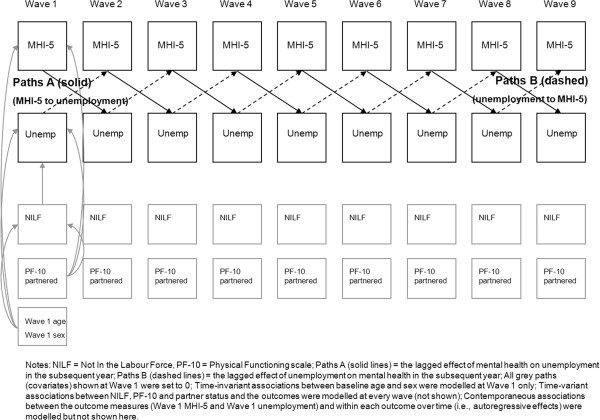
Data were from working-age respondents (20 to 55 years at baseline) who completed nine waves of the Household, Income and Labour Dynamics in Australia (HILDA) Survey (N=7176). Cross-lagged path analyses were used to test the lagged and concurrent associations between unemployment and mental health over time, adjusting for sociodemographic characteristics.
Mental health was shown to be both a consequence of and risk factor for unemployment. Thus, the poorer mental health observed amongst people who are not working is attributable to both the impact of unemployment and existing mental health problems. While the strength of these two effects was similar for women, the results for men suggested that the effect of unemployment on subsequent mental health was weaker than the effect of mental health on subsequent risk of unemployment.
Disentangling the reciprocal links between mental health and workforce participation is central to the development and success of clinical goals and health and social policies that aim to promote either aspect. This study demonstrates that both effects are important and supports concurrent responses to prevent a cycle of disadvantage and entrenched social exclusion.
劳动力参与是全球公共心理健康和社会包容政策的一个关键特征,也是治疗环境中的一个治疗目标。由于研究方法的不足,对参与和心理健康之间的相互关系的理解受到了限制。这是第一项在单个普通人群样本中同时检查和对比失业对心理健康的相对影响以及心理健康对就业状况影响的研究。
数据来自参加工作年龄的受访者(基线时 20 至 55 岁),他们完成了澳大利亚家庭、收入和劳动力动态调查(HILDA)的九轮调查(N=7176)。跨期路径分析用于测试失业和心理健康之间随时间的滞后和同期关联,同时调整了社会人口特征。
心理健康既是失业的结果,也是失业的风险因素。因此,未就业人群中较差的心理健康状况既归因于失业的影响,也归因于现有的心理健康问题。虽然这两种影响在女性中的强度相似,但男性的结果表明,失业对随后心理健康的影响弱于心理健康对随后失业风险的影响。
解开心理健康和劳动力参与之间的相互关系对于制定和成功实施旨在促进任何一方面的临床目标以及健康和社会政策至关重要。这项研究表明,这两种影响都很重要,并支持同时采取措施来防止劣势和社会排斥的恶性循环。