Health Economics Research Group, Brunel University, Uxbridge, UK,
Qual Life Res. 2013 Dec;22(10):2813-28. doi: 10.1007/s11136-013-0417-6. Epub 2013 May 26.
This review examines psychometric performance of three widely used generic preference-based measures, that is, EuroQol 5 dimensions (EQ-5D), Health Utility Index 3 (HUI3) and Short-form 6 dimensions (SF-6D) in patients with hearing impairments.
A systematic search was undertaken to identify studies of patients with hearing impairments where health state utility values were measured and reported. Data were extracted and analysed to assess the reliability, validity (known group differences and convergent validity) and responsiveness of the measures across hearing impairments.
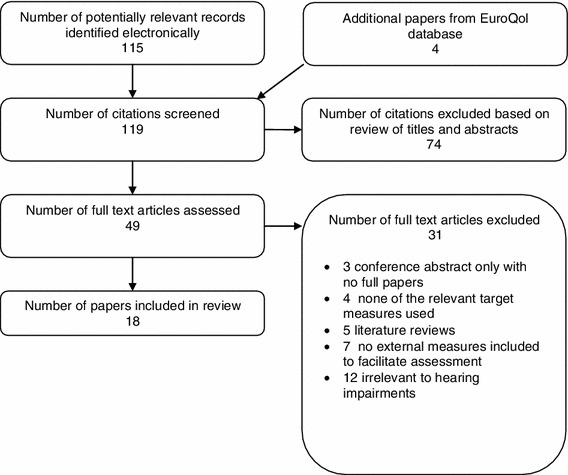
Fourteen studies (18 papers) were included in the review. HUI3 was the most commonly used utility measures in hearing impairment. In all six studies, the HUI3 detected difference between groups defined by the severity of impairment, and four out of five studies detected statistically significant changes as a result of intervention. The only study available suggested that EQ-5D only had weak ability to discriminate difference between severity groups, and in four out of five studies, EQ-5D failed to detected changes. Only one study involved the SF-6D; thus, the information is too limited to conclude on its performance. Also evidence for the reliability of these measures was not found.
Overall, the validity and responsiveness of the HUI3 in hearing impairment was good. The responsiveness of EQ-5D was relatively poor and weak validity was suggested by limited evidence. The evidence on SF-6D was too limited to make any judgment. More head-to-head comparisons of these and other preference measures of health are required.
本综述考察了三种广泛使用的通用偏好测量工具(即 EuroQol 5 维度(EQ-5D)、健康效用指数 3(HUI3)和简短 6 维度(SF-6D))在听力障碍患者中的心理测量性能。
系统检索了评估听力障碍患者健康状况效用值的研究,并提取和分析数据,以评估这些测量工具在听力障碍患者中的可靠性、有效性(已知组间差异和收敛有效性)和反应性。
本综述纳入了 14 项研究(18 篇论文)。HUI3 是听力障碍中最常用的效用测量工具。在所有六项研究中,HUI3 检测到了由听力损伤严重程度定义的组间差异,并且五项研究中有四项检测到了干预后的统计学显著变化。唯一一项涉及 EQ-5D 的研究表明,EQ-5D 仅具有区分严重程度组间差异的微弱能力,在五项研究中有四项未能检测到变化。只有一项研究涉及 SF-6D;因此,信息有限,无法得出其性能结论。也没有发现这些措施可靠性的证据。
总体而言,HUI3 在听力障碍中的有效性和反应性良好。EQ-5D 的反应性相对较差,有限的证据表明其有效性较弱。SF-6D 的证据非常有限,无法做出任何判断。需要对头对头比较这些和其他健康偏好测量工具。