Department of Medical Sciences, University of Turin, Turin, Italy.
Ann Oncol. 2013 Sep;24(9):2292-7. doi: 10.1093/annonc/mdt183. Epub 2013 May 24.
The group of estrogen receptor (ER)-positive breast cancers (both luminal-A and -B) behaves differently from the ER-negative group. At least in early follow-up, ER expression influences positively patients' prognosis. This low aggressive biology flattens out the differences of clinical management. Thus we aimed to produce a prognostic index specific for ER-positive (ERPI) cancers that could be of aid for clinical decision.
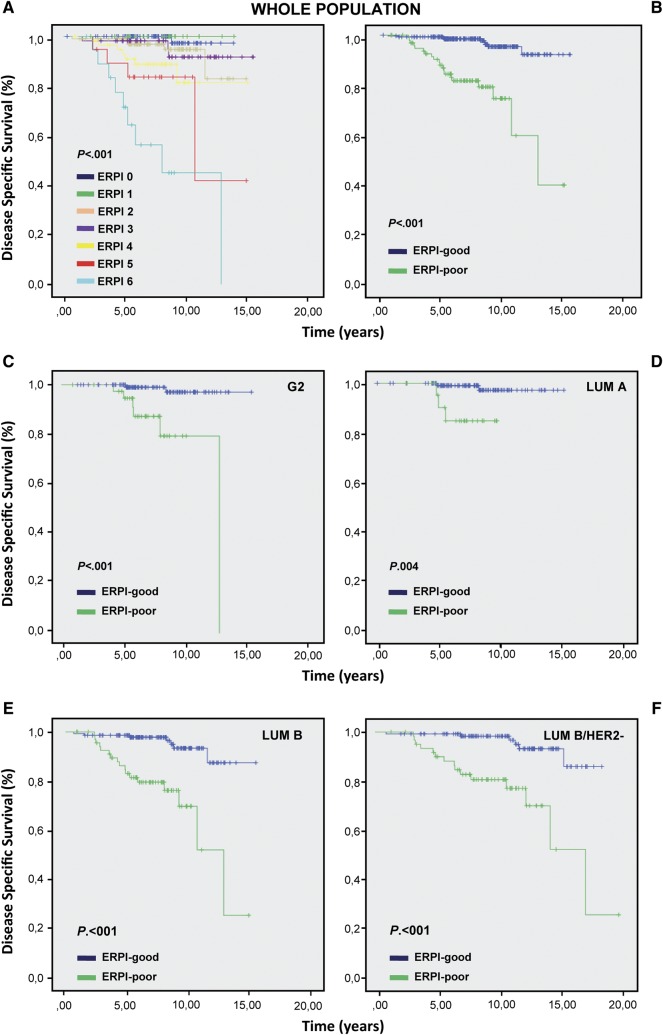
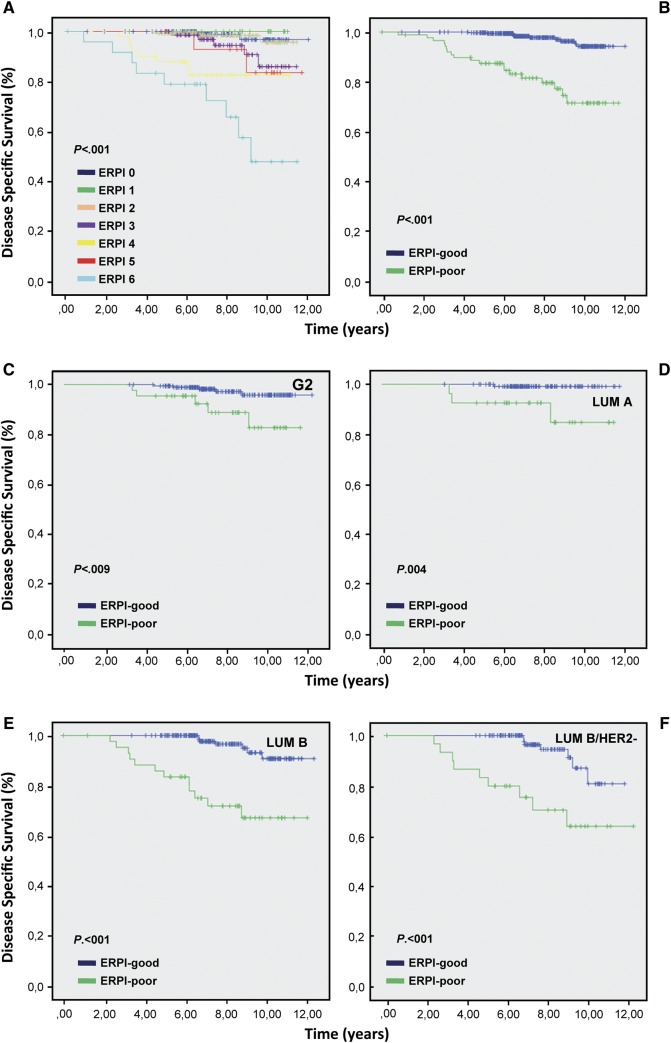
The test set comprised 495 consecutive ER-positive breast cancers. Tumor size, number of metastatic lymph nodes and androgen receptor expression were the only independent variables related to disease-specific survival. These variables were used to create the ERPI, which was applied to the entire test set and to selected subpopulations (grade 2 (G2)-tumors, luminal-A and -B breast cancers). A series of 581 ER-positive breast cancers, collected from another hospital, was used to validate ERPI.
In the test population, 96.9% of patients classified as ERPI-good showed a good prognosis compared with 79.6% classified as ERPI-poor (P < 0.001). ERPI effectively discriminated outcome in luminal-A and luminal-B and in G2-tumors. In the validation series, the ERPI maintained its value.
ERPI is a practical tool in refining the prediction of outcome of patients with ER-positive breast cancer.
雌激素受体(ER)阳性乳腺癌(包括 luminal-A 和 -B)的表现与 ER 阴性组不同。至少在早期随访中,ER 表达对患者的预后有积极影响。这种低侵袭性生物学特性削弱了临床管理的差异。因此,我们旨在为 ER 阳性(ERPI)癌症制定一个特定的预后指数,以帮助临床决策。
测试集包括 495 例连续的 ER 阳性乳腺癌。肿瘤大小、转移淋巴结数量和雄激素受体表达是与疾病特异性生存相关的唯一独立变量。这些变量被用于创建 ERPI,该指数应用于整个测试集和选定的亚群(G2 肿瘤、luminal-A 和 -B 乳腺癌)。另一组来自另一家医院的 581 例 ER 阳性乳腺癌被用于验证 ERPI。
在测试人群中,96.9%的 ERPI 良好分类的患者预后良好,而 79.6%的 ERPI 较差分类的患者预后较差(P<0.001)。ERPI 有效地在 luminal-A 和 luminal-B 以及 G2 肿瘤中区分了结局。在验证系列中,ERPI 保持了其价值。
ERPI 是一种实用的工具,可以细化预测 ER 阳性乳腺癌患者的预后。