Department of Integrated Traditional Chinese Medicine and Western Medicine, Union Hospital, Tongji Medical College, Huazhong University of Science and Technology, Wuhan, Hubei 430022, China.
Int J Endocrinol. 2013;2013:534352. doi: 10.1155/2013/534352. Epub 2013 Apr 22.
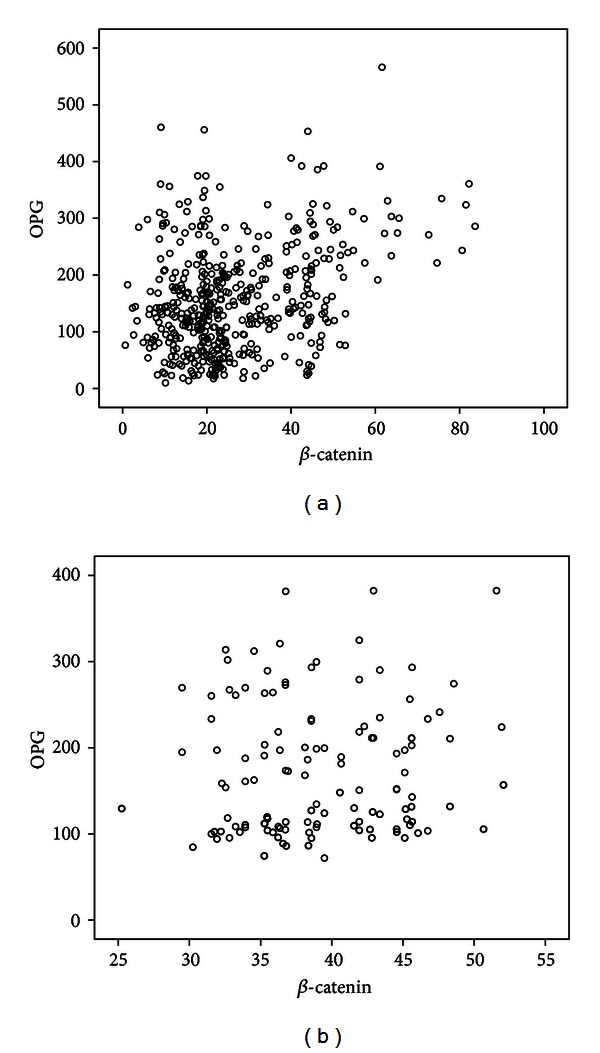
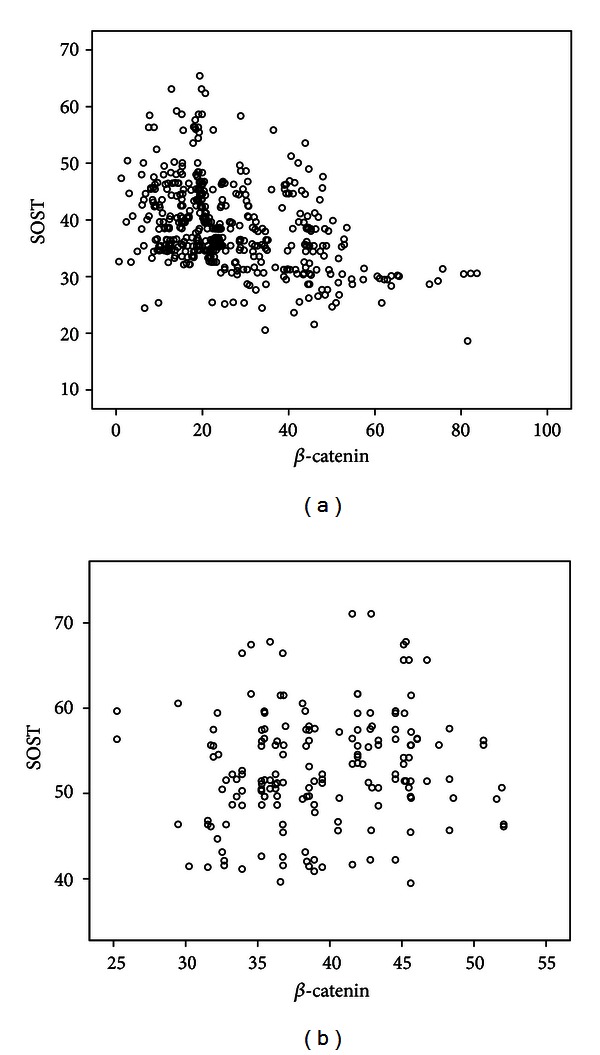
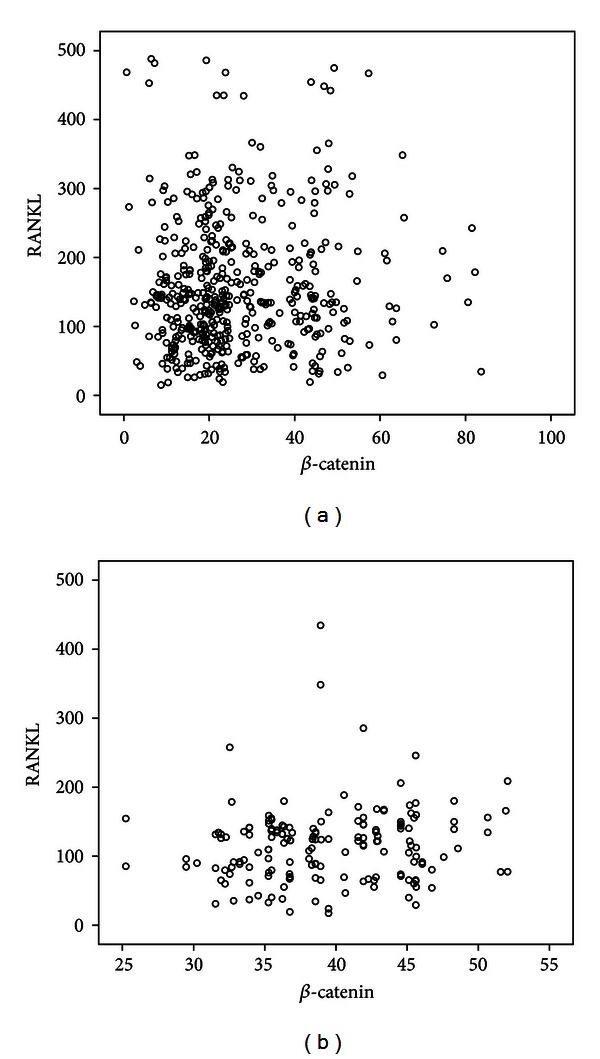
Objective. To demonstrate the role of Wnt/ β -catenin canonical pathway in postmenopausal osteoporosis by evaluating serum β -catenin levels in patients with postmenopausal osteoporosis and analyzing their possible relationship with serum OPG, RANKL, the ratio of RANKL/OPG, sclerostin, and bone turnover markers. Methods. 480 patients with postmenopausal osteoporosis and 170 healthy postmenopausal women were enrolled in the study. Serum β -catenin, OPG, RANKL, and sclerostin levels were measured by enzyme-linked immunosorbent assay. Bone status was assessed by measuring bone mineral density and bone turnover markers. Estradiol levels were also detected. Results. Serum β -catenin levels were lower in postmenopausal osteoporotic women compared to nonosteoporotic postmenopausal women (26.26 ± 14.81 versus 39.33 ± 5.47 pg/mL, P < 0.001). Serum β -catenin was positively correlated with osteoprotegerin (r = 0.232, P < 0.001) and negatively correlated with the ratio of RANKL/OPG, body mass index, and sclerostin (r = -0.128, P = 0.005; r = -0.117, P = 0.010; r = -0.400, P < 0.001, resp.) in patients with postmenopausal osteoporosis. Conclusion. The results indicate that lower serum β -catenin and concomitantly higher ratio of RANKL/OPG may be involved in the pathogenesis of postmenopausal osteoporosis. Functional communication between RANKL/RANK/OPG system and Wnt pathways plays an important role in postmenopausal osteoporosis.
目的。通过评估绝经后骨质疏松症患者血清β-连环蛋白水平,并分析其与血清 OPG、RANKL、RANKL/OPG 比值、骨硬化蛋白和骨转换标志物的可能关系,来研究 Wnt/β-连环蛋白经典通路在绝经后骨质疏松症中的作用。
方法。研究纳入了 480 例绝经后骨质疏松症患者和 170 例健康绝经后妇女。通过酶联免疫吸附试验测定血清β-连环蛋白、OPG、RANKL 和骨硬化蛋白水平。通过测量骨密度和骨转换标志物来评估骨骼状况。还检测了雌二醇水平。
结果。与非骨质疏松的绝经后妇女相比,绝经后骨质疏松症妇女的血清β-连环蛋白水平较低(26.26±14.81 与 39.33±5.47 pg/ml,P<0.001)。血清β-连环蛋白与骨保护素呈正相关(r=0.232,P<0.001),与 RANKL/OPG 比值、体重指数和骨硬化蛋白呈负相关(r=-0.128,P=0.005;r=-0.117,P=0.010;r=-0.400,P<0.001)。
结论。结果表明,血清β-连环蛋白水平降低和 RANKL/OPG 比值升高可能与绝经后骨质疏松症的发病机制有关。RANKL/RANK/OPG 系统和 Wnt 通路之间的功能通讯在绝经后骨质疏松症中起着重要作用。