Department of Medicine, Samsung Medical Center, Sungkyunkwan University School of Medicine, Seoul, Korea.
Gut Liver. 2013 May;7(3):290-4. doi: 10.5009/gnl.2013.7.3.290. Epub 2013 Apr 9.
BACKGROUND/AIMS: The management of asymptomatic erosive esophagitis is controversial. We surveyed physicians' opinions on asymptomatic erosive esophagitis using e-mail.
All members of the Korean Society of Neurogastro-enterology and Motility were invited to answer the questionnaire on the treatment and follow-up of patients with asymptomatic erosive esophagitis by e-mail.
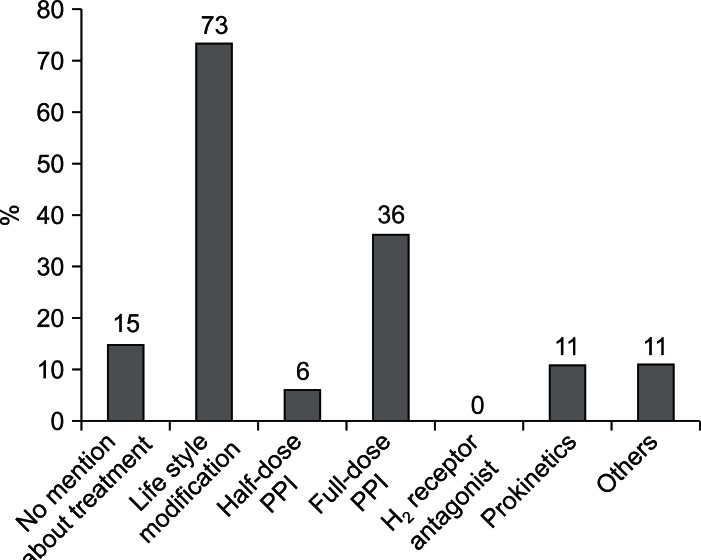
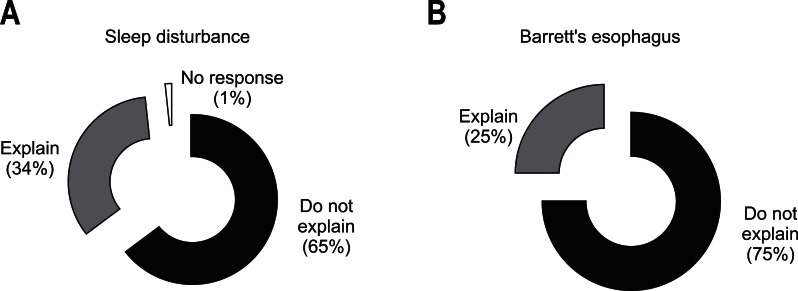
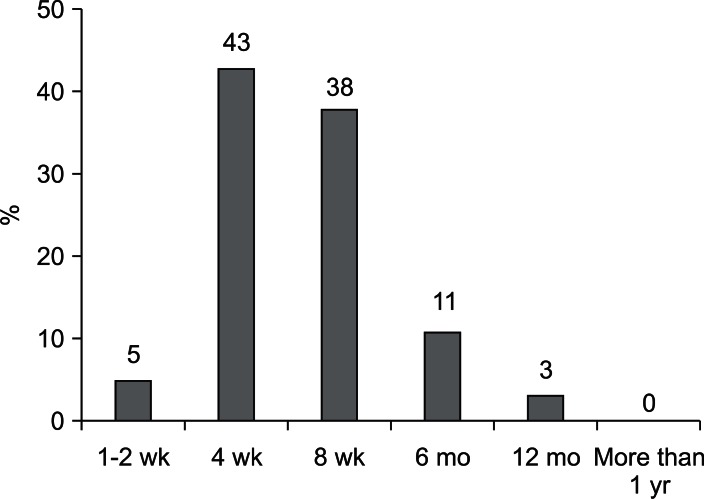
A total of 73 members answered the questionnaire (response rate, 18%). As initial management, 41% of respondents chose pharmacologic treatment, whereas 59% chose nonpharmacologic treatment. In the case of pharmacologic treatment, proton pump inhibitors were the preferred medication. The most common treatment duration was 4 weeks (43%), followed by 8 weeks (38%), and 6 months (11%). Sixty-two percent of the respondents recommended follow-up endoscopy annually, whereas 29% chose no endoscopic follow-up. Thirty-four percent of the respondents answered that they would talk about reflux-related sleep disturbances. Only 25% of the respondents explained the possibility of Barrett's esophagus or esophageal adenocarcinoma to their patients.
There are substantial practice variations in the management of asymptomatic erosive esophagitis in Korea.
背景/目的:无症状性糜烂性食管炎的治疗存在争议。我们通过电子邮件调查了医生对无症状性糜烂性食管炎的看法。
邀请韩国神经胃肠病学和动力学会的所有成员通过电子邮件回答关于无症状性糜烂性食管炎患者治疗和随访的问卷。
共有 73 名成员回答了问卷(应答率为 18%)。作为初始治疗,41%的受访者选择药物治疗,而 59%的受访者选择非药物治疗。在药物治疗的情况下,质子泵抑制剂是首选药物。最常见的治疗时间为 4 周(43%),其次为 8 周(38%)和 6 个月(11%)。62%的受访者建议每年进行内镜随访,而 29%的受访者选择不进行内镜随访。34%的受访者回答说他们会谈论与反流相关的睡眠障碍。只有 25%的受访者向患者解释了 Barrett 食管或食管腺癌的可能性。
韩国在无症状性糜烂性食管炎的治疗方面存在很大的实践差异。