Yu Li-Li, Chang Kai, Lu Lin-Shan, Zhao Dan, Han Jian, Zheng Ying-Ru, Yan Yao-Hua, Yi Ping, Guo Jian-Xin, Zhou Yuan-Guo, Chen Ming, Li Li
Department of Obstetrics and Gynecology, Daping Hospital, The Third Military Medical University, Chongqing 400042, China.
BMC Cell Biol. 2013 May 27;14:26. doi: 10.1186/1471-2121-14-26.
H19 is a paternally imprinted gene that has been shown to be highly expressed in the trophoblast tissue. Results from previous studies have initiated a debate as to whether noncoding RNA H19 acts as a tumor suppressor or as a tumor promotor in trophoblast tissue. In the present study, we developed lentiviral vectors expressing H19-specific small interfering RNA (siRNA) to specifically block the expression of H19 in the human choriocarcinoma cell line JAR. Using this approach, we investigated the impact of the H19 gene on the proliferation, invasion and apoptosis of JAR cells. Moreover, we examined the effect of H19 knockdown on the expression of insulin-like growth factor 2 (IGF2), hairy and enhancer of split homologue-1 (HES-1) and dual-specific phosphatase 5 (DUSP5) genes.
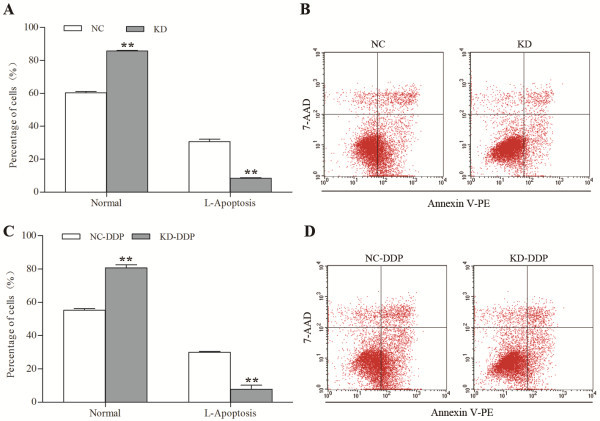
H19 knockdown inhibited apoptosis and proliferation of JAR cells, but had no significant impact on cell invasion. In addition, H19 knockdown resulted in significant upregulation of HES-1 and DUSP5 expression, but not IGF2 expression in JAR cells.
The finding that H19 downregulation could simultaneously inhibit proliferation and apoptosis of JAR cells highlights a putative dual function for H19 in choriocarcinoma and may explain the debate on whether H19 acts as a tumor suppressor or a tumor promotor in trophoblast tissue. Furthermore, upregulation of HES-1 and DUSP5 may mediate H19 downregulation-induced suppression of proliferation and apoptosis of JAR cells.
H19是一个父系印记基因,已被证明在滋养层组织中高度表达。先前研究的结果引发了关于非编码RNA H19在滋养层组织中是作为肿瘤抑制因子还是肿瘤促进因子的争论。在本研究中,我们构建了表达H19特异性小干扰RNA(siRNA)的慢病毒载体,以特异性阻断人绒毛膜癌细胞系JAR中H19的表达。利用这种方法,我们研究了H19基因对JAR细胞增殖、侵袭和凋亡的影响。此外,我们检测了H19基因敲低对胰岛素样生长因子2(IGF2)、毛状分裂增强子同源物1(HES-1)和双特异性磷酸酶5(DUSP5)基因表达的影响。
H19基因敲低抑制了JAR细胞的凋亡和增殖,但对细胞侵袭没有显著影响。此外,H19基因敲低导致JAR细胞中HES-1和DUSP5表达显著上调,但IGF2表达未上调。
H19下调可同时抑制JAR细胞的增殖和凋亡这一发现凸显了H19在绒毛膜癌中的一种假定双重功能,可能解释了关于H19在滋养层组织中是作为肿瘤抑制因子还是肿瘤促进因子的争论。此外,HES-1和DUSP5的上调可能介导了H19下调诱导的JAR细胞增殖和凋亡抑制。