1] Bachelor of Health Sciences, McMaster University, Hamilton, Ontario, Canada [2] Chanchlani Research Centre, McMaster University, Hamilton, Ontario, Canada.
Nutr Diabetes. 2013 May 27;3(5):e69. doi: 10.1038/nutd.2013.10.
South Asian people who originate from the Indian subcontinent have greater percent body fat (%BF) for the same body mass index (BMI) compared with white Caucasians. This has been implicated in their increased risk of type 2 diabetes and cardiovascular disease. There is limited information comparing different measures of body fat in this ethnic group.
The objectives of this study were: (1) to investigate the correlation of %BF measured by a foot-to-foot bioelectrical impedance analysis (FF-BIA) against the BOD POD, a method of air-displacement plethysmography, and (2) to determine the correlations of simple anthropometric measures, (that is, BMI, body adiposity index (BAI), waist circumference (WC), hip circumference (HC) and waist-to-hip ratio (WHR)) against the BOD POD measure of body fat.
Eighty apparently healthy South Asian men and women were recruited from the community, and measurements of height, weight, WC, HC and body composition using Tanita FF-BIA and BOD POD were taken.
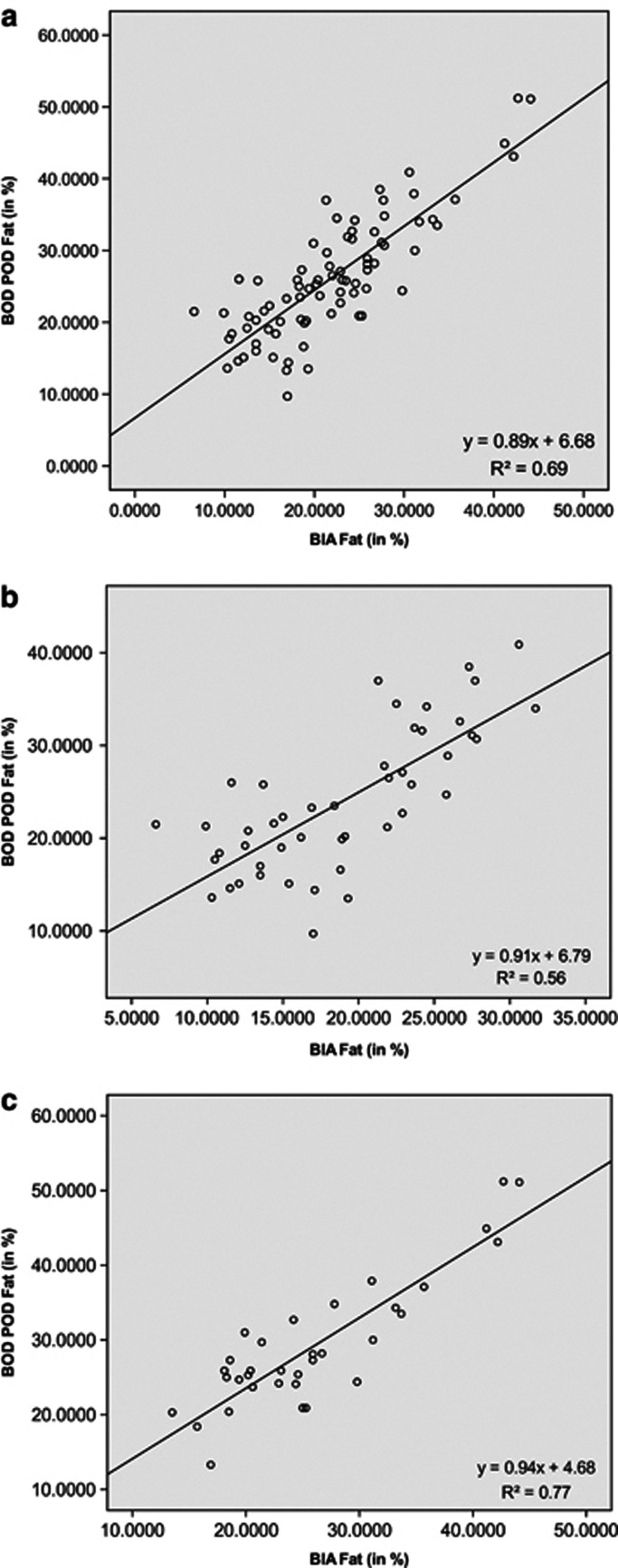
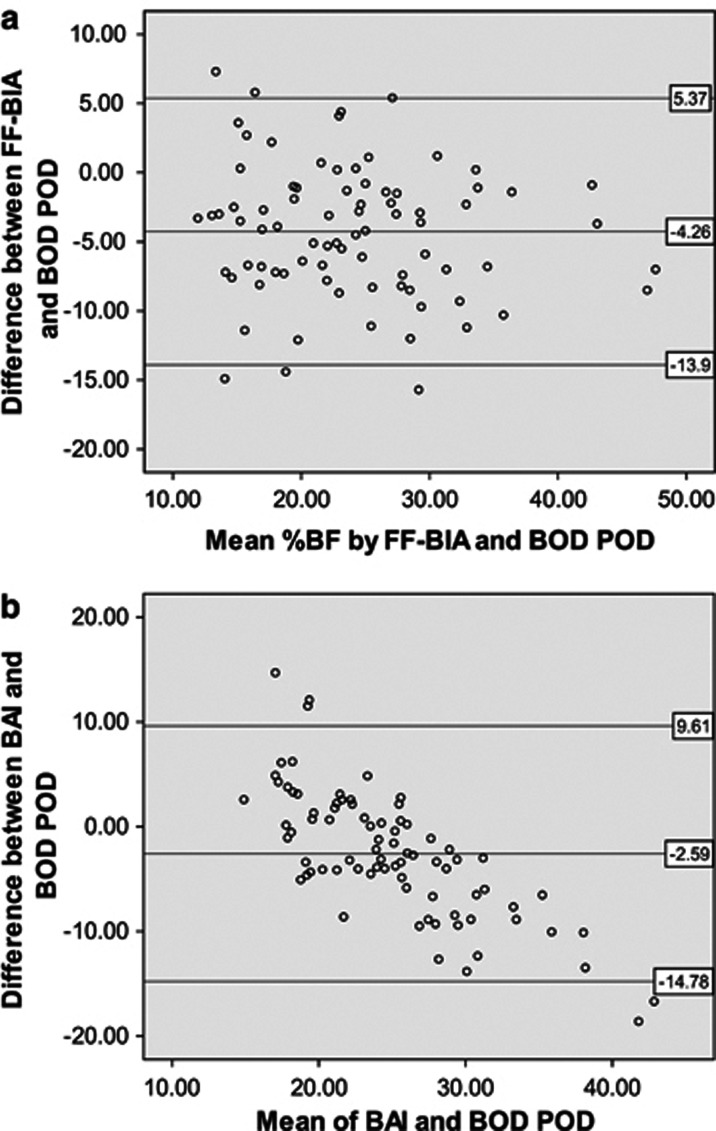
The mean±s.d. age of participants was 27.78±10.49 years, 42.5% were women, and the mean BMI was 22.68±3.51 kg m(-2). The mean body fat (%BF) calculated by FF-BIA and BOD POD was 21.94±7.88% and 26.20±8.47%, respectively. The %BF calculated by FF-BIA was highly correlated with the BOD POD (Pearson's r=0.83, P<0.001), however, FF-BIA underestimated %BF by 4.3%. When anthropometric measures were compared with % BF by BOD POD, the BAI showed the strongest correlation (r=0.74) and the WHR showed the weakest (r=0.33). BAI generally underestimated %BF by 2.6% in comparison with %BF by BOD POD. The correlations of BOD POD with other measures of %BF were much stronger in subjects with a BMI >21 kg m(-2) than those with a BMI 21 kg m(-2).
The FF-BIA and BAI estimates of %BF are highly correlated with that of BOD POD among people of South Asian origin, although both methods somewhat underestimate % BF. Furthermore, their correlations with % BF from BOD POD are significantly weakened among men and women with a BMI 21 kg m(-2).
南亚人(源自印度次大陆的人群)的体脂百分比(%BF)与白种高加索人相同,但体质量指数(BMI)更高。这与他们患 2 型糖尿病和心血管疾病的风险增加有关。关于该人群不同身体脂肪测量方法的信息有限。
本研究的目的是:(1)探讨足部到足部生物电阻抗分析(FF-BIA)测量的%BF与空气置换体描记法(BOD POD)的相关性,(2)确定简单人体测量指标(即 BMI、体脂指数(BAI)、腰围(WC)、臀围(HC)和腰臀比(WHR))与 BOD POD 测量的体脂的相关性。
从社区招募了 80 名明显健康的南亚男性和女性,使用 Tanita FF-BIA 和 BOD POD 测量身高、体重、WC、HC 和身体成分。
参与者的平均年龄±标准差为 27.78±10.49 岁,42.5%为女性,平均 BMI 为 22.68±3.51kg/m²。FF-BIA 和 BOD POD 计算的平均体脂(%BF)分别为 21.94±7.88%和 26.20±8.47%。FF-BIA 与 BOD POD 高度相关(Pearson 相关系数=0.83,P<0.001),但低估了 4.3%的%BF。当将人体测量指标与 BOD POD 测量的%BF 进行比较时,BAI 显示出最强的相关性(r=0.74),而 WHR 显示出最弱的相关性(r=0.33)。与 BOD POD 测量的%BF 相比,BAI 通常低估 2.6%的%BF。在 BMI>21kg/m²的受试者中,BOD POD 与其他%BF 测量值的相关性比 BMI<21kg/m²的受试者更强。
在南亚裔人群中,FF-BIA 和 BAI 对%BF 的估计与 BOD POD 高度相关,尽管这两种方法都有些低估了%BF。此外,在 BMI<21kg/m²的男性和女性中,它们与 BOD POD 测量的%BF 的相关性显著减弱。