Griffiths John, Hatch Robert A, Bishop Judith, Morgan Kayleigh, Jenkinson Crispin, Cuthbertson Brian H, Brett Stephen J
Crit Care. 2013 May 28;17(3):R100. doi: 10.1186/cc12745.
The socio-economic impact of critical illnesses on patients and their families in Europe has yet to be determined. The aim of this exploratory study was to estimate changes in family circumstances, social and economic stability, care requirements and access to health services for patients during their first 12 months after ICU discharge.
Multi-center questionnaire-based study of survivors of critical illness at 6 and 12 months after ICU discharge.
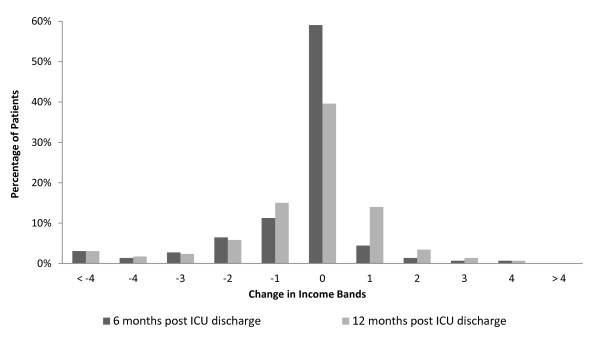
Data for 293 consenting patients who spent greater than 48 hours in one of 22 UK ICUs were obtained at 6 and 12 months post-ICU discharge. There was little evidence of a change in accommodation or relationship status between pre-admission and 12 months following discharge from an ICU. A negative impact on family income was reported by 33% of all patients at 6 months and 28% at 12 months. There was nearly a 50% reduction in the number of patients who reported employment as their sole source of income at 12 months (19% to 11%) compared with pre-admission. One quarter of patients reported themselves in need of care assistance at 6 months and 22% at 12 months. The majority of care was provided by family members (80% and 78%, respectively), for half of whom there was a negative impact on employment. Amongst all patients receiving care, 26% reported requiring greater than 50 hours a week. Following discharge, 79% of patients reported attending their primary care physician and 44% had seen a community nurse. Mobility problems nearly doubled between pre-admission and 6 months (32% to 64%). Furthermore, 73% reported moderate or severe pain at 12 months and 44% remained significantly anxious or depressed.
Survivors of critical illness in the UK face a negative impact on employment and commonly have a care requirement after discharge from hospital. This has a corresponding negative impact on family income. The majority of the care required is provided by family members. This effect was apparent by 6 months and had not materially improved by 12 months. This exploratory study has identified the potential for a significant socio-economic burden following critical illness.
危重症对欧洲患者及其家庭的社会经济影响尚未确定。这项探索性研究的目的是评估患者在重症监护病房(ICU)出院后的前12个月内家庭情况、社会和经济稳定性、护理需求以及获得医疗服务的情况变化。
基于问卷的多中心研究,调查ICU出院后6个月和12个月的危重症幸存者。
获取了293名同意参与研究的患者的数据,这些患者在英国22家ICU中的一家住院时间超过48小时,数据采集时间为ICU出院后的6个月和12个月。几乎没有证据表明入院前和ICU出院后12个月之间患者的居住情况或关系状态发生了变化。6个月时,33%的患者报告家庭收入受到负面影响,12个月时这一比例为28%。与入院前相比,12个月时报告以就业为唯一收入来源的患者数量减少了近50%(从19%降至11%)。四分之一的患者在6个月时报告需要护理协助,12个月时这一比例为22%。大部分护理由家庭成员提供(分别为80%和78%),其中一半人的就业受到负面影响。在所有接受护理的患者中,26%报告每周需要护理时间超过50小时。出院后,79%的患者报告去看过初级保健医生,44%看过社区护士。入院前到6个月之间,行动不便问题几乎增加了一倍(从32%增至64%)。此外,73%的患者在12个月时报告有中度或重度疼痛,44%仍有明显焦虑或抑郁情绪。
英国危重症幸存者面临就业方面的负面影响,出院后通常有护理需求。这对家庭收入有相应的负面影响。所需的大部分护理由家庭成员提供。这种影响在6个月时就很明显,到12个月时没有实质性改善。这项探索性研究确定了危重症后可能产生重大社会经济负担。