Department of Critical Care Medicine, Sunnybrook Health Sciences Centre, 2075 Bayview Avenue, Toronto, M4N 3M5, Canada.
Crit Care. 2010;14(1):R6. doi: 10.1186/cc8848. Epub 2010 Jan 20.
Data on quality of life beyond 2 years after intensive care discharge are limited and we aimed to explore this area further. Our objective was to quantify quality of life and health utilities in the 5 years after intensive care discharge.
A prospective longitudinal cohort study in a University Hospital in the UK. Quality of life was assessed from the period before ICU admission until 5 years and quality adjusted life years calculated.
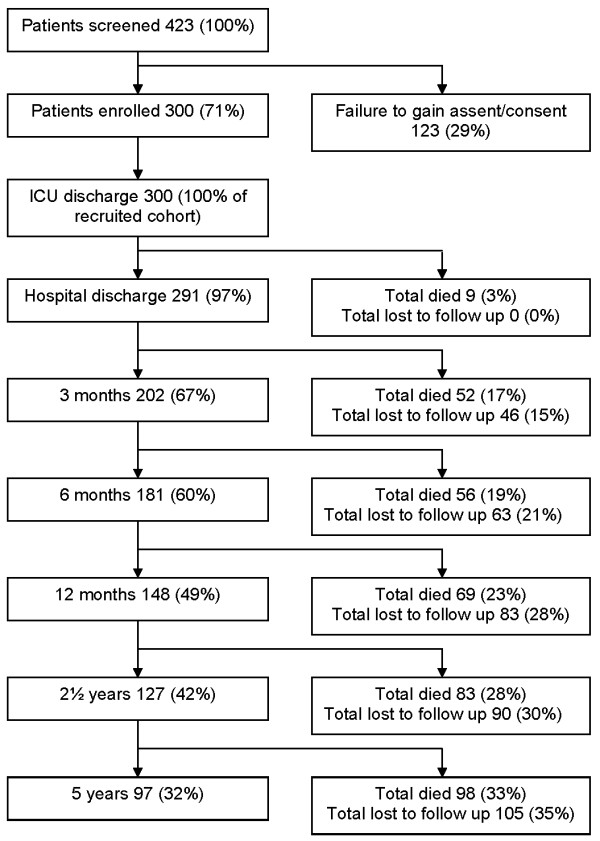
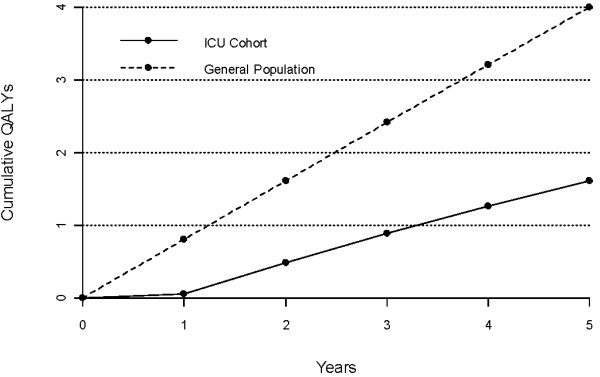
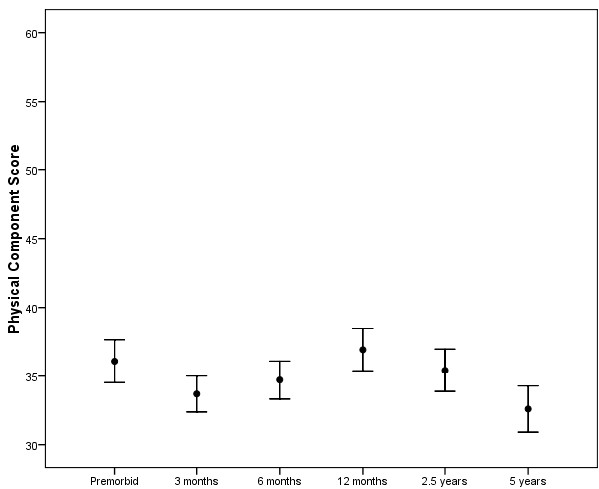
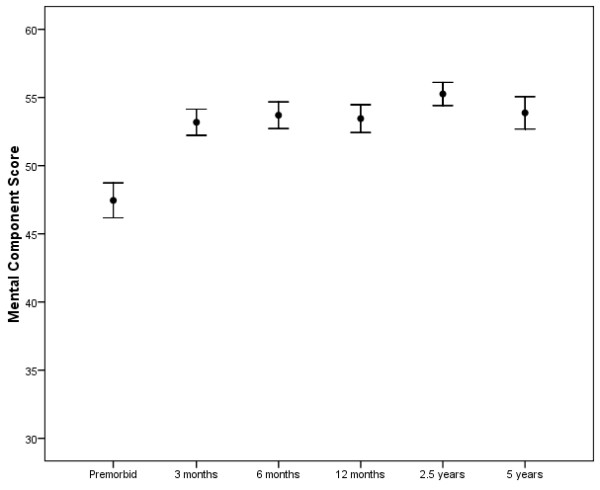
300 level 3 intensive care patients of median age 60.5 years and median length of stay 6.7 days, were recruited. Physical quality of life fell to 3 months (P = 0.003), rose back to pre-morbid levels at 12 months then fell again from 2.5 to 5 years after intensive care (P = 0.002). Mean physical scores were below the population norm at all time points but the mean mental scores after 6 months were similar to those population norms. The utility value measured using the EuroQOL-5D quality of life assessment tool (EQ-5D) at 5 years was 0.677. During the five years after intensive care unit, the cumulative quality adjusted life years were significantly lower than that expected for the general population (P < 0.001).
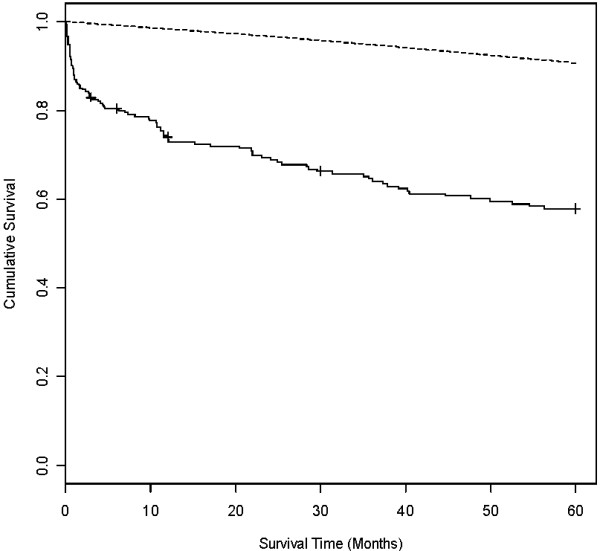
Intensive care unit admission is associated with a high mortality, a poor physical quality of life and a low quality adjusted life years gained compared to the general population for 5 years after discharge. In this group, critical illness associated with ICU admission should be treated as a life time diagnosis with associated excess mortality, morbidity and the requirement for ongoing health care support.
关于重症监护出院后 2 年以上生活质量的数据有限,我们旨在对此进行进一步探索。我们的目的是量化重症监护出院后 5 年内的生活质量和健康效用。
这是一项在英国大学医院进行的前瞻性纵向队列研究。在 ICU 入院前至 5 年内评估生活质量,并计算质量调整生命年。
共招募了 300 名中位年龄为 60.5 岁、中位住院时间为 6.7 天的 3 级重症监护患者。身体生活质量在 3 个月时下降(P = 0.003),在 12 个月时恢复到发病前水平,然后在重症监护后 2.5 至 5 年内再次下降(P = 0.002)。所有时间点的平均身体评分均低于人群正常值,但 6 个月后的平均心理评分与人群正常值相似。使用欧洲五维健康量表(EQ-5D)评估工具测量的效用值在 5 年后为 0.677。在重症监护病房后 5 年内,累积质量调整生命年明显低于普通人群(P < 0.001)。
与普通人群相比,重症监护病房入院后 5 年内死亡率高,身体生活质量差,质量调整生命年低。在这组人群中,与 ICU 入院相关的危重病应被视为终身诊断,与额外的死亡率、发病率和对持续医疗保健支持的需求相关。