State Key Laboratory of Urban and Regional Ecology, Research Center for Eco-Environmental Sciences, Chinese Academy of Sciences, Beijing, China.
PLoS One. 2013 May 22;8(5):e63375. doi: 10.1371/journal.pone.0063375. Print 2013.
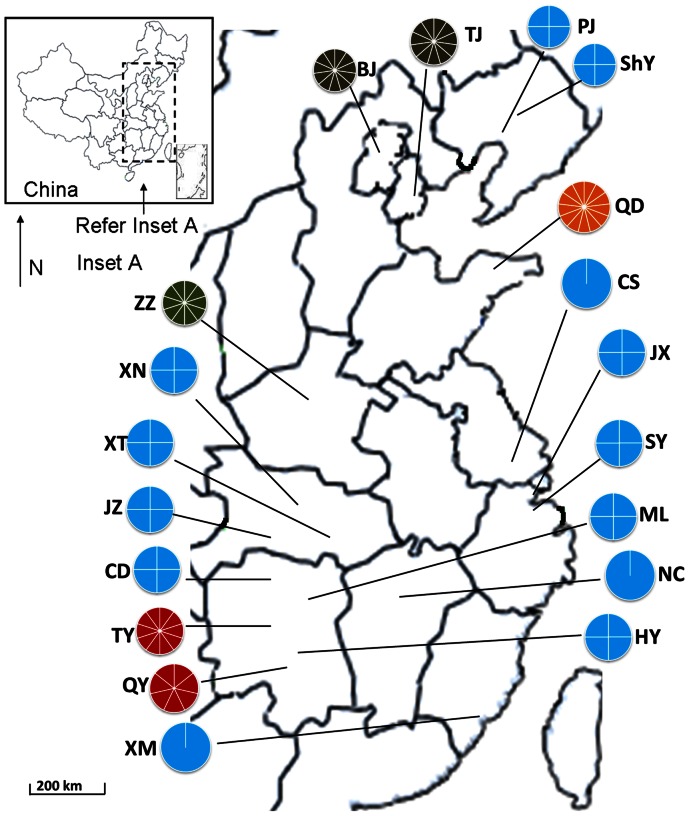
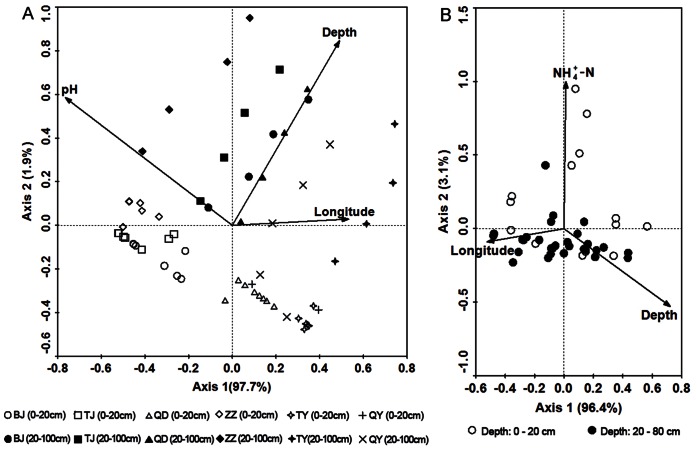
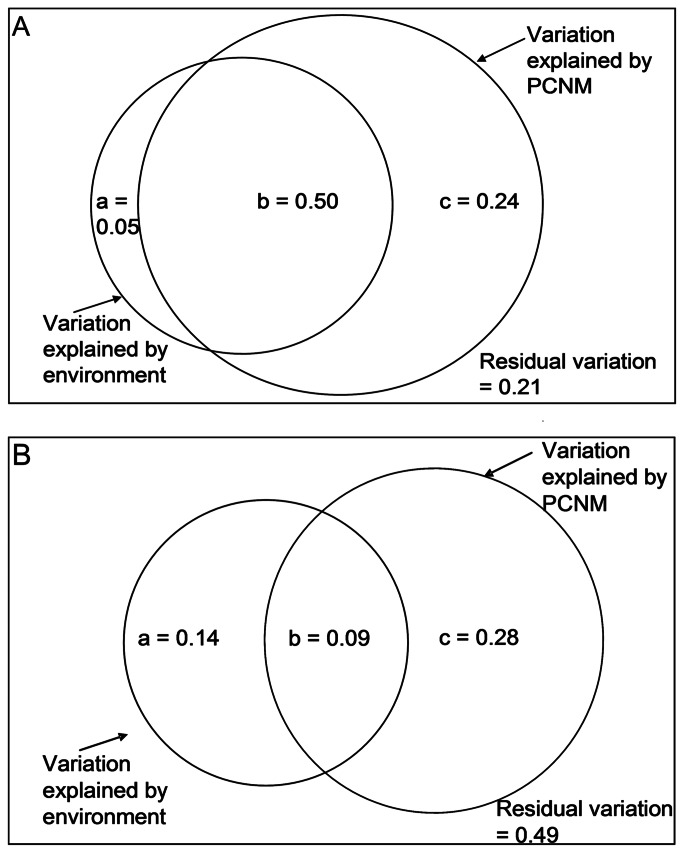
Knowledge about the biogeography of organisms has long been a focus in ecological research, including the mechanisms that generate and maintain diversity. In this study, we targeted a microbial group relatively underrepresented in the microbial biogeographic literature, the soil Archaea. We surveyed the archaeal abundance and community composition using real-time quantitative PCR and T-RFLP approaches for 105 soil samples from 2 habitat types to identify the archaeal distribution patterns and factors driving these patterns. Results showed that the soil archaeal community was affected by spatial and environmental variables, and 79% and 51% of the community variation was explained in the non-flooded soil (NS) and flooded soil (FS) habitat, respectively, showing its possible biogeographic distribution. The diversity patterns of soil Archaea across the landscape were influenced by a combination of stochastic and deterministic processes. The contribution from neutral processes was higher than that from deterministic processes associated with environmental variables. The variables pH, sample depth and longitude played key roles in determining the archaeal distribution in the NS habitat, while sampling depth, longitude and NH4 (+)-N were most important in the FS habitat. Overall, there might be similar ecological drivers in the soil archaeal community as in macroorganism communities.
关于生物的生物地理学知识一直是生态研究的重点,包括产生和维持多样性的机制。在这项研究中,我们针对微生物生物地理文献中相对代表性不足的微生物群体,即土壤古菌,进行了研究。我们使用实时定量 PCR 和 T-RFLP 方法对来自 2 种生境的 105 个土壤样本进行了调查,以确定古菌的分布模式和驱动这些模式的因素。结果表明,土壤古菌群落受空间和环境变量的影响,未受洪水影响的土壤(NS)和受洪水影响的土壤(FS)分别解释了群落变化的 79%和 51%,表明其可能具有生物地理分布。景观中土壤古菌的多样性模式受到随机和确定性过程的共同影响。中性过程的贡献高于与环境变量相关的确定性过程。pH 值、样本深度和经度等变量在 NS 生境中对古菌分布起着关键作用,而在 FS 生境中,采样深度、经度和 NH4 (+)-N 则起着最重要的作用。总的来说,土壤古菌群落可能存在与宏观生物群落相似的生态驱动因素。