Constancias Florentin, Saby Nicolas P A, Terrat Sébastien, Dequiedt Samuel, Horrigue Wallid, Nowak Virginie, Guillemin Jean-Philippe, Biju-Duval Luc, Chemidlin Prévost-Bouré Nicolas, Ranjard Lionel
INRA, UMR1347 Agroécologie, BP 86510, F-21000, Dijon, France.
INRA, US1106 InfoSol, F-45075, Orléans, France.
Microbiologyopen. 2015 Jun;4(3):518-31. doi: 10.1002/mbo3.256. Epub 2015 Apr 28.
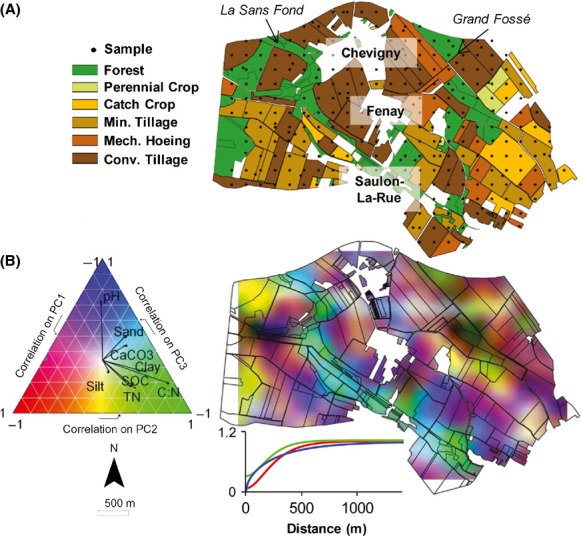
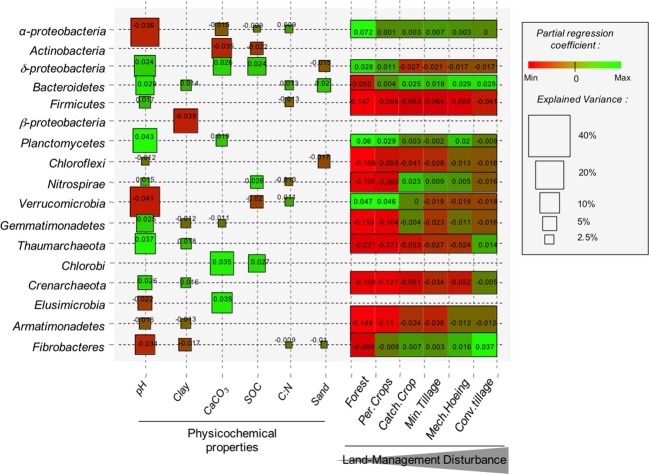
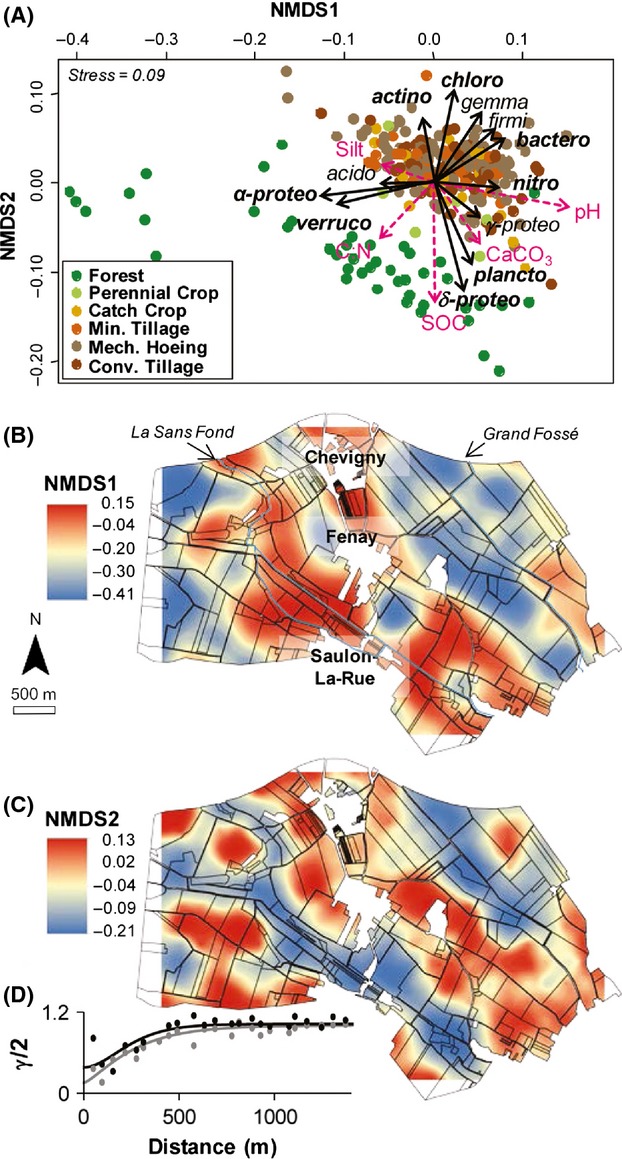
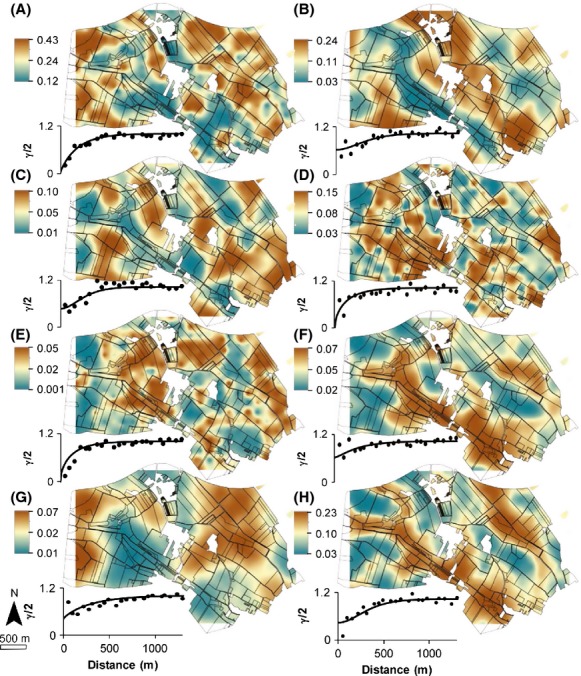
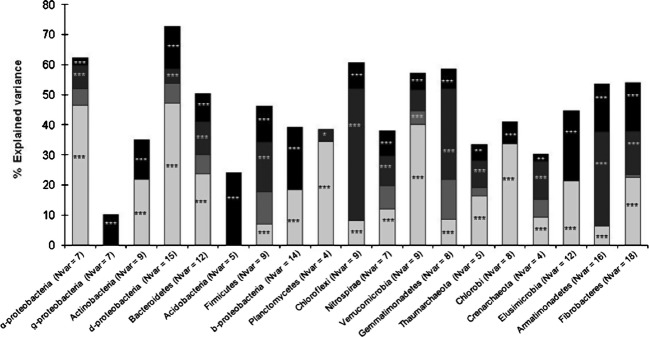
Even though recent studies have clarified the influence and hierarchy of environmental filters on bacterial community structure, those constraining bacterial populations variations remain unclear. In consequence, our ability to understand to ecological attributes of soil bacteria and to predict microbial community response to environmental stress is therefore limited. Here, we characterized the bacterial community composition and the various bacterial taxonomic groups constituting the community across an agricultural landscape of 12 km(2) , by using a 215 × 215 m systematic grid representing 278 sites to precisely decipher their spatial distribution and drivers at this scale. The bacterial and Archaeal community composition was characterized by applying 16S rRNA gene pyrosequencing directly to soil DNA from samples. Geostatistics tools were used to reveal the heterogeneous distribution of bacterial composition at this scale. Soil physical parameters and land management explained a significant amount of variation, suggesting that environmental selection is the major process shaping bacterial composition. All taxa systematically displayed also a heterogeneous and particular distribution patterns. Different relative influences of soil characteristics, land use and space were observed, depending on the taxa, implying that selection and spatial processes might be differentially but not exclusively involved for each bacterial phylum. Soil pH was a major factor determining the distribution of most of the bacterial taxa and especially the most important factor explaining the spatial patterns of α-Proteobacteria and Planctomycetes. Soil texture, organic carbon content and quality were more specific to a few number of taxa (e.g., β-Proteobacteria and Chlorobi). Land management also influenced the distribution of bacterial taxa across the landscape and revealed different type of response to cropping intensity (positive, negative, neutral or hump-backed relationships) according to phyla. Altogether, this study provided valuable clues about the ecological behavior of soil bacterial and archaeal taxa at an agricultural landscape scale and could be useful for developing sustainable strategies of land management.
尽管最近的研究已经阐明了环境过滤对细菌群落结构的影响和层级关系,但那些限制细菌种群变异的因素仍不明确。因此,我们理解土壤细菌生态属性以及预测微生物群落对环境压力响应的能力受到限制。在此,我们通过使用一个代表278个位点的215×215米系统网格,对12平方公里的农业景观中细菌群落组成以及构成该群落的各种细菌分类群进行了表征,以精确解读它们在此尺度下的空间分布和驱动因素。通过将16S rRNA基因焦磷酸测序直接应用于样本土壤DNA来表征细菌和古菌群落组成。地统计学工具用于揭示此尺度下细菌组成的异质分布。土壤物理参数和土地管理解释了相当一部分变异,这表明环境选择是塑造细菌组成的主要过程。所有分类群也都系统地呈现出异质且特定的分布模式。根据分类群的不同,观察到土壤特征、土地利用和空间的相对影响各异,这意味着选择和空间过程可能以不同方式但并非仅对每个细菌门类起作用。土壤pH是决定大多数细菌分类群分布的主要因素,尤其是解释α-变形菌门和浮霉菌门空间格局的最重要因素。土壤质地、有机碳含量和质量对少数分类群(如β-变形菌门和绿菌门)更为特定。土地管理也影响了细菌分类群在整个景观中的分布,并根据门类揭示了对种植强度的不同类型响应(正相关、负相关、中性或驼峰形关系)。总之,本研究为农业景观尺度下土壤细菌和古菌分类群的生态行为提供了有价值的线索,可能有助于制定可持续的土地管理策略。