Molecular Microbial Ecology Group, Institute of Aquatic Ecology, Universitat de Girona, Girona, Spain.
PLoS One. 2013 May 23;8(5):e63460. doi: 10.1371/journal.pone.0063460. Print 2013.
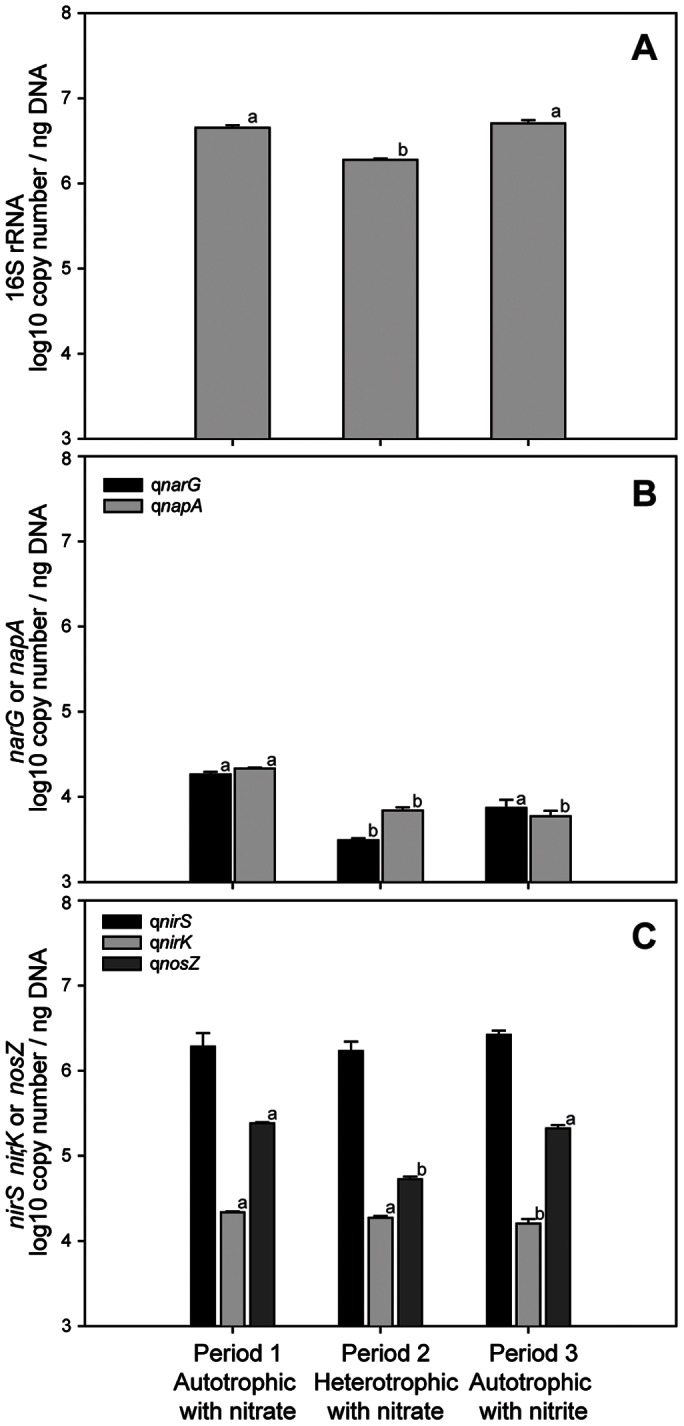
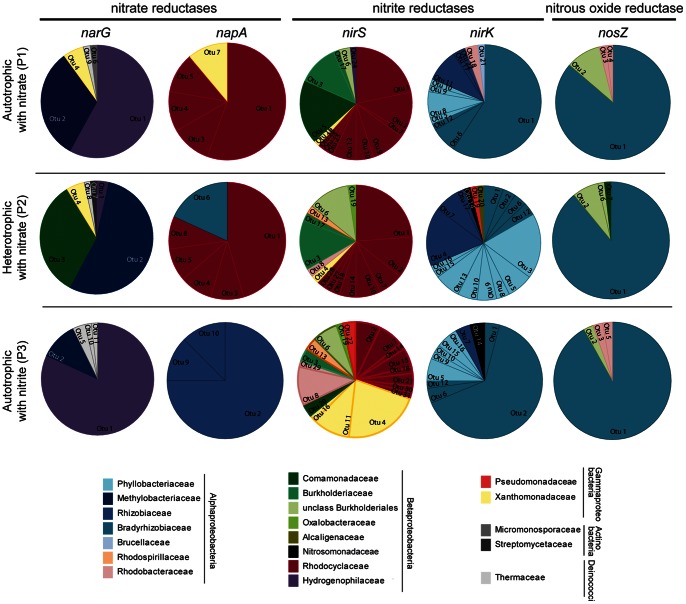
The biocathodic reduction of nitrate in Microbial Fuel Cells (MFCs) is an alternative to remove nitrogen in low carbon to nitrogen wastewater and relies entirely on microbial activity. In this paper the community composition of denitrifiers in the cathode of a MFC is analysed in relation to added electron acceptors (nitrate and nitrite) and organic matter in the cathode. Nitrate reducers and nitrite reducers were highly affected by the operational conditions and displayed high diversity. The number of retrieved species-level Operational Taxonomic Units (OTUs) for narG, napA, nirS and nirK genes was 11, 10, 31 and 22, respectively. In contrast, nitrous oxide reducers remained virtually unchanged at all conditions. About 90% of the retrieved nosZ sequences grouped in a single OTU with a high similarity with Oligotropha carboxidovorans nosZ gene. nirS-containing denitrifiers were dominant at all conditions and accounted for a significant amount of the total bacterial density. Current production decreased from 15.0 A · m(-3) NCC (Net Cathodic Compartment), when nitrate was used as an electron acceptor, to 14.1 A · m(-3) NCC in the case of nitrite. Contrarily, nitrous oxide (N2O) accumulation in the MFC was higher when nitrite was used as the main electron acceptor and accounted for 70% of gaseous nitrogen. Relative abundance of nitrite to nitrous oxide reducers, calculated as (qnirS+qnirK)/qnosZ, correlated positively with N2O emissions. Collectively, data indicate that bacteria catalysing the initial denitrification steps in a MFC are highly influenced by main electron acceptors and have a major influence on current production and N2O accumulation.
微生物燃料电池(MFC)中硝酸盐的生物阴极还原是去除低碳氮废水中氮的一种替代方法,完全依赖微生物活性。本文分析了 MFC 阴极中硝酸盐和亚硝酸盐添加电子受体和阴极中有机物对反硝化菌群落组成的影响。硝酸盐还原菌和亚硝酸盐还原菌受操作条件的影响很大,显示出很高的多样性。narG、napA、nirS 和 nirK 基因的可回收种水平操作分类单元(OTU)数量分别为 11、10、31 和 22。相比之下,一氧化二氮还原菌在所有条件下几乎保持不变。大约 90%的nosZ 序列与 Oligotropha carboxidovorans nosZ 基因的高度相似,聚集成一个单一的 OTU。在所有条件下,含 nirS 的反硝化菌都占主导地位,占总细菌密度的很大比例。当硝酸盐作为电子受体时,电流产生从 15.0 A·m(-3) NCC(净阴极室)下降到硝酸盐作为电子受体时的 14.1 A·m(-3) NCC。相反,当亚硝酸盐作为主要电子受体时,MFC 中氮气的积累更高,占气态氮的 70%。计算的亚硝酸盐和一氧化二氮还原菌相对丰度,qnirS+qnirK/qnosZ,与 N2O 排放呈正相关。总的来说,数据表明,在 MFC 中催化初始反硝化步骤的细菌受主要电子受体的影响很大,对电流产生和 N2O 积累有重大影响。