Department of Biomedical Engineering, Seoul National University College of Medicine, Seoul, Republic of Korea.
PLoS One. 2013 May 22;8(5):e63468. doi: 10.1371/journal.pone.0063468. Print 2013.
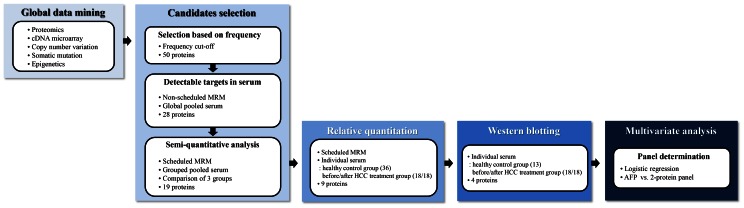
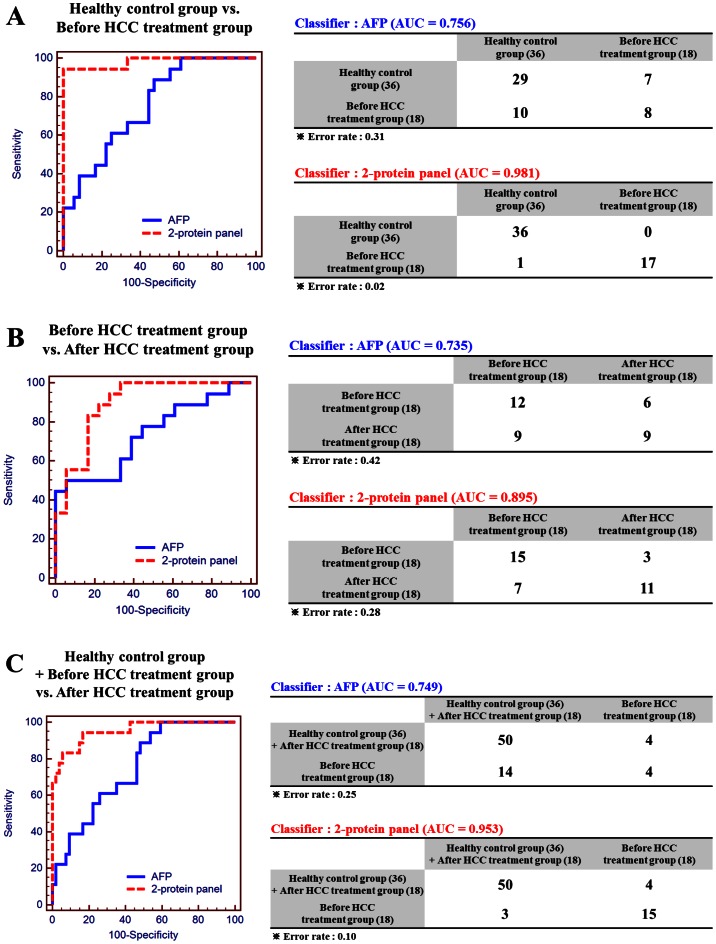
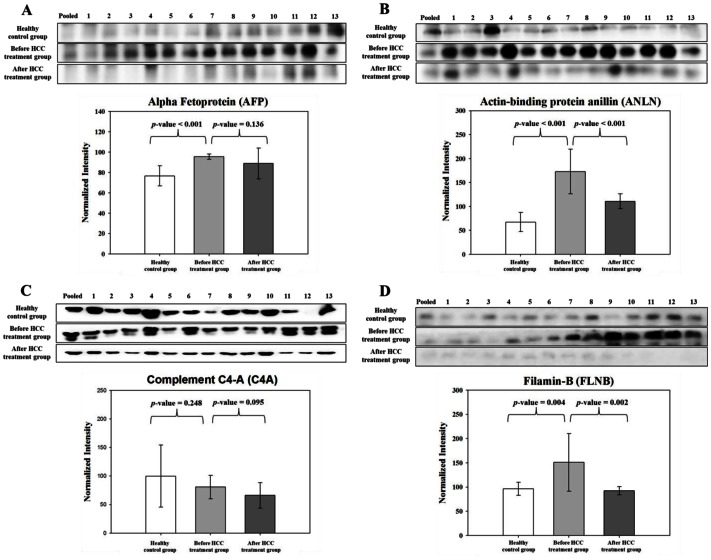
Hepatocellular carcinoma (HCC) is one of the most common and aggressive cancers and is associated with a poor survival rate. Clinically, the level of alpha-fetoprotein (AFP) has been used as a biomarker for the diagnosis of HCC. The discovery of useful biomarkers for HCC, focused solely on the proteome, has been difficult; thus, wide-ranging global data mining of genomic and proteomic databases from previous reports would be valuable in screening biomarker candidates. Further, multiple reaction monitoring (MRM), based on triple quadrupole mass spectrometry, has been effective with regard to high-throughput verification, complementing antibody-based verification pipelines. In this study, global data mining was performed using 5 types of HCC data to screen for candidate biomarker proteins: cDNA microarray, copy number variation, somatic mutation, epigenetic, and quantitative proteomics data. Next, we applied MRM to verify HCC candidate biomarkers in individual serum samples from 3 groups: a healthy control group, patients who have been diagnosed with HCC (Before HCC treatment group), and HCC patients who underwent locoregional therapy (After HCC treatment group). After determining the relative quantities of the candidate proteins by MRM, we compared their expression levels between the 3 groups, identifying 4 potential biomarkers: the actin-binding protein anillin (ANLN), filamin-B (FLNB), complementary C4-A (C4A), and AFP. The combination of 2 markers (ANLN, FLNB) improved the discrimination of the before HCC treatment group from the healthy control group compared with AFP. We conclude that the combination of global data mining and MRM verification enhances the screening and verification of potential HCC biomarkers. This efficacious integrative strategy is applicable to the development of markers for cancer and other diseases.
肝细胞癌 (HCC) 是最常见和侵袭性最强的癌症之一,与生存率差有关。临床上,甲胎蛋白 (AFP) 水平已被用作 HCC 诊断的生物标志物。由于专注于蛋白质组学,因此很难发现对 HCC 有用的生物标志物,因此,对以前报告的基因组和蛋白质组数据库进行广泛的全球数据挖掘对于筛选生物标志物候选者将是有价值的。此外,基于三重四极杆质谱的多重反应监测 (MRM) 在高通量验证方面非常有效,可补充抗体验证管道。在这项研究中,使用 5 种 HCC 数据类型(cDNA 微阵列、拷贝数变异、体细胞突变、表观遗传学和定量蛋白质组学数据)进行了全球数据挖掘,以筛选候选生物标志物蛋白。接下来,我们应用 MRM 在 3 组个体血清样本中验证 HCC 候选生物标志物:健康对照组、已被诊断为 HCC 的患者(HCC 治疗前组)和接受局部区域治疗的 HCC 患者(HCC 治疗后组)。通过 MRM 确定候选蛋白的相对量后,我们比较了它们在 3 组之间的表达水平,鉴定出 4 种潜在的生物标志物:肌动蛋白结合蛋白肌球蛋白结合蛋白 (ANLN)、细丝蛋白-B (FLNB)、补体 C4-A (C4A) 和 AFP。与 AFP 相比,2 种标志物 (ANLN、FLNB) 的组合可提高 HCC 治疗前组与健康对照组的区分能力。我们得出结论,全球数据挖掘和 MRM 验证的结合增强了潜在 HCC 生物标志物的筛选和验证。这种有效的综合策略适用于癌症和其他疾病标志物的开发。