Biologie-Zoologie, Philipps-University, Marburg, Germany.
PLoS One. 2013 May 22;8(5):e63803. doi: 10.1371/journal.pone.0063803. Print 2013.
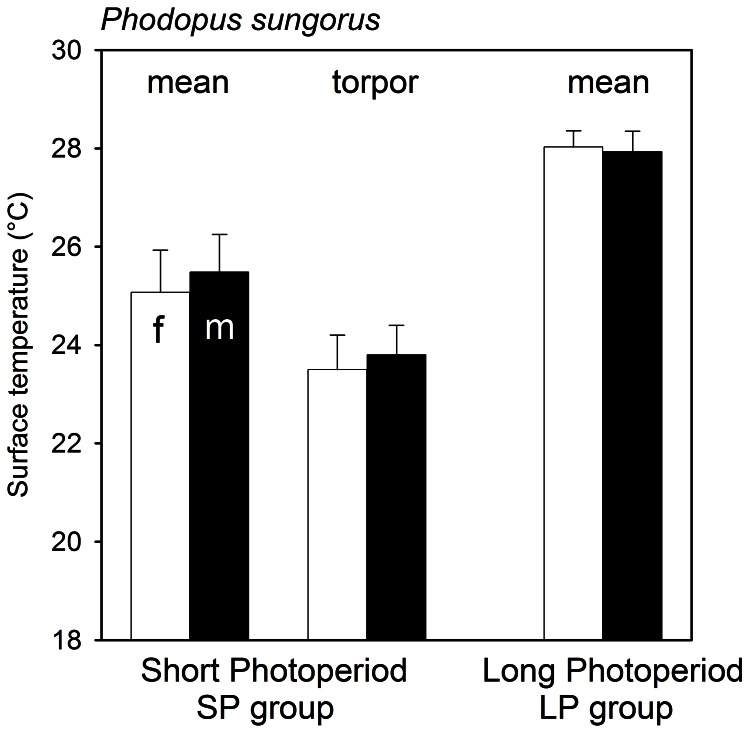
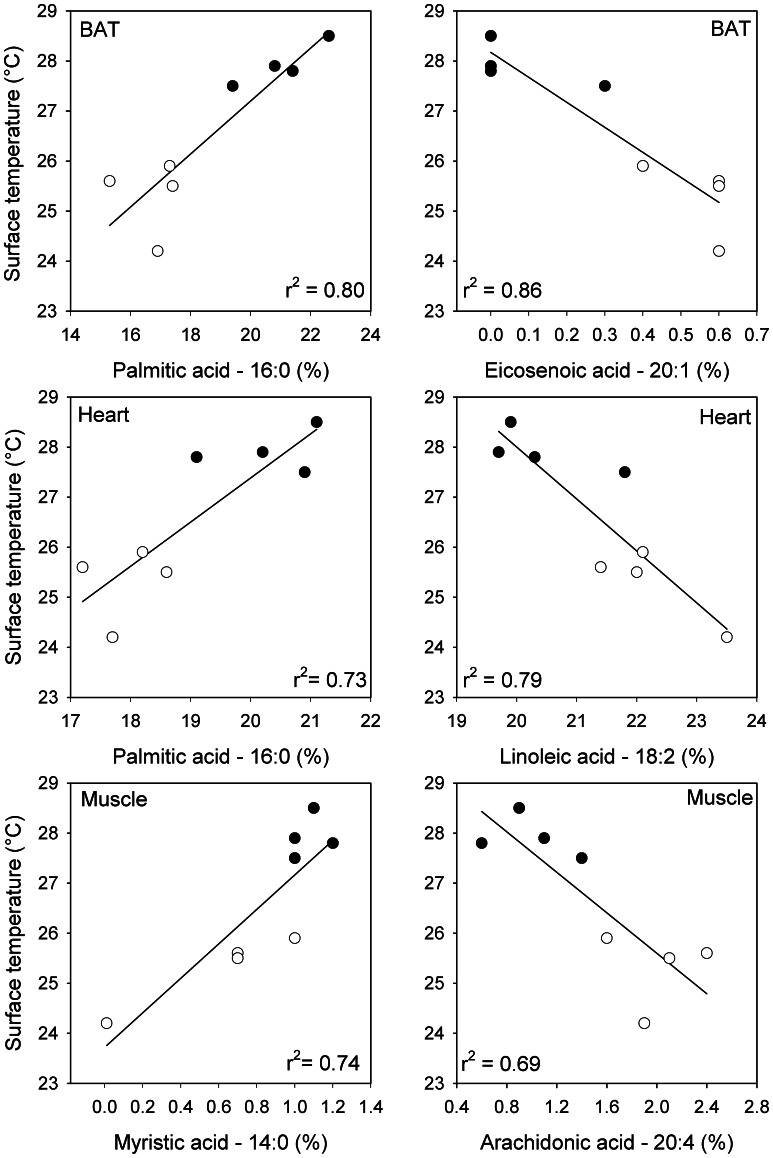
The seasonal changes in thermal physiology and torpor expression of many heterothermic mammals are controlled by photoperiod. As function at low body temperatures during torpor requires changes of tissue lipid composition, we tested for the first time whether and how fatty acids are affected by photoperiod acclimation in hamsters, Phodopus sungorus, a strongly photoperiodic species. We also examined changes in fatty acid composition in relation to those in morphology and thermal biology. Hamsters in short photoperiod had smaller reproductive organs and most had a reduced body mass in comparison to those in long photoperiod. Pelage colour of hamsters under short photoperiod was almost white while that of long photoperiod hamsters was grey-brown and black. Short photoperiod acclimation resulted in regular (28% of days) torpor use, whereas all hamsters in long photoperiod remained normothermic. The composition of total fatty acids differed between acclimation groups for brown adipose tissue (5 of 8 fatty acids), heart muscle (4 of 7 fatty acids) and leg muscle (3 of 11 fatty acids). Importantly, 54% of all fatty acids detected were correlated (r(2) = 0.60 to 0.87) with the minimum surface temperature of individuals, but the responses of tissues differed. While some of the compositional changes of fatty acids were consistent with a 'homeoviscous' response, this was not the case for all, including the sums of saturated and unsaturated fatty acids, which did not differ between acclimation groups. Our data identify a possible nexus between photoperiod acclimation, morphology, reproductive biology, thermal biology and fatty acid composition. They suggest that some of the changes in thermal physiology are linked to the composition of tissue and organ fatty acids.
许多异温哺乳动物的热生理学和蛰伏表达的季节性变化受光周期控制。由于在蛰伏期间的低体温下的功能需要组织脂质组成的变化,我们首次测试了脂肪酸是否以及如何受到光周期驯化的影响在仓鼠中,Phodopus sungorus,一种强烈的光周期物种。我们还检查了脂肪酸组成的变化与形态和热生物学的变化之间的关系。在短光周期下的仓鼠的生殖器官较小,并且与在长光周期下的仓鼠相比,大多数仓鼠的体重减轻。在短光周期下的仓鼠的被毛颜色几乎是白色的,而在长光周期下的仓鼠的被毛颜色是灰棕色和黑色的。短光周期驯化导致定期(28%的天数)使用蛰伏,而所有在长光周期下的仓鼠均保持正常体温。总脂肪酸的组成在棕色脂肪组织(8 种脂肪酸中的 5 种)、心肌(7 种脂肪酸中的 4 种)和腿部肌肉(11 种脂肪酸中的 3 种)之间因驯化组而有所不同。重要的是,检测到的所有脂肪酸中有 54%(r²=0.60 到 0.87)与个体的最小表面温度相关,但组织的反应不同。虽然一些脂肪酸的组成变化与“同型粘弹性”反应一致,但并非所有脂肪酸都是如此,包括饱和和不饱和脂肪酸的总和,这两组之间没有差异。我们的数据确定了光周期驯化、形态、生殖生物学、热生物学和脂肪酸组成之间的可能联系。它们表明,一些热生理学的变化与组织和器官脂肪酸的组成有关。