Division of Otolaryngology-Head and Neck Surgery, Department of Surgery, University of Alberta Hospital, 8440 112 St, Edmonton, AB T6H 2H7, Canada.
J Otolaryngol Head Neck Surg. 2013 May 29;42(1):36. doi: 10.1186/1916-0216-42-36.
The incidence of human papillomavirus (HPV)-related oropharyngeal squamous cell carcinoma (OPSCCs) is rising in developed nations. Studies have shown that these virally mediated tumours are epidemiologically, clinically, and biologically different than other head and neck squamous cell carcinomas and traditional concepts of field cancerization may not apply to HPV-related oropharyngeal cancer.
The purpose of this study was to evaluate the rate of second primary tumors and the diagnostic yield of field cancerization work up in the upper aerodigestive tract in patients with HPV-related and HPV-unrelated oropharyngeal squamous cell carcinoma.
Retrospective review.
Tertiary cancer care centers in Alberta.
Retrospective review of 406 patients diagnosed with OPSCC in Alberta between 2005 and 2009. HPV-status of tumours was determined by tissue microarray using immunohistochemistry staining for p16.
incidence of upper aerodigestive tract second primary tumours in p16-positive versus p16-negative OPSCC.
diagnostic yield of traditional field cancerization work-up in p16-positive versus negative patients.
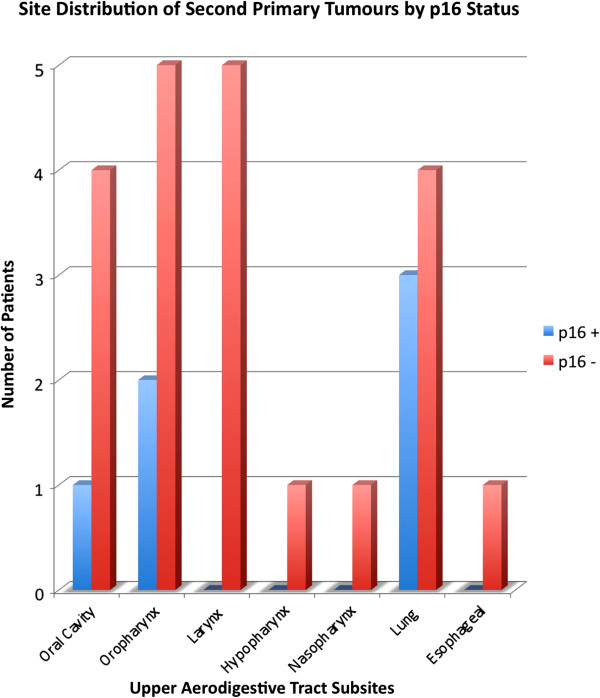
The overall rate of SPTs was 7.4% (30/406). The incidence rate of SPTs was significantly lower in p16-positive patients (0.7 per 100 patient-yrs vs. 8.5 in p16-negative, p < 0.0001). Field cancerization work-up for synchronous lesions in the upper aerodigestive tract, including panendoscopy and whole-body PET-CT, had decreased diagnostic yield in p16-positive patients (2.8% vs. 10.2% in HPV-negative patients, p=0.02).
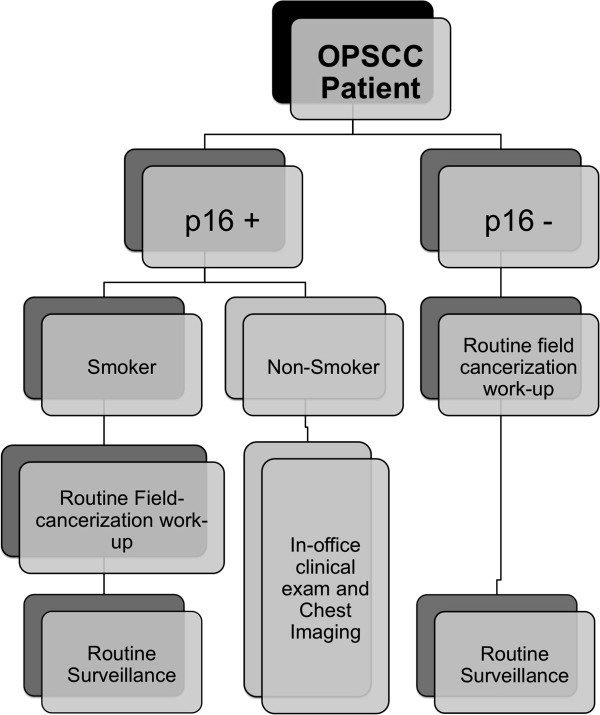
Patients with HPV-related OPSCC, who are non-smokers have decreased risk of developing second primary tumours in the upper aerodigestive tract and have low yield on field cancerization work-up. This study provides further evidence that virally mediated OPSCC are distinct and may benefit from alternate diagnostic pathways.
在发达国家,人乳头瘤病毒(HPV)相关的口咽鳞状细胞癌(OPSCC)的发病率正在上升。研究表明,这些病毒介导的肿瘤在流行病学、临床和生物学方面与其他头颈部鳞状细胞癌不同,传统的区域性癌变概念可能不适用于 HPV 相关的口咽癌。
本研究旨在评估 HPV 相关和 HPV 无关的口咽鳞状细胞癌患者的上呼吸道第二原发肿瘤的发生率和区域性癌变检查的诊断收益。
回顾性研究。
艾伯塔省的三级癌症治疗中心。
回顾性分析 2005 年至 2009 年间在艾伯塔省诊断为 OPSCC 的 406 例患者。通过组织微阵列使用 p16 的免疫组织化学染色来确定肿瘤的 HPV 状态。
p16 阳性与 p16 阴性 OPSCC 中发生上呼吸道第二原发肿瘤的发生率。
p16 阳性与阴性患者中传统区域性癌变检查的诊断收益。
总的 SPT 发生率为 7.4%(30/406)。p16 阳性患者 SPT 的发生率明显较低(每 100 例患者年 0.7 例 vs. p16 阴性患者 8.5 例,p < 0.0001)。上呼吸道同步病变的区域性癌变检查,包括全内镜检查和全身 PET-CT,在 p16 阳性患者中的诊断收益降低(2.8% vs. p16 阴性患者 10.2%,p=0.02)。
HPV 相关 OPSCC 的患者,不吸烟者,在上呼吸道发生第二原发肿瘤的风险降低,并且区域性癌变检查的收益较低。本研究进一步证明,病毒介导的 OPSCC 是不同的,可能受益于替代诊断途径。