Knüpfer Christian, Beckstein Clemens, Dittrich Peter, Le Novère Nicolas
Artificial Intelligence Group, University of Jena, Ernst-Abbe-Platz 2, Jena, Germany.
BMC Syst Biol. 2013 May 31;7:43. doi: 10.1186/1752-0509-7-43.
Systems Biology develops computational models in order to understand biological phenomena. The increasing number and complexity of such "bio-models" necessitate computer support for the overall modelling task. Computer-aided modelling has to be based on a formal semantic description of bio-models. But, even if computational bio-models themselves are represented precisely in terms of mathematical expressions their full meaning is not yet formally specified and only described in natural language.
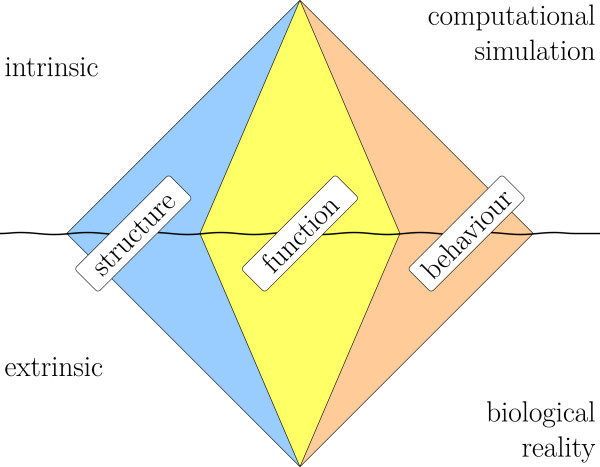
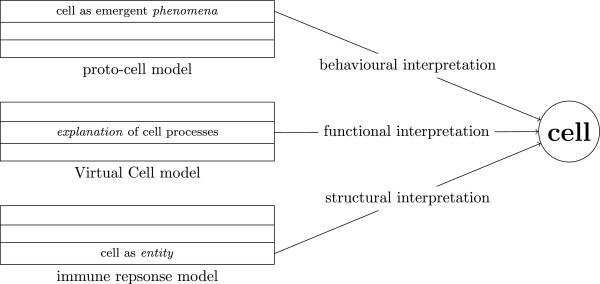
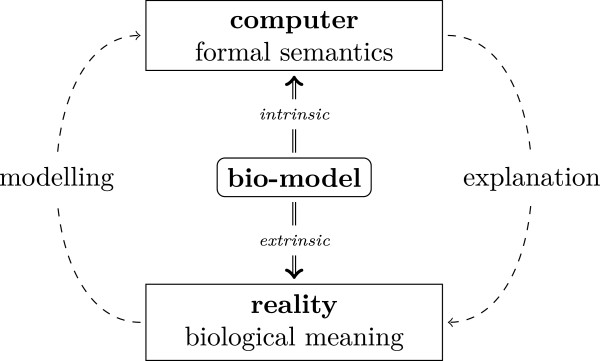
We present a conceptual framework - the meaning facets - which can be used to rigorously specify the semantics of bio-models. A bio-model has a dual interpretation: On the one hand it is a mathematical expression which can be used in computational simulations (intrinsic meaning). On the other hand the model is related to the biological reality (extrinsic meaning). We show that in both cases this interpretation should be performed from three perspectives: the meaning of the model's components (structure), the meaning of the model's intended use (function), and the meaning of the model's dynamics (behaviour). In order to demonstrate the strengths of the meaning facets framework we apply it to two semantically related models of the cell cycle. Thereby, we make use of existing approaches for computer representation of bio-models as much as possible and sketch the missing pieces.
The meaning facets framework provides a systematic in-depth approach to the semantics of bio-models. It can serve two important purposes: First, it specifies and structures the information which biologists have to take into account if they build, use and exchange models. Secondly, because it can be formalised, the framework is a solid foundation for any sort of computer support in bio-modelling. The proposed conceptual framework establishes a new methodology for modelling in Systems Biology and constitutes a basis for computer-aided collaborative research.
系统生物学开发计算模型以理解生物现象。此类“生物模型”数量的不断增加及其复杂性使得计算机需为整体建模任务提供支持。计算机辅助建模必须基于生物模型的形式语义描述。但是,即便计算生物模型本身以数学表达式精确表示,其完整含义仍未得到形式化规定,仅以自然语言进行描述。
我们提出了一个概念框架——意义层面,可用于严格规定生物模型的语义。生物模型具有双重解释:一方面,它是可用于计算模拟的数学表达式(内在意义)。另一方面,该模型与生物现实相关(外在意义)。我们表明,在这两种情况下,这种解释都应从三个角度进行:模型组件的意义(结构)、模型预期用途的意义(功能)以及模型动态的意义(行为)。为了展示意义层面框架的优势,我们将其应用于细胞周期的两个语义相关模型。由此,我们尽可能利用现有的生物模型计算机表示方法,并勾勒出缺失部分。
意义层面框架为生物模型的语义提供了一种系统深入的方法。它可服务于两个重要目的:第一,它规定并构建了生物学家在构建、使用和交换模型时必须考虑的信息。第二,由于它可以形式化,该框架是生物建模中任何形式计算机支持的坚实基础。所提出的概念框架为系统生物学建模建立了一种新方法,并构成了计算机辅助协作研究的基础。