Department of Dental Material, Dental School, Azad University, Tehran Branch and Kamal Asgar Research Center, Tehran, Iran
Med Oral Patol Oral Cir Bucal. 2013 Jul 1;18(4):e714-20. doi: 10.4317/medoral.18922.
Recently, it was shown that NanoMTA improved the setting time and promoted a better hydration process which prevents washout and the dislodgment of this novel biomaterial in comparison with WTMA. This study analyzed the compressive strength of ProRoot WMTA (Dentsply), a NanoWMTA (Kamal Asgar Research Center), and Bioaggregate (Innovative Bioceramix) after its exposure to a range of environmental pH conditions during hydration.
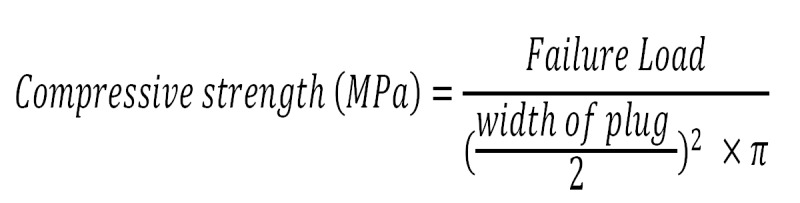
After mixing the cements under aseptic condition and based on the manufacturers` recommendations, the cements were condensed with moderate force using plugger into 9 × 6 mm split molds. Each type of cement was then randomly divided into three groups (n=10). Specimens were exposed to environments with pH values of 4.4, 7.4, or 10.4 for 3 days. Cement pellets were compressed by using an Instron testing machine. Values were recorded and compared. Data were analyzed by using one-way analysis of variance and a post hoc Tukey's test.
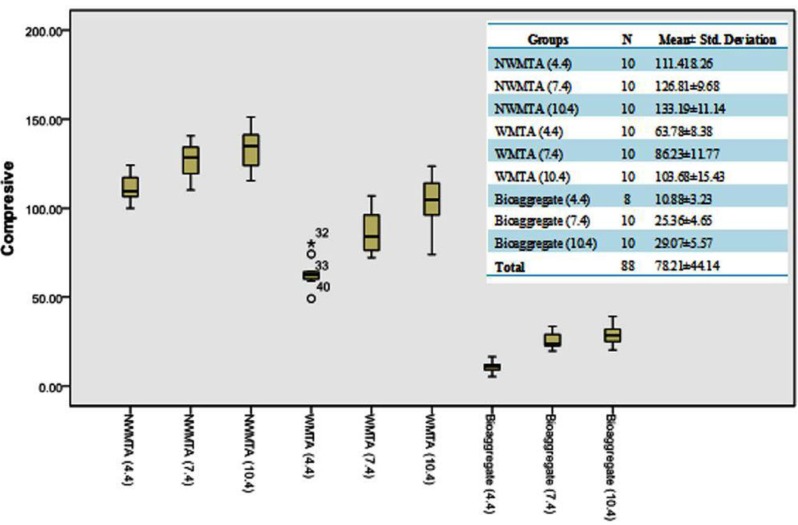
After 3 days, the samples were solid when probed with an explorer before removing them from the molds. The greatest mean compressive strength 133.19 ± 11.14 MPa was observed after exposure to a pH value of 10.4 for NanoWMTA. The values decreased to 111.41 ± 8.26 MPa after exposure to a pH value of 4.4. Increasing of pH had a significant effect on the compressive strength of the groups (p<0.001). The mean compressive strength for the NanoWMTA was statistically higher than for ProRoot WMTA and Bioaggregate (p<0.001). Moreover, increasing of pH values had a significant effect on compressive strength of the experimental groups (p<0.001).
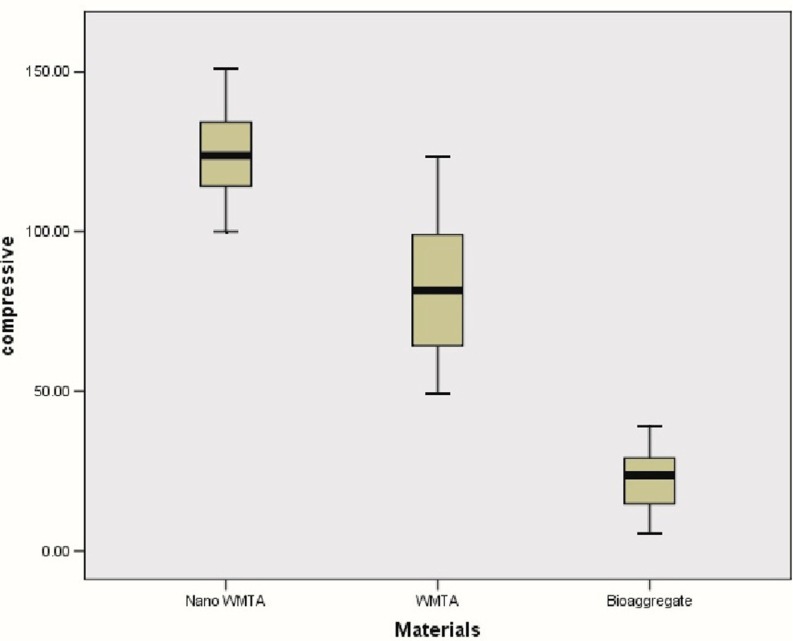
The compressive strength of NanoWMTA was significantly higher than WMTA and Bioaggregate; the more acidic the environmental pH, the lower was the compressive strength.
最近的研究表明,与传统的 WMTA 相比,NanoMTA 可缩短凝固时间并促进更好的水化过程,从而防止这种新型生物材料的洗脱和移位。本研究分析了 ProRoot WMTA(登士柏)、NanoWMTA(Kamal Asgar 研究中心)和 Bioaggregate(Innovative Bioceramix)在水化过程中暴露于一系列环境 pH 值条件下的抗压强度。
在无菌条件下混合水泥,并根据制造商的建议,用平头塞以适度的力量将水泥压缩到 9×6mm 的分体模具中。然后,将每种类型的水泥随机分为三组(n=10)。将试件暴露于 pH 值为 4.4、7.4 或 10.4 的环境中 3 天。然后使用 In stron 试验机压缩水泥丸。记录并比较数值。使用单向方差分析和事后 Tukey 检验对数据进行分析。
3 天后,在从模具中取出试件之前,用探测器探测试件时,试件已凝固。暴露于 pH 值为 10.4 时,NanoWMTA 的最大平均抗压强度为 133.19±11.14MPa。暴露于 pH 值为 4.4 时,强度值下降至 111.41±8.26MPa。pH 值的升高对各组的抗压强度有显著影响(p<0.001)。NanoWMTA 的平均抗压强度显著高于 ProRoot WMTA 和 Bioaggregate(p<0.001)。此外,pH 值的升高对实验组的抗压强度有显著影响(p<0.001)。
NanoWMTA 的抗压强度明显高于 WMTA 和 Bioaggregate;环境 pH 值越低,抗压强度越低。