Maibam Punyakishore, Nawkar Ganesh M, Park Joung Hun, Sahi Vaidurya Pratap, Lee Sang Yeol, Kang Chang Ho
Division of Applied Life Sciences (BK21 program), Gyeongsang National University, Jinju 660-701, Korea.
Int J Mol Sci. 2013 May 30;14(6):11527-43. doi: 10.3390/ijms140611527.
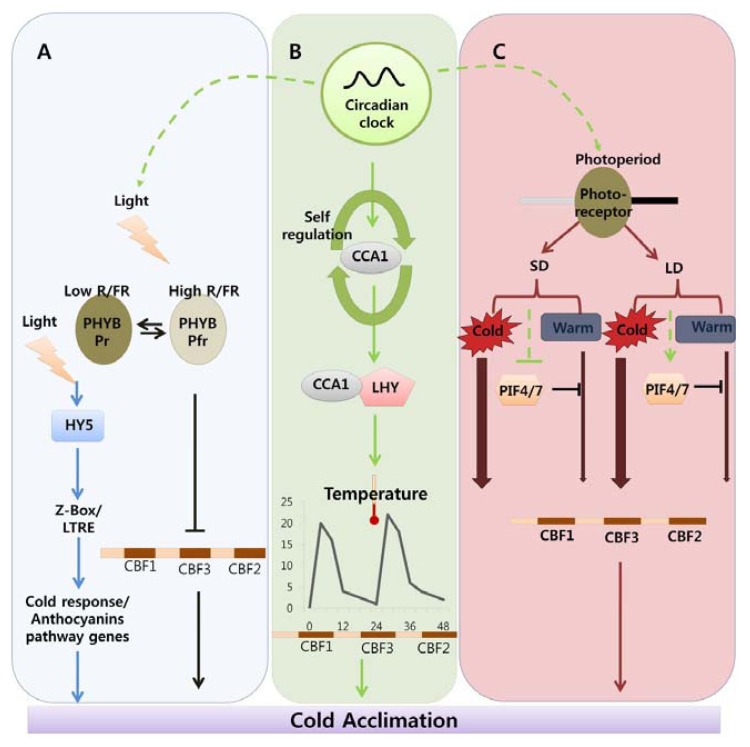
Low temperature adversely affects crop yields by restraining plant growth and productivity. Most temperate plants have the potential to increase their freezing tolerance upon exposure to low but nonfreezing temperatures, a process known as cold acclimation. Various physiological, molecular, and metabolic changes occur during cold acclimation, which suggests that the plant cold stress response is a complex, vital phenomenon that involves more than one pathway. The C-Repeat Binding Factor (CBF) pathway is the most important and well-studied cold regulatory pathway that imparts freezing tolerance to plants. The regulation of freezing tolerance involves the action of phytochromes, which play an important role in light-mediated signalling to activate cold-induced gene expression through the CBF pathway. Under normal temperature conditions, CBF expression is regulated by the circadian clock through the action of a central oscillator and also day length (photoperiod). The phytochrome and phytochrome interacting factor are involved in the repression of the CBF expression under long day (LD) conditions. Apart from the CBF regulon, a novel pathway involving the Z-box element also mediates the cold acclimation response in a light-dependent manner. This review provides insights into the progress of cold acclimation in relation to light quality, circadian regulation, and photoperiodic regulation and also explains the underlying molecular mechanisms of cold acclimation for introducing the engineering of economically important, cold-tolerant plants.
低温通过抑制植物生长和生产力对作物产量产生不利影响。大多数温带植物在暴露于低温但不结冰的温度下时,有提高其抗冻性的潜力,这一过程称为冷驯化。冷驯化过程中会发生各种生理、分子和代谢变化,这表明植物冷应激反应是一个复杂的、至关重要的现象,涉及多个途径。C-重复结合因子(CBF)途径是赋予植物抗冻性的最重要且研究最深入的冷调节途径。抗冻性的调节涉及光敏色素的作用,光敏色素在光介导的信号传导中发挥重要作用,通过CBF途径激活冷诱导基因表达。在正常温度条件下,CBF表达受生物钟通过中央振荡器的作用以及日长(光周期)的调节。光敏色素和光敏色素相互作用因子在长日(LD)条件下参与对CBF表达的抑制。除了CBF调控子外,一条涉及Z-box元件的新途径也以光依赖的方式介导冷驯化反应。本综述深入探讨了与光质、生物钟调节和光周期调节相关的冷驯化进展,并解释了冷驯化的潜在分子机制,以引入经济上重要的耐寒植物的工程技术。