Department of Social Medicine and Health Education, School of Public Health, Peking University, Beijing, China.
PLoS One. 2013 May 28;8(5):e64153. doi: 10.1371/journal.pone.0064153. Print 2013.
There is no special instrument to measure skills-based health literacy where it concerns infectious respiratory diseases. This study aimed to explore and evaluate a new skills-based instrument on health literacy regarding respiratory infectious diseases.
This instrument was designed to measure not only an individual's reading and numeracy ability, but also their oral communication ability and their ability to use the internet to seek information. Sixteen stimuli materials were selected to enable measurement of the skills, which were sourced from the WHO, China CDC, and Chinese Center of Health Education. The information involved the distribution of epidemics, immunization programs, early symptoms, means of disease prevention, individual's preventative behavior, use of medications and thermometers, treatment plans and the location of hospitals. Multi-stage stratified cluster sampling was employed to collect participants. Psychometric properties were used to evaluate the reliability and validity of the instrument.
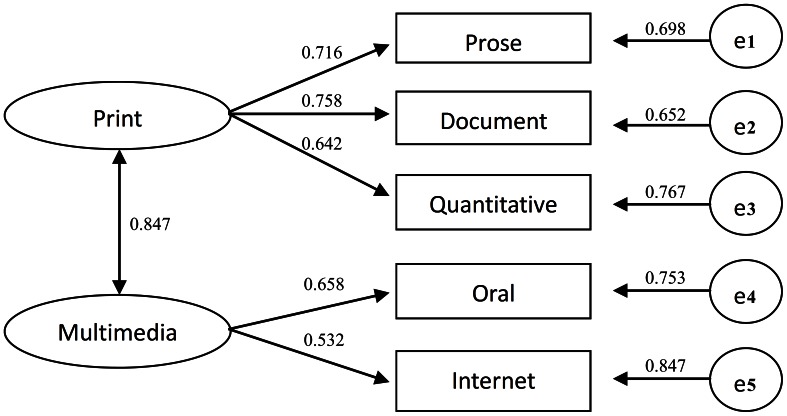
The overall degree of difficulty and discrimination of the instrument were 0.693 and 0.482 respectively. The instrument demonstrated good internal consistency reliability with a Cronbach's alpha of 0.864. As for validity, six factors were extracted from 30 items, which together explained 47.3% of the instrument's variance. And based on confirmatory factor analysis, the items were grouped into five subscales representing prose, document, quantitative, oral and internet based information seeking skills (χ(2) = 9.200, P>0.05, GFI = 0.998, TLI = 0.988, AGFI = 0.992, RMSEA = 0.028).
The new instrument has good reliability and validity, and it could be used to assess the health literacy regarding respiratory infectious disease status of different groups.
目前尚无专门用于测量传染性呼吸道疾病技能型健康素养的工具。本研究旨在探索和评估一种新的针对呼吸道传染病的基于技能的健康素养工具。
该工具不仅旨在衡量个人的阅读和计算能力,还衡量其口头交流能力和使用互联网获取信息的能力。选择了 16 个刺激材料来衡量这些技能,这些材料来源于世界卫生组织、中国疾病预防控制中心和中国健康教育中心。信息涉及疫情分布、免疫计划、早期症状、疾病预防措施、个人预防行为、药物和体温计使用、治疗计划以及医院位置。采用多阶段分层聚类抽样收集参与者。使用心理测量学特性来评估仪器的可靠性和有效性。
该仪器的整体难度和区分度分别为 0.693 和 0.482。仪器具有良好的内部一致性信度,Cronbach's alpha 为 0.864。至于有效性,从 30 个项目中提取了 6 个因素,这 6 个因素共同解释了仪器 47.3%的方差。基于验证性因子分析,项目分为五个子量表,代表散文、文件、定量、口头和基于互联网的信息搜索技能(χ²=9.200,P>0.05,GFI=0.998,TLI=0.988,AGFI=0.992,RMSEA=0.028)。
新仪器具有良好的信度和效度,可用于评估不同群体的呼吸道传染病健康素养状况。