Department of Fundamental Care and Medical-Surgical Nursing, Campus of Health Science of Bellvitge, Nursing School, University of Barcelona, Hospitalet de Llobregat, Barcelona, Spain.
BMC Med Ethics. 2013 Jun 1;14:22. doi: 10.1186/1472-6939-14-22.
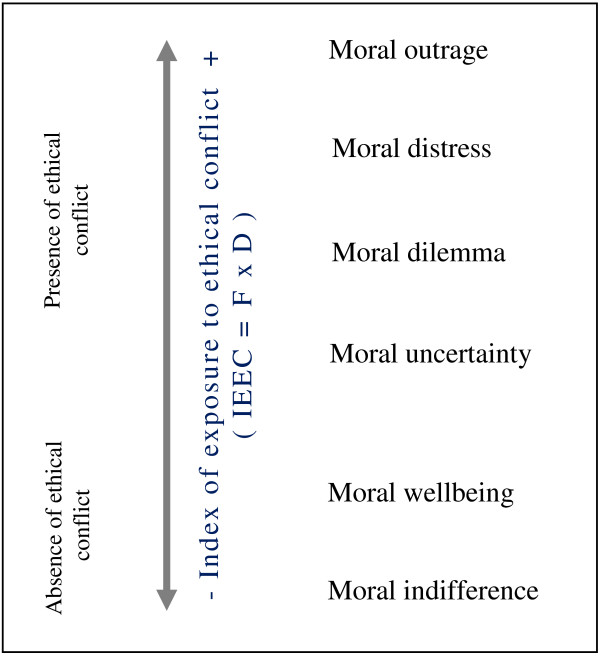
Ethical conflicts are arising as a result of the growing complexity of clinical care, coupled with technological advances. Most studies that have developed instruments for measuring ethical conflict base their measures on the variables 'frequency' and 'degree of conflict'. In our view, however, these variables are insufficient for explaining the root of ethical conflicts. Consequently, the present study formulates a conceptual model that also includes the variable 'exposure to conflict', as well as considering six 'types of ethical conflict'. An instrument was then designed to measure the ethical conflicts experienced by nurses who work with critical care patients. The paper describes the development process and validation of this instrument, the Ethical Conflict in Nursing Questionnaire Critical Care Version (ECNQ-CCV).
The sample comprised 205 nursing professionals from the critical care units of two hospitals in Barcelona (Spain). The ECNQ-CCV presents 19 nursing scenarios with the potential to produce ethical conflict in the critical care setting. Exposure to ethical conflict was assessed by means of the Index of Exposure to Ethical Conflict (IEEC), a specific index developed to provide a reference value for each respondent by combining the intensity and frequency of occurrence of each scenario featured in the ECNQ-CCV. Following content validity, construct validity was assessed by means of Exploratory Factor Analysis (EFA), while Cronbach's alpha was used to evaluate the instrument's reliability. All analyses were performed using the statistical software PASW v19.
Cronbach's alpha for the ECNQ-CCV as a whole was 0.882, which is higher than the values reported for certain other related instruments. The EFA suggested a unidimensional structure, with one component accounting for 33.41% of the explained variance.
The ECNQ-CCV is shown to a valid and reliable instrument for use in critical care units. Its structure is such that the four variables on which our model of ethical conflict is based may be studied separately or in combination. The critical care nurses in this sample present moderate levels of exposure to ethical conflict. This study represents the first evaluation of the ECNQ-CCV.
随着临床护理的日益复杂以及技术的进步,伦理冲突不断出现。大多数开发用于衡量伦理冲突的工具的研究都是基于变量“频率”和“冲突程度”。然而,在我们看来,这些变量不足以解释伦理冲突的根源。因此,本研究提出了一个概念模型,其中还包括变量“冲突暴露”,并考虑了六种“类型的伦理冲突”。然后设计了一种工具来衡量护理人员在重症监护病房工作时所经历的伦理冲突。本文介绍了该工具的开发过程和验证,即重症监护版护理伦理冲突问卷(ECNQ-CCV)。
该样本包括来自巴塞罗那(西班牙)两家医院重症监护病房的 205 名护理专业人员。ECNQ-CCV 提出了 19 种可能在重症监护环境中产生伦理冲突的护理场景。通过伦理冲突暴露指数(IEEC)来评估伦理冲突的暴露情况,该指数是一种特定的指数,通过结合 ECNQ-CCV 中每个场景的强度和发生频率,为每个回答者提供一个参考值。在内容有效性之后,通过探索性因素分析(EFA)评估了构建有效性,使用 Cronbach's alpha 评估了工具的可靠性。所有分析均使用统计软件 PASW v19 进行。
ECNQ-CCV 的 Cronbach's alpha 整体为 0.882,高于某些其他相关工具报告的值。EFA 表明存在一个单维结构,一个组成部分占解释方差的 33.41%。
ECNQ-CCV 是一种在重症监护病房中使用的有效且可靠的工具。其结构使得我们的伦理冲突模型所基于的四个变量可以单独或组合进行研究。该样本中的重症监护护士表现出中等程度的伦理冲突暴露。本研究代表了对 ECNQ-CCV 的首次评估。