INRA, UMR444 Laboratoire de Génétique Cellulaire, Castanet-Tolosan F-31326, France.
BMC Genet. 2013 Jun 1;14:46. doi: 10.1186/1471-2156-14-46.
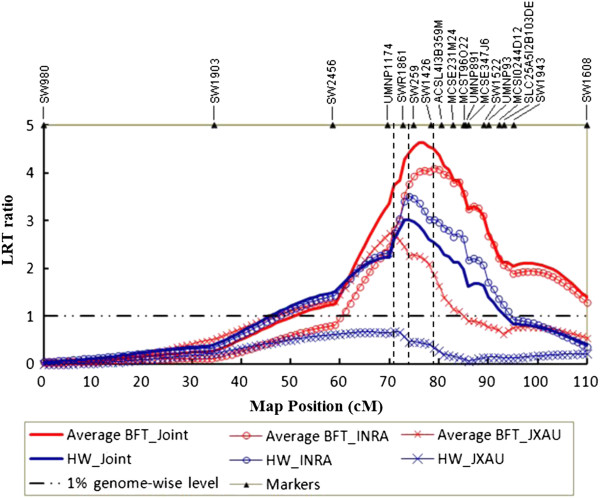
Porcine chromosome X harbors four QTL strongly affecting backfat thickness (BFT), ham weight (HW), intramuscular fat content (IMF) and loin eye area (LEA). The confidence intervals (CI) of these QTL overlap and span more than 30 cM, or approximately 80 Mb. This study therefore attempts to fine map these QTL by joint analysis of two large-scale F₂ populations (Large White × Meishan and White Duroc × Erhualian constructed by INRA and JXAU respectively) and furthermore, to determine whether these QTL are caused by mutations in three positional candidate genes (ACSL4, SERPINA7 and IRS4) involved in lipid biosynthesis.
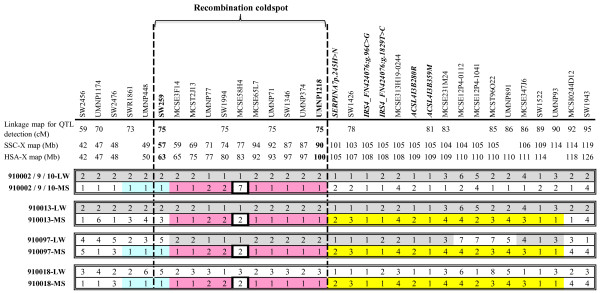
A female-specific linkage map with an average distance of 2 cM between markers in the initial QTL interval (SW2456-SW1943) was created and used here. The CI of QTL for BFT, HW and LEA were narrowed down to 6-7 cM, resulting from the joint analysis. For IMF, two linked QTL were revealed in the INRA population but not in the JXAU population, causing a wider CI (13 cM) for IMF QTL. Linkage analyses using two subsets of INRA F₁ dam families demonstrate that the BFT and HW QTL were segregating in the Meishan pigs. Moreover, haplotype comparisons between these dams suggest that within the refined QTL region, the recombination coldspot (~34 Mb) flanked by markers MCSE3F14 and UMNP1218 is unlikely to contain QTL genes. Two SNPs in the ACSL4 gene were identified and showed significant association with BFT and HW, but they and the known polymorphisms in the other two genes are unlikely to be causal mutations.
The candidate QTL regions have been greatly reduced and the QTL are most likely located downstream of the recombination coldspot. The segregation of SSCX QTL for BFT and HW within Meishan breed provides an opportunity for us to make effective use of Meishan chromosome X in crossbreeding. Further studies should attempt to identify the impact of additional DNA sequence (e.g. CNV) and expression variation in the three genes or their surrounding genes on these traits.
猪的 X 染色体上有四个 QTL 强烈影响背膘厚(BFT)、火腿重量(HW)、肌内脂肪含量(IMF)和腰眼面积(LEA)。这些 QTL 的置信区间(CI)重叠,跨越超过 30cM,约 80Mb。因此,本研究试图通过联合分析两个大型 F₂群体(分别由 INRA 和 JXAU 构建的大白猪×梅山猪和白杜洛克×二花脸)来精细定位这些 QTL,并进一步确定这些 QTL 是否由三个参与脂质生物合成的定位候选基因(ACSL4、SERPINA7 和 IRS4)的突变引起。
创建了一个具有标记间平均距离为 2cM 的雌性特异性连锁图谱,用于初始 QTL 区间(SW2456-SW1943)。BFT、HW 和 LEA 的 QTL CI 通过联合分析缩小到 6-7cM。对于 IMF,在 INRA 群体中揭示了两个连锁的 QTL,但在 JXAU 群体中没有,导致 IMF QTL 的 CI 更宽(13cM)。使用 INRA F₁ 母系的两个子集的连锁分析表明,BFT 和 HW QTL 在梅山猪中分离。此外,这些母系之间的单倍型比较表明,在精细定位的 QTL 区域内,由标记 MCSE3F14 和 UMNP1218 侧翼的重组冷点(~34Mb)不太可能包含 QTL 基因。在 ACSL4 基因中鉴定出两个 SNP,它们与 BFT 和 HW 显著相关,但它们和其他两个基因中的已知多态性不太可能是因果突变。
候选 QTL 区域已大大缩小,QTL 很可能位于重组冷点的下游。梅山猪 BFT 和 HW 的 SSCX QTL 分离为我们在杂交中有效利用梅山猪 X 染色体提供了机会。进一步的研究应该试图确定三个基因或其周围基因的附加 DNA 序列(例如 CNV)和表达变异对这些性状的影响。