Department of Biochemistry, Molecular Biology, and Biophysics, University of Minnesota, Minneapolis, MN 55455, USA.
Free Radic Biol Med. 2013 Oct;63:390-8. doi: 10.1016/j.freeradbiomed.2013.05.030. Epub 2013 May 28.
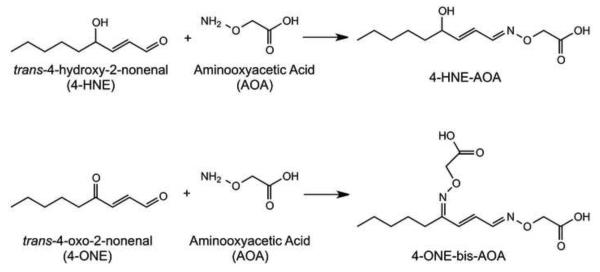
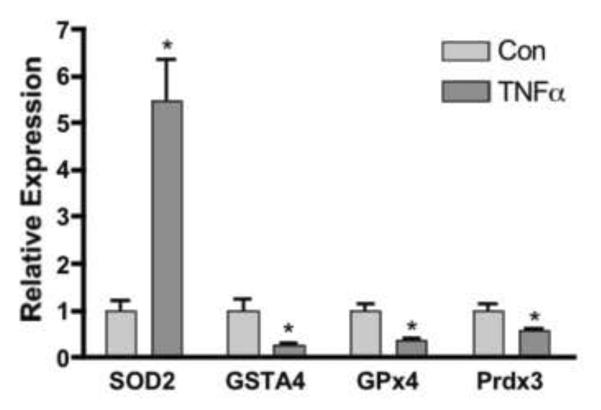
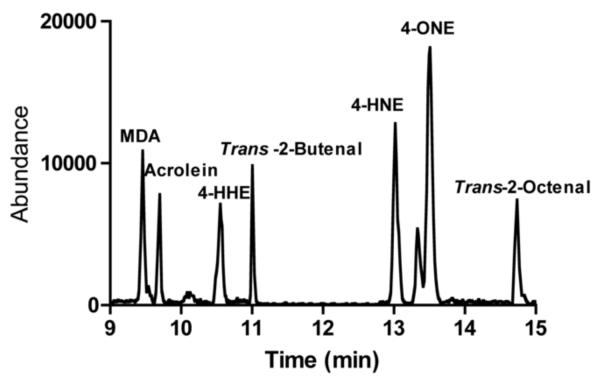
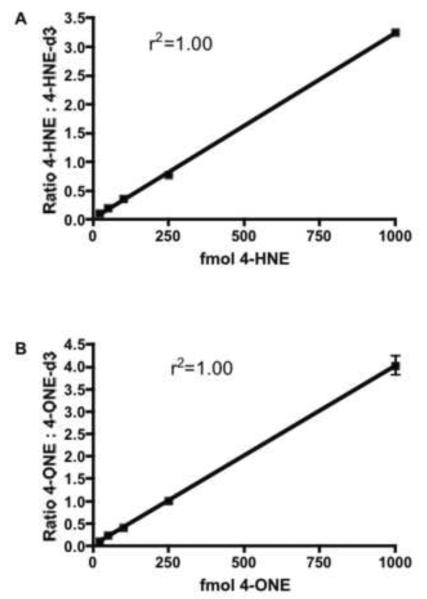
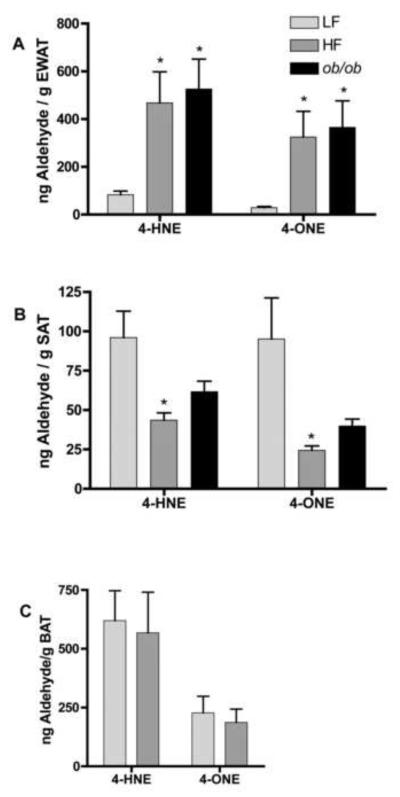
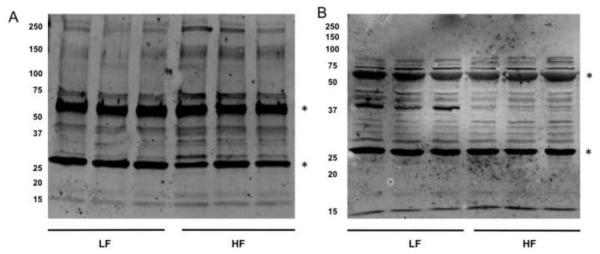
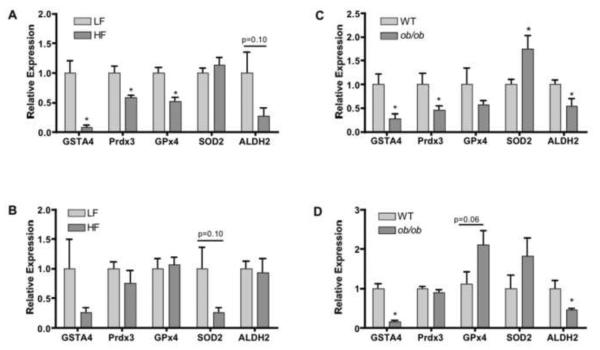
Protein carbonylation is the covalent modification of proteins by α,β-unsaturated aldehydes produced by nonenzymatic lipid peroxidation of polyunsaturated fatty acids. The most widely studied aldehyde product of lipid peroxidation, trans-4-hydroxy-2-nonenal (4-HNE), is associated with obesity-induced metabolic dysfunction and has demonstrated reactivity toward key proteins involved in cellular function. However, 4-HNE is only one of many lipid peroxidation products and the lipid aldehyde profile in adipose tissue has not been characterized. To further understand the role of oxidative stress in obesity-induced metabolic dysfunction, a novel LC-MS/MS method was developed to evaluate aldehyde products of lipid peroxidation and applied to the analysis of adipose tissue. 4-HNE and trans-4-oxo-2-nonenal (4-ONE) were the most abundant aldehydes present in adipose tissue. In high fat-fed C57Bl/6J and ob/ob mice the levels of lipid peroxidation products were increased 5- to 11-fold in epididymal adipose, unchanged in brown adipose, but decreased in subcutaneous adipose tissue. Epididymal adipose tissue of high fat-fed mice also exhibited increased levels of proteins modified by 4-HNE and 4-ONE, whereas subcutaneous adipose tissue levels of these modifications were decreased. High fat feeding of C57Bl/6J mice resulted in decreased expression of a number of genes linked to antioxidant biology selectively in epididymal adipose tissue. Moreover, TNFα treatment of 3T3-L1 adipocytes resulted in decreased expression of GSTA4, GPx4, and Prdx3 while upregulating the expression of SOD2. These results suggest that inflammatory cytokines selectively downregulate antioxidant gene expression in visceral adipose tissue, resulting in elevated lipid aldehydes and increased protein carbonylation.
蛋白质羰基化是指由多不饱和脂肪酸非酶脂质过氧化产生的α,β-不饱和醛共价修饰蛋白质。脂质过氧化的最广泛研究的醛产物反式-4-羟基-2-壬烯醛(4-HNE)与肥胖引起的代谢功能障碍有关,并已证明与细胞功能相关的关键蛋白质具有反应性。然而,4-HNE 只是许多脂质过氧化产物之一,脂肪组织中的脂质醛谱尚未得到表征。为了进一步了解氧化应激在肥胖引起的代谢功能障碍中的作用,开发了一种新的 LC-MS/MS 方法来评估脂质过氧化的醛产物,并将其应用于脂肪组织的分析。4-HNE 和反式-4-氧代-2-壬烯醛(4-ONE)是脂肪组织中含量最丰富的醛。在高脂肪喂养的 C57Bl/6J 和 ob/ob 小鼠中,附睾脂肪中的脂质过氧化产物水平增加了 5-11 倍,棕色脂肪中不变,但皮下脂肪组织中的水平降低。高脂肪喂养的 C57Bl/6J 小鼠的附睾脂肪组织中还显示出 4-HNE 和 4-ONE 修饰的蛋白质水平增加,而这些修饰的皮下脂肪组织水平降低。高脂肪喂养 C57Bl/6J 小鼠导致与抗氧化生物学相关的许多基因在附睾脂肪组织中选择性表达降低。此外,TNFα处理 3T3-L1 脂肪细胞导致 GSTA4、GPx4 和 Prdx3 的表达减少,而 SOD2 的表达上调。这些结果表明,炎症细胞因子选择性地下调内脏脂肪组织中抗氧化基因的表达,导致脂质醛和蛋白质羰基化增加。