Department of Biomedical, Metabolic and Neurological Sciences, University of Modena and Reggio-Emilia Modena, Italy.
Front Hum Neurosci. 2013 May 17;7:202. doi: 10.3389/fnhum.2013.00202. eCollection 2013.
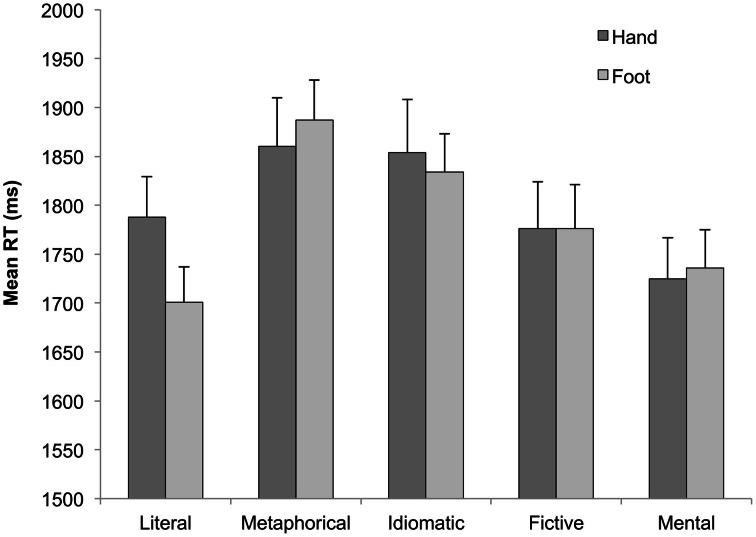
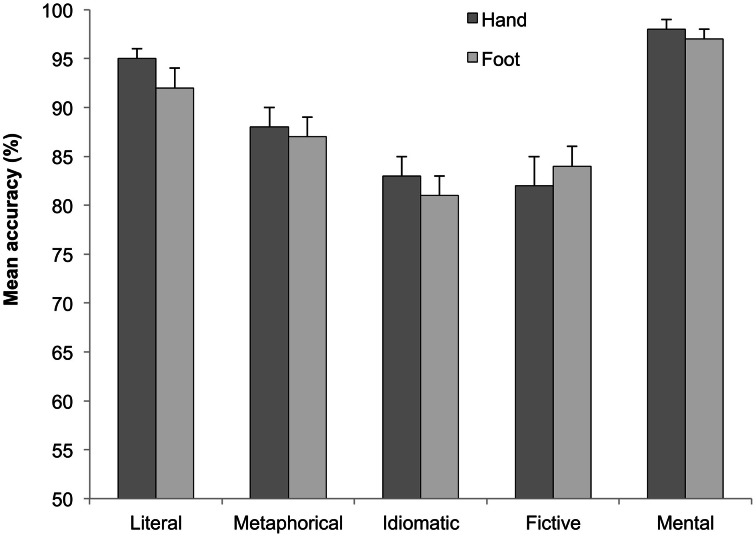
Despite the impressive amount of evidence showing involvement of the sensorimotor systems in language processing, important questions remain unsolved among which the relationship between non-literal uses of language and sensorimotor activation. The literature did not yet provide a univocal answer on whether the comprehension of non-literal, abstract motion sentences engages the same neural networks recruited for literal sentences. A previous TMS study using the same experimental materials of the present study showed activation for literal, fictive and metaphoric motion sentences but not for idiomatic ones. To evaluate whether this may depend on insufficient time for elaborating the idiomatic meaning, we conducted a behavioral experiment that used a sensibility judgment task performed by pressing a button either with a hand finger or with a foot. Motor activation is known to be sensitive to the action-congruency of the effector used for responding. Therefore, all other things being equal, significant differences between response emitted with an action-congruent or incongruent effector (foot vs. hand) may be attributed to motor activation. Foot-related action verbs were embedded in sentences conveying literal motion, fictive motion, metaphoric motion or idiomatic motion. Mental sentences were employed as a control condition. foot responses were significantly faster than finger responses but only in literal motion sentences. We hypothesize that motor activation may arise in early phases of comprehension processes (i.e., upon reading the verb) for then decaying as a function of the strength of the semantic motion component of the verb.
尽管有大量证据表明感觉运动系统参与语言处理,但仍有一些重要问题尚未解决,其中包括语言的非字面用法与感觉运动激活之间的关系。文献尚未提供明确的答案,即理解非字面的、抽象的运动句子是否涉及为字面句子招募的相同神经网络。一项先前的 TMS 研究使用了与本研究相同的实验材料,结果表明,对字面、虚构和隐喻运动句子的理解会激活大脑,但对惯用句则不会。为了评估这是否可能取决于没有足够的时间来理解惯用句的含义,我们进行了一项行为实验,该实验使用敏感性判断任务,参与者通过用手或脚按下按钮来做出反应。运动激活对用于反应的效应器的动作一致性很敏感。因此,在其他条件相同的情况下,用动作一致或不一致的效应器(脚与手)发出的反应之间的显著差异可能归因于运动激活。与脚相关的动作动词被嵌入传达字面运动、虚构运动、隐喻运动或惯用运动的句子中。心理句子被用作控制条件。脚的反应明显快于手指的反应,但仅在字面运动句子中如此。我们假设运动激活可能出现在理解过程的早期阶段(即阅读动词时),然后随着动词语义运动成分的强度而衰减。