Department of Psychology, McGill University Montreal, QC, Canada.
Front Hum Neurosci. 2013 May 17;7:205. doi: 10.3389/fnhum.2013.00205. eCollection 2013.
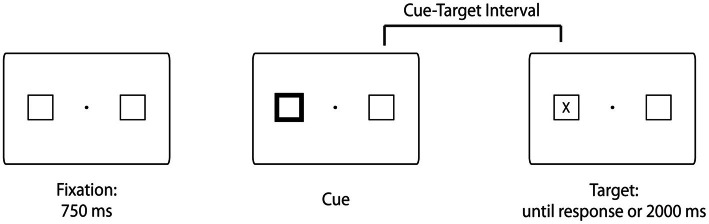
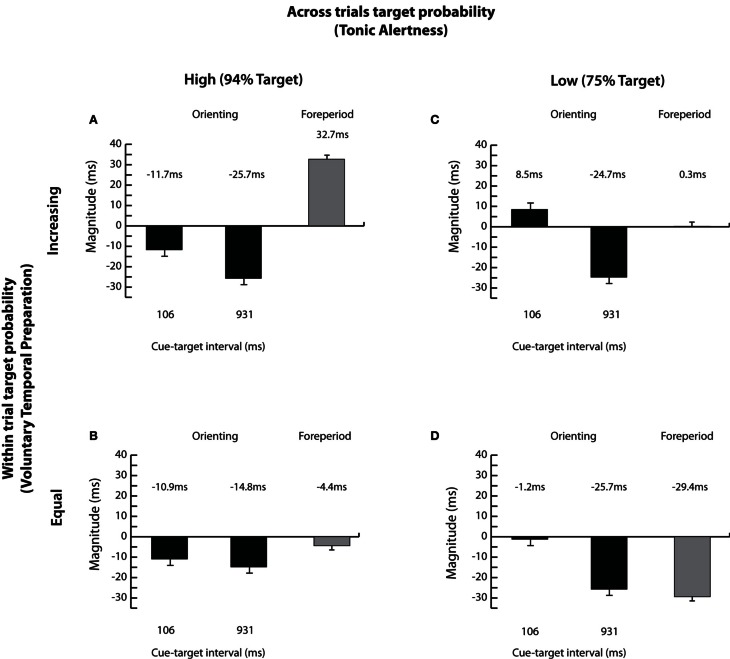
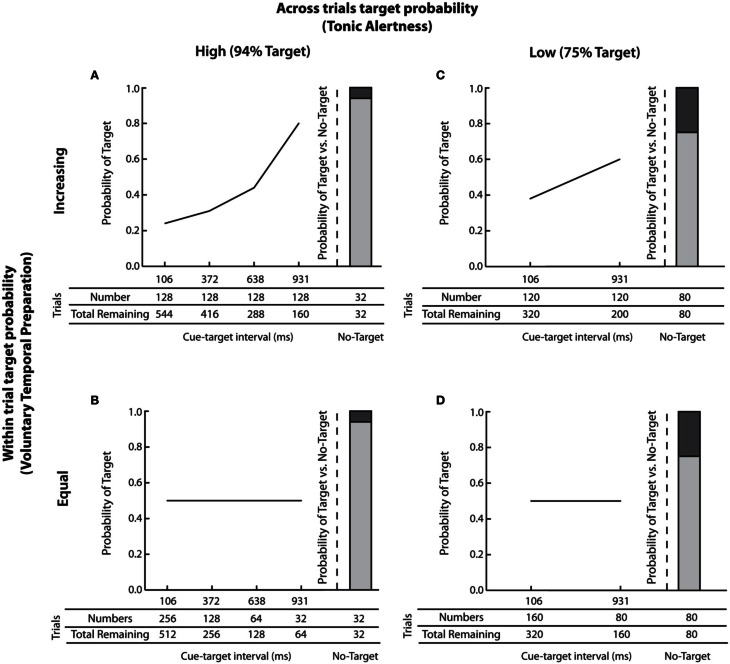
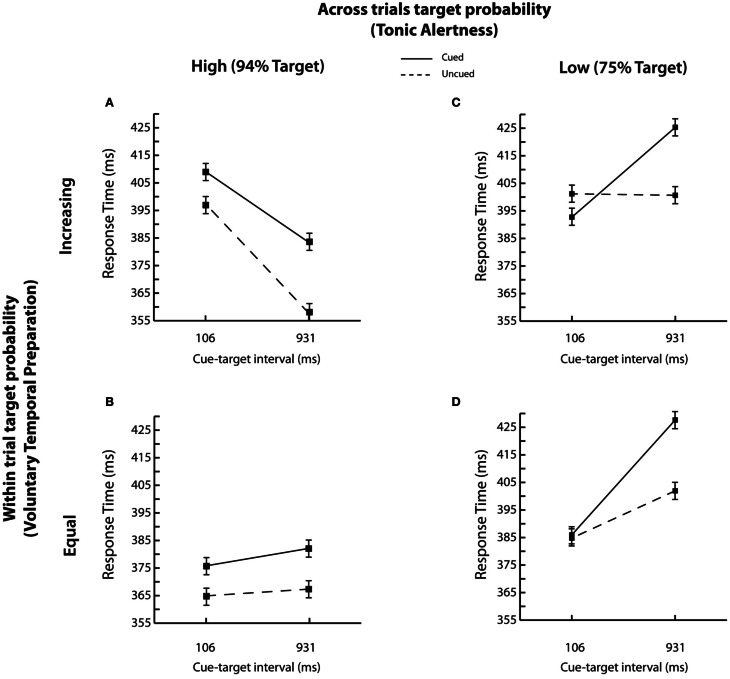
Numerous studies conducted within the recent decades have utilized the Posner cuing paradigm for eliciting, measuring, and theoretically characterizing attentional orienting. However, the data from recent studies suggest that the Posner cuing task might not provide an unambiguous measure of attention, as reflexive spatial orienting has been found to interact with extraneous processes engaged by the task's typical structure, i.e., the probability of target presence across trials, which affects tonic alertness, and the probability of target presence within trials, which affects voluntary temporal preparation. To understand the contribution of each of these two processes to the measurement of attentional orienting we assessed their individual and combined effects on reflexive attention elicited by a spatially nonpredictive peripheral cue. Our results revealed that the magnitude of spatial orienting was modulated by joint changes in the global probability of target presence across trials and the local probability of target presence within trials, while the time course of spatial orienting was susceptible to changes in the probability of target presence across trials. These data thus raise important questions about the choice of task parameters within the Posner cuing paradigm and their role in both the measurement and theoretical attributions of the observed attentional effects.
近几十年来,许多研究利用 Posner 线索范式来引出、测量和从理论上描述注意力的定向。然而,最近的研究数据表明,Posner 线索任务可能无法提供注意力的明确衡量标准,因为反射性空间定向已经被发现与任务的典型结构所涉及的额外过程相互作用,即试验间目标出现的概率,这会影响到紧张性警觉,以及试验内目标出现的概率,这会影响到自愿的时间准备。为了理解这两个过程中的每一个对注意力定向测量的贡献,我们评估了它们对由空间非预测性外围线索引起的反射性注意力的单独和综合影响。我们的结果表明,空间定向的幅度受到试验间整体目标出现概率和试验内目标出现概率的共同变化的调节,而空间定向的时程则容易受到试验间目标出现概率的变化的影响。因此,这些数据提出了关于 Posner 线索范式内任务参数的选择及其在观察到的注意力效应的测量和理论归因中的作用的重要问题。