Department of Psychiatry, Johns Hopkins School of Medicine Baltimore, MD, USA.
Front Genet. 2013 May 17;4:87. doi: 10.3389/fgene.2013.00087. eCollection 2013.
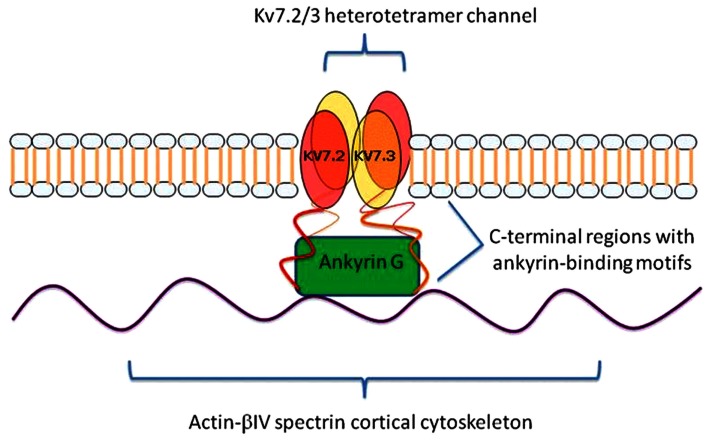
Genome-wide association studies (GWAS) have implicated ANK3 as a susceptibility gene for bipolar disorder (BP). We examined whether epistasis with ANK3 may contribute to the "missing heritability" in BP. We first identified via the STRING database 14 genes encoding proteins with prior biological evidence that they interact molecularly with ANK3. We then tested for statistical evidence of interactions between SNPs in these genes in association with BP in a discovery GWAS dataset and two replication GWAS datasets. The most significant interaction in the discovery GWAS was between SNPs in ANK3 and KCNQ2 (p = 3.18 × 10(-8)). A total of 31 pair-wise interactions involving combinations between two SNPs from KCNQ2 and 16 different SNPs in ANK3 were significant after permutation. Of these, 28 pair-wise interactions were significant in the first replication GWAS. None were significant in the second replication GWAS, but the two SNPs from KCNQ2 were found to significantly interact with five other SNPs in ANK3, suggesting possible allelic heterogeneity. KCNQ2 forms homo- and hetero-meric complexes with KCNQ3 that constitute voltage-gated potassium channels in neurons. ANK3 is an adaptor protein that, through its interaction with KCNQ2 and KCNQ3, directs the localization of this channel in the axon initial segment (AIS). At the AIS, the KCNQ2/3 complex gives rise to the M-current, which stabilizes the neuronal resting potential and inhibits repetitive firing of action potentials. Thus, these channels act as "dampening" components and prevent neuronal hyperactivity. The interactions between ANK3 and KCNQ2 merit further investigation, and if confirmed, may motivate a new line of research into a novel therapeutic target for BP.
全基因组关联研究(GWAS)已经将 ANK3 确定为双相情感障碍(BP)的易感基因。我们研究了 ANK3 与其他基因的相互作用是否会导致 BP 的“遗传缺失”。我们首先通过 STRING 数据库确定了 14 个编码与 ANK3 分子相互作用的蛋白质的基因,这些基因具有先前的生物学证据。然后,我们在发现 GWAS 数据集和两个复制 GWAS 数据集中测试了这些基因中的 SNP 与 BP 之间相互作用的统计证据。在发现 GWAS 中最显著的相互作用是 ANK3 和 KCNQ2 中的 SNP 之间的相互作用(p=3.18×10(-8))。经过置换检验,KCNQ2 和 ANK3 中 16 个不同 SNP 之间的 31 个 SNP 组合之间存在总计 31 个相互作用,其中 28 个在第一次复制 GWAS 中具有统计学意义。第二次复制 GWAS 中没有显著作用,但 KCNQ2 中的两个 SNP 与 ANK3 中的另外五个 SNP 显著相互作用,表明可能存在等位基因异质性。KCNQ2 与 KCNQ3 形成同型和异型复合物,构成神经元中的电压门控钾通道。ANK3 是一种衔接蛋白,通过与 KCNQ2 和 KCNQ3 的相互作用,将该通道定位在轴突起始段(AIS)。在 AIS 处,KCNQ2/3 复合物产生 M 电流,稳定神经元静息电位并抑制动作电位的重复发射。因此,这些通道作为“阻尼”元件,防止神经元过度兴奋。ANK3 和 KCNQ2 之间的相互作用值得进一步研究,如果得到证实,可能会激发针对 BP 的新治疗靶点的研究。