Biomedical Research and Translational Medicine, Masonic Medical Research Institute, 2150 Bleecker St., Utica, NY 13501, USA.
Int J Mol Sci. 2020 Dec 27;22(1):188. doi: 10.3390/ijms22010188.
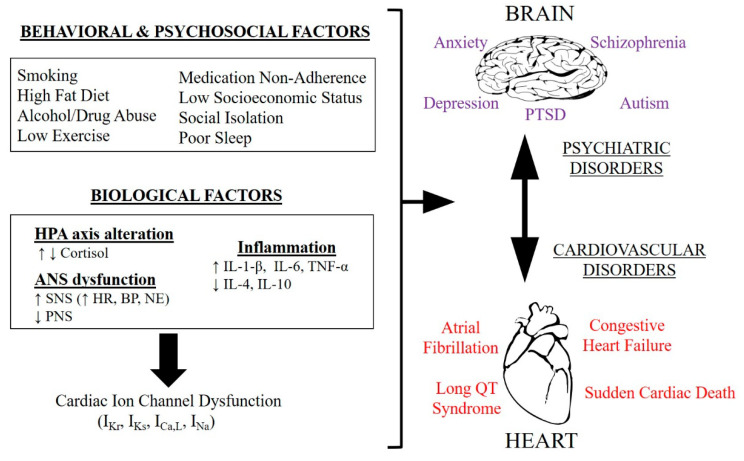
Neurological disorders including depression, anxiety, post-traumatic stress disorder (PTSD), schizophrenia, autism and epilepsy are associated with an increased incidence of cardiovascular disorders and susceptibility to heart failure. The underlying molecular mechanisms that link neurological disorders and adverse cardiac function are poorly understood. Further, a lack of progress is likely due to a paucity of studies that investigate the relationship between neurological disorders and cardiac electrical activity in health and disease. Therefore, there is an important need to understand the spatiotemporal behavior of neurocardiac mechanisms. This can be advanced through the identification and validation of neurological and cardiac signaling pathways that may be adversely regulated. In this review we highlight how dysfunction of the hypothalamic-pituitary-adrenal (HPA) axis, autonomic nervous system (ANS) activity and inflammation, predispose to psychiatric disorders and cardiac dysfunction. Moreover, antipsychotic and antidepressant medications increase the risk for adverse cardiac events, mostly through the block of the human ether-a-go-go-related gene (hERG), which plays a critical role in cardiac repolarization. Therefore, understanding how neurological disorders lead to adverse cardiac ion channel remodeling is likely to have significant implications for the development of effective therapeutic interventions and helps improve the rational development of targeted therapeutics with significant clinical implications.
神经系统疾病包括抑郁症、焦虑症、创伤后应激障碍(PTSD)、精神分裂症、自闭症和癫痫,与心血管疾病的发病率增加和心力衰竭的易感性有关。将神经系统疾病与不良心脏功能联系起来的潜在分子机制还知之甚少。此外,进展缓慢可能是由于缺乏研究来调查神经系统疾病与健康和疾病中心脏电活动之间的关系。因此,了解神经心脏机制的时空行为非常重要。这可以通过识别和验证可能受到不利调节的神经和心脏信号通路来实现。在这篇综述中,我们强调了下丘脑-垂体-肾上腺(HPA)轴、自主神经系统(ANS)活动和炎症的功能障碍如何导致精神疾病和心脏功能障碍。此外,抗精神病药和抗抑郁药会增加不良心脏事件的风险,这主要是通过阻断人类 ether-a-go-go-related 基因(hERG)来实现的,hERG 在心脏复极中起着关键作用。因此,了解神经系统疾病如何导致不良心脏离子通道重塑,很可能对开发有效的治疗干预措施具有重要意义,并有助于提高具有重要临床意义的靶向治疗药物的合理开发。