Center for Integrative Medicine, Faculty of Health, University of Witten/Herdecke, Gerhard Kienle Weg 4, Herdecke D-58313, Germany.
BMC Complement Altern Med. 2013 Jun 3;13:125. doi: 10.1186/1472-6882-13-125.
The aim of this publication is to present a case study of how to locate and appraise qualitative studies for the conduct of a meta-ethnography in the field of complementary and alternative medicine (CAM). CAM is commonly associated with individualized medicine. However, one established scientific approach to the individual, qualitative research, thus far has been explicitly used very rarely. This article demonstrates a case example of how qualitative research in the field of CAM studies was identified and critically appraised.
Several search terms and techniques were tested for the identification and appraisal of qualitative CAM research in the conduct of a meta-ethnography. Sixty-seven electronic databases were searched for the identification of qualitative CAM trials, including CAM databases, nursing, nutrition, psychological, social, medical databases, the Cochrane Library and DIMDI.
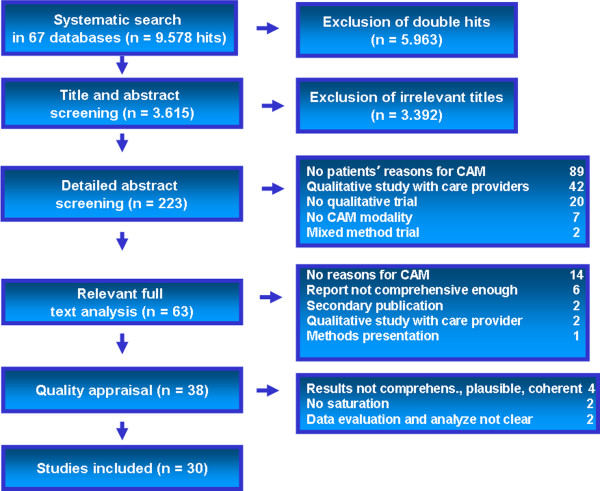
9578 citations were screened, 223 articles met the pre-specified inclusion criteria, 63 full text publications were reviewed, 38 articles were appraised qualitatively and 30 articles were included. The search began with PubMed, yielding 87% of the included publications of all databases with few additional relevant findings in the specific databases. CINHAL and DIMDI also revealed a high number of precise hits. Although CAMbase and CAM-QUEST® focus on CAM research only, almost no hits of qualitative trials were found there. Searching with broad text terms was the most effective search strategy in all databases.
This publication presents a case study on how to locate and appraise qualitative studies in the field of CAM. The example shows that the literature search for qualitative studies in the field of CAM is most effective when the search is begun in PubMed followed by CINHAL or DIMDI using broad text terms. Exclusive CAM databases delivered no additional findings to locate qualitative CAM studies.
本出版物旨在展示一个案例研究,说明如何在补充和替代医学(CAM)领域定位和评估定性研究,以进行元民族志研究。CAM 通常与个体化医学相关。然而,到目前为止,一种针对个体的既定科学方法,即定性研究,很少被明确使用。本文展示了一个案例,说明如何在 CAM 研究领域中确定和批判性评估定性研究。
为了进行元民族志研究,我们测试了几种搜索术语和技术,以确定和评估 CAM 定性研究。为了确定定性 CAM 试验,我们在 67 个电子数据库中进行了搜索,包括 CAM 数据库、护理、营养、心理、社会、医学数据库、Cochrane 图书馆和 DIMDI。
共筛选了 9578 条引文,符合预先规定的纳入标准的有 223 篇文章,对 63 篇全文出版物进行了审查,对 38 篇文章进行了定性评估,纳入了 30 篇文章。搜索从 PubMed 开始,从所有数据库中产生了 87%的纳入文献,而在特定数据库中仅发现了少数其他相关发现。CINHAL 和 DIMDI 也显示出了大量精确的命中。尽管 CAMbase 和 CAM-QUEST®仅专注于 CAM 研究,但几乎没有在那里找到定性试验的命中。在所有数据库中,使用广泛的文本术语进行搜索是最有效的搜索策略。
本出版物展示了一个案例研究,说明如何在 CAM 领域定位和评估定性研究。该示例表明,在 PubMed 中开始搜索后,使用 CINHAL 或 DIMDI 并使用广泛的文本术语,对 CAM 领域的定性研究进行文献搜索最为有效。独家的 CAM 数据库没有提供额外的发现来定位定性 CAM 研究。