School of Psychology and Clinical Language Sciences, Centre for Integrative Neuroscience and Neurodynamics, University of Reading Reading, UK.
Front Hum Neurosci. 2013 May 23;7:174. doi: 10.3389/fnhum.2013.00174. eCollection 2013.
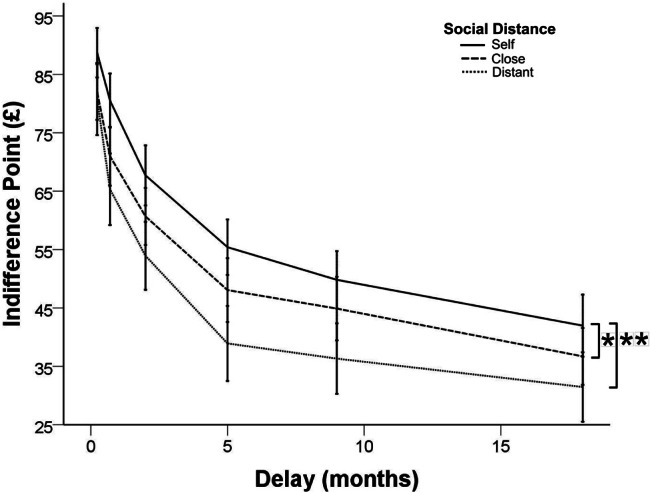
As social animals, we regularly act in the interest of others by making decisions on their behalf. These decisions can take the form of choices between smaller short-term rewards and larger long-term rewards, and can be effectively indexed by temporal discounting (TD). In a TD paradigm, a reward loses subjective value with increasing delay presumably because it becomes more difficult to simulate how much the recipient (e.g., future self) will value it. If this is the case, then the value of delayed rewards should be discounted even more steeply when we are choosing for someone whose feelings we do not readily simulate, such as socially distant strangers. Second, the ability to simulate shows individual differences and is indexed by trait empathy. We hypothesized that individuals high in trait empathy will more readily simulate, and hence discount less steeply for distant others, compared to those who are low on trait empathy. To test these predictions, we asked 63 participants from the general population to perform a TD task from the perspectives of close and distant others, as well as their own. People were found to discount less steeply for themselves, and the steepness of TD increased with increasing distance from self. Additionally, individuals who scored high in trait empathy were found to discount less steeply for distant others compared to those who scored low. These findings confirm the role of empathy in determining how we choose rewards for others.
作为社会动物,我们经常代表他人做出决策,以符合他们的利益。这些决策可以表现为在较小的短期奖励和较大的长期奖励之间进行选择,并且可以通过时间折扣(TD)有效地进行索引。在 TD 范式中,奖励的主观价值随着延迟的增加而降低,这可能是因为我们越来越难以模拟接受者(例如,未来的自我)将对其的重视程度。如果是这样,那么当我们为那些我们不容易模拟其感受的人(例如,社交距离较远的陌生人)做出选择时,延迟奖励的价值应该会更加陡峭地贴现。其次,模拟能力存在个体差异,并由特质同理心来衡量。我们假设,与低特质同理心的人相比,高特质同理心的个体更容易模拟,因此对远方他人的贴现率较低。为了检验这些预测,我们要求来自普通人群的 63 名参与者从亲密他人和远方他人的角度,以及从自己的角度来执行 TD 任务。结果发现,人们对自己的贴现率较低,TD 的陡峭程度随着与自我的距离增加而增加。此外,高特质同理心的个体对远方他人的贴现率低于低特质同理心的个体。这些发现证实了同理心在决定我们如何为他人选择奖励方面的作用。