Searle Chemistry Laboratory, Computation Institute, University of Chicago Chicago, IL, USA ; Computing, Environment and Life Sciences, Argonne National Laboratory Chicago, IL, USA.
Front Microbiol. 2013 May 22;4:136. doi: 10.3389/fmicb.2013.00136. eCollection 2013.
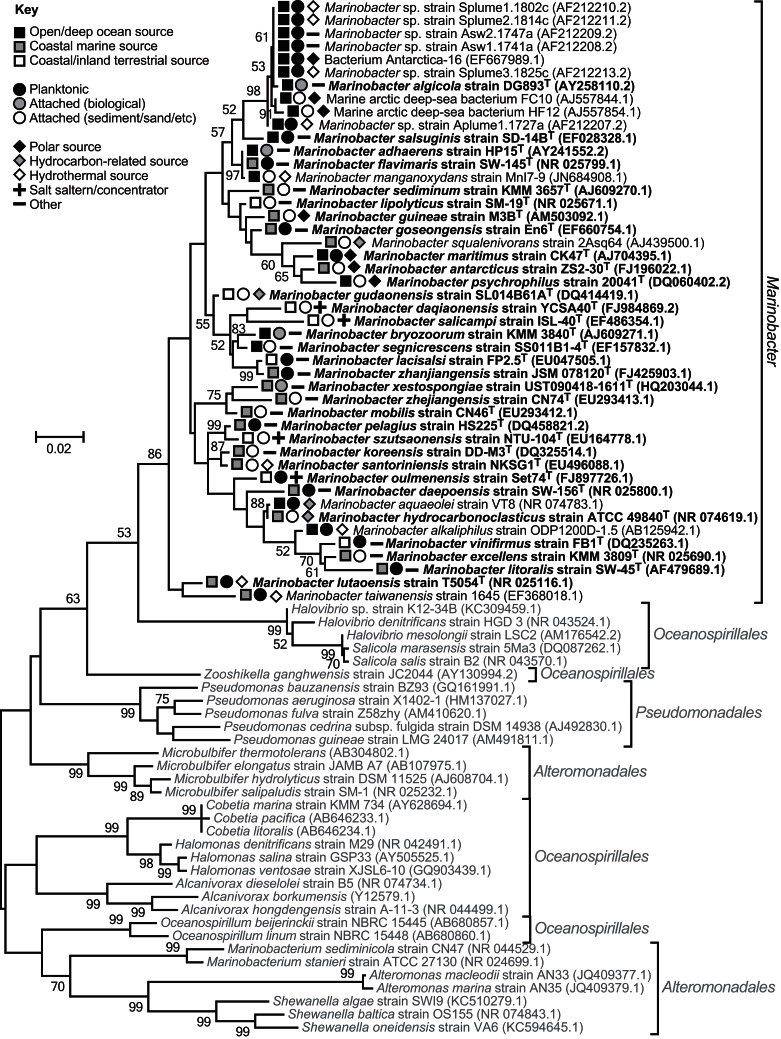
The Marinobacter genus comprises widespread marine bacteria, found in localities as diverse as the deep ocean, coastal seawater and sediment, hydrothermal settings, oceanic basalt, sea-ice, sand, solar salterns, and oil fields. Terrestrial sources include saline soil and wine-barrel-decalcification wastewater. The genus was designated in 1992 for the Gram-negative, hydrocarbon-degrading bacterium Marinobacter hydrocarbonoclasticus. Since then, a further 31 type strains have been designated. Nonetheless, the metabolic range of many Marinobacter species remains largely unexplored. Most species have been classified as aerobic heterotrophs, and assessed for limited anaerobic pathways (fermentation or nitrate reduction), whereas studies of low-temperature hydrothermal sediments, basalt at oceanic spreading centers, and phytoplankton have identified species that possess a respiratory repertoire with significant biogeochemical implications. Notable physiological traits include nitrate-dependent Fe(II)-oxidation, arsenic and fumarate redox cycling, and Mn(II) oxidation. There is also evidence for Fe(III) reduction, and metal(loid) detoxification. Considering the ubiquity and metabolic capabilities of the genus, Marinobacter species may perform an important and underestimated role in the biogeochemical cycling of organics and metals in varied marine habitats, and spanning aerobic-to-anoxic redox gradients.
海洋盐杆菌属包含广泛分布的海洋细菌,存在于多种多样的环境中,包括深海、沿海海水和沉积物、热液环境、海洋玄武岩、海冰、沙子、太阳能盐场和油田。陆地来源包括盐渍土和酒桶脱钙废水。该属于 1992 年因革兰氏阴性、烃类降解细菌 Marinobacter hydrocarbonoclasticus 而被指定。此后,又指定了 31 个模式菌株。尽管如此,许多海洋盐杆菌属物种的代谢范围在很大程度上仍未被探索。大多数物种被归类为需氧异养生物,并评估了有限的厌氧途径(发酵或硝酸盐还原),而对低温热液沉积物、海洋扩张中心的玄武岩和浮游植物的研究表明,一些物种具有具有重要生物地球化学意义的呼吸谱。值得注意的生理特征包括硝酸盐依赖的 Fe(II)氧化、砷和富马酸氧化还原循环以及 Mn(II)氧化。也有铁(III)还原和金属(类)解毒的证据。考虑到该属的普遍性和代谢能力,海洋盐杆菌属的物种可能在各种海洋生境中有机物和金属的生物地球化学循环中发挥着重要而被低估的作用,跨越需氧到缺氧的氧化还原梯度。