Institute of Public Health, University of Heidelberg, Heidelberg, Germany.
Glob Health Action. 2013 Jun 3;6:20472. doi: 10.3402/gha.v6i0.20472.
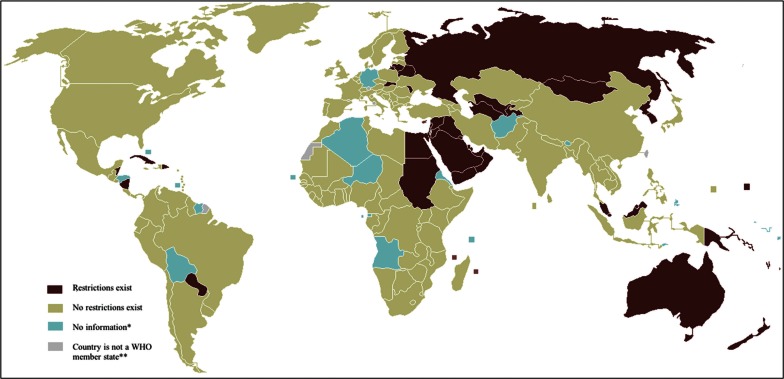
Increasingly, HIV-seropositive individuals cross international borders. HIV-related restrictions on entry, stay, and residence imposed by countries have important consequences for this mobile population. Our aim was to describe the geographical distribution of countries with travel restrictions and to examine the trends and characteristics of countries with such restrictions.
In 2011, data presented to UNAIDS were used to establish a list of countries with and without HIV restrictions on entry, stay, and residence and to describe their geographical distribution. The following indicators were investigated to describe the country characteristics: population at mid-year, international migrants as a percentage of the population, Human Development Index, estimated HIV prevalence (age: 15-49), presence of a policy prohibiting HIV screening for general employment purposes, government and civil society responses to having non-discrimination laws/regulations which specify migrants/mobile populations, government and civil society responses to having laws/regulations/policies that present obstacles to effective HIV prevention, treatment, care, and support for migrants/mobile populations, Corruption Perception Index, and gross national income per capita.
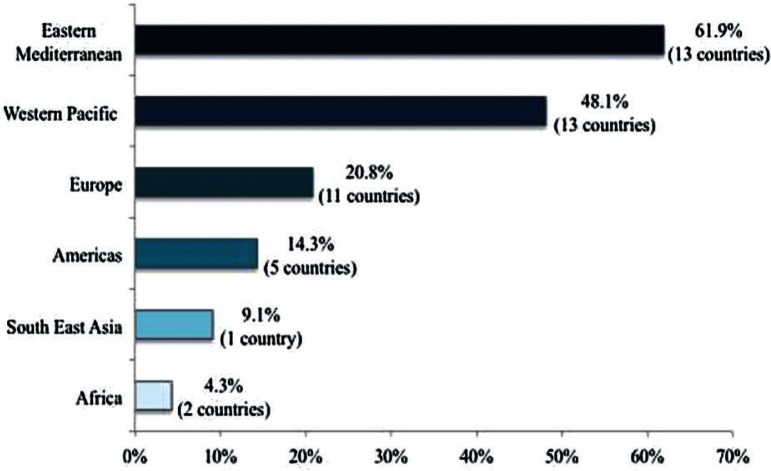
HIV-related restrictions exist in 45 out of 193 WHO countries (23%) in all regions of the world. We found that the Eastern Mediterranean and Western Pacific Regions have the highest proportions of countries with these restrictions. Our analyses showed that countries that have opted for restrictions have the following characteristics: smaller populations, higher proportions of migrants in the population, lower HIV prevalence rates, and lack of legislation protecting people living with HIV from screening for employment purposes, compared with countries without restrictions.
Countries with a high proportion of international migrants tend to have travel restrictions - a finding that is relevant to migrant populations and travel medicine providers alike. Despite international pressure to remove travel restrictions, many countries continue to implement these restrictions for HIV-positive individuals on entry and stay. Since 2010, the United States and China have engaged in high profile removals. This may be indicative of an increasing trend, facilitated by various factors, including international advocacy and the setting of a UNAIDS goal to halve the number of countries with restrictions by 2015.
越来越多的 HIV 阳性个体跨越国际边界。各国对入境、停留和居住施加的与 HIV 相关的限制对这一流动人群产生了重要影响。我们的目的是描述对入境、停留和居住有 HIV 限制的国家的地理分布,并研究这些国家限制的趋势和特征。
2011 年,使用向联合国艾滋病规划署提交的数据,建立了一份有和没有 HIV 入境、停留和居住限制的国家名单,并描述了它们的地理分布。为了描述国家特征,我们研究了以下指标:年中人口、国际移民占人口的百分比、人类发展指数、估计的 HIV 流行率(年龄:15-49 岁)、存在禁止出于一般就业目的进行 HIV 筛查的政策、政府和民间社会对具有非歧视法律/法规的反应,这些法律/法规具体规定了移民/流动人口、政府和民间社会对具有法律/法规/政策的反应,这些法律/法规/政策对移民/流动人口的有效艾滋病毒预防、治疗、护理和支持构成障碍、腐败感知指数以及人均国民总收入。
在全球所有地区的 193 个世卫组织国家中,有 45 个国家(23%)存在与 HIV 相关的限制。我们发现,东地中海和西太平洋地区的国家比例最高。我们的分析表明,选择限制的国家具有以下特征:人口较少、人口中移民比例较高、HIV 流行率较低、以及缺乏保护艾滋病毒感染者免受就业目的筛查的立法,与没有限制的国家相比。
拥有大量国际移民的国家往往会有旅行限制——这一发现与移民群体和旅行医学提供者都有关。尽管国际上要求取消旅行限制,但许多国家仍在对入境和停留的 HIV 阳性个体实施这些限制。自 2010 年以来,美国和中国已高调取消了这些限制。这可能表明,在各种因素的推动下,包括国际宣传和设定到 2015 年将实施限制的国家数量减少一半的联合国艾滋病规划署目标,这种趋势正在增加。