Newmann Sara J, Mishra Kavita, Onono Maricianah, Bukusi Elizabeth A, Cohen Craig R, Gage Olivia, Odeny Rose, Schwartz Katie D, Grossman Daniel
Department of Obstetrics, Gynecology and Reproductive Sciences, University of California, San Francisco, San Francisco General Hospital, 1001 Potrero Avenue, Ward 6D-14, San Francisco, CA 94110, USA.
AIDS Res Treat. 2013;2013:915923. doi: 10.1155/2013/915923. Epub 2013 May 2.
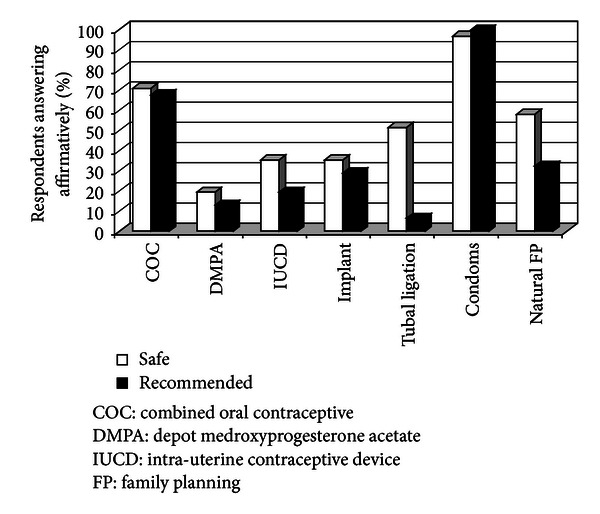
Objective. To inform an intervention integrating family planning into HIV care, family planning (FP) knowledge, attitudes and practices, and perspectives on integrating FP into HIV care were assessed among healthcare providers in Nyanza Province, Kenya. Methods. Thirty-one mixed-method, structured interviews were conducted among a purposive sample of healthcare workers (HCWs) from 13 government HIV care facilities in Nyanza Province. Structured questions and case scenarios assessed contraceptive knowledge, training, and FP provision experience. Open-ended questions explored perspectives on integration. Data were analyzed descriptively and qualitatively. Results. Of the 31 HCWs interviewed, 45% reported previous FP training. Few providers thought long-acting methods were safe for HIV-positive women (19% viewed depot medroxyprogesterone acetate as safe and 36% viewed implants and intrauterine contraceptives as safe); fewer felt comfortable recommending them to HIV-positive women. Overall, providers supported HIV and family planning integration, yet several potential barriers were identified including misunderstandings about contraceptive safety, gendered power differentials relating to fertility decisions, staff shortages, lack of FP training, and contraceptive shortages. Conclusions. These findings suggest the importance of considering issues such as patient flow, provider burden, commodity supply, gender and cultural issues affecting FP use, and provider training in FP/HIV when designing integrated FP/HIV services in high HIV prevalence areas.
目的。为一项将计划生育纳入艾滋病护理的干预措施提供信息,对肯尼亚尼扬扎省医疗服务提供者的计划生育(FP)知识、态度和做法以及将计划生育纳入艾滋病护理的观点进行了评估。方法。对来自尼扬扎省13家政府艾滋病护理机构的医护人员(HCWs)进行了31次混合方法的结构化访谈。结构化问题和案例情景评估了避孕知识、培训和计划生育服务提供经验。开放式问题探讨了关于整合的观点。对数据进行了描述性和定性分析。结果。在接受访谈的31名医护人员中,45%报告曾接受过计划生育培训。很少有提供者认为长效方法对艾滋病毒阳性女性是安全的(19%认为醋酸甲羟孕酮注射液是安全的,36%认为植入物和宫内避孕药是安全的);更少有人愿意向艾滋病毒阳性女性推荐这些方法。总体而言,提供者支持艾滋病和计划生育的整合,但也发现了一些潜在障碍,包括对避孕安全性的误解、与生育决策相关的性别权力差异、人员短缺、缺乏计划生育培训以及避孕药具短缺。结论。这些发现表明,在艾滋病高流行地区设计综合的计划生育/艾滋病服务时,考虑诸如患者流程、提供者负担、商品供应、影响计划生育使用的性别和文化问题以及提供者在计划生育/艾滋病方面的培训等问题非常重要。