Singh Gopal K, Azuine Romuladus E, Siahpush Mohammad
US Department of Health and Human Services, Health Resources and Services Administration, Maternal and Child Health Bureau, 5600 Fishers Lane, Room 18-41, Rockville, MD 20857, USA.
Adv Prev Med. 2013;2013:657961. doi: 10.1155/2013/657961. Epub 2013 May 7.
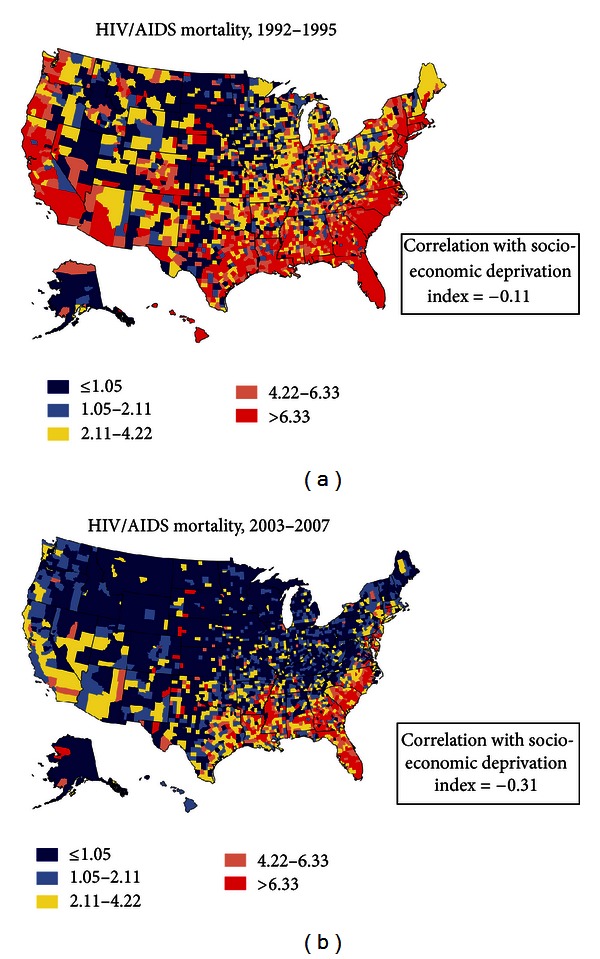
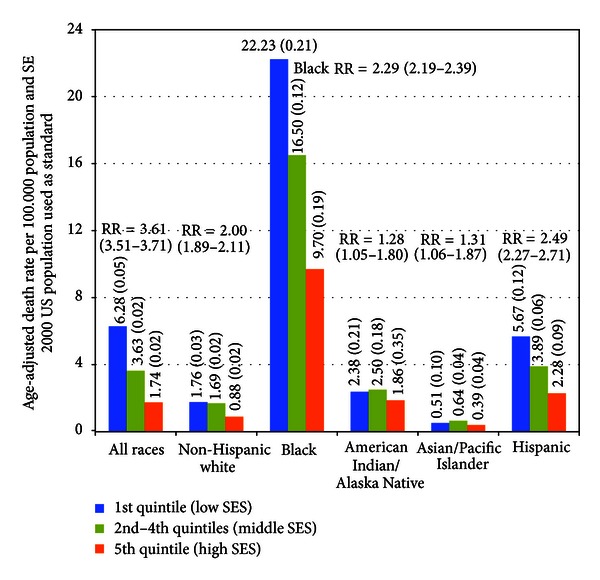
This study examined the extent to which socioeconomic and racial and geographic disparities in HIV/AIDS mortality in the United States changed between 1987 and 2011. Census-based deprivation indices were linked to county-level mortality data from 1987 to 2009. Log-linear, least-squares, and Poisson regression were used to model mortality trends and differentials. HIV/AIDS mortality rose between 1987 and 1995 and then declined markedly for all groups between 1996 and 2011. Despite the steep mortality decline, socioeconomic gradients and racial and geographic disparities in HIV/AIDS mortality increased substantially during the study period. Compared to whites, blacks had 3 times higher HIV/AIDS mortality in 1987 and 8 times higher mortality in 2011. In 1987, those in the most-deprived group had 1.9 times higher HIV/AIDS mortality than those in the most-affluent group; the corresponding relative risks increased to 2.9 in 1998 and 3.6 in 2009. Socioeconomic gradients existed across all race-sex groups, with mortality risk being 8-16 times higher among blacks than whites within each deprivation group. Dramatic reductions in HIV/AIDS mortality represent a major public health success. However, slower mortality declines among more deprived groups and blacks contributed to the widening gap. Mortality disparities reflect inequalities in incidence, access to antiretroviral therapy, and patient survival.
本研究调查了1987年至2011年间美国艾滋病毒/艾滋病死亡率方面的社会经济、种族和地理差异的变化程度。基于人口普查的贫困指数与1987年至2009年的县级死亡率数据相关联。使用对数线性、最小二乘法和泊松回归对死亡率趋势和差异进行建模。1987年至1995年间艾滋病毒/艾滋病死亡率上升,然后在1996年至2011年间所有群体的死亡率均显著下降。尽管死亡率急剧下降,但在研究期间,艾滋病毒/艾滋病死亡率方面的社会经济梯度以及种族和地理差异大幅增加。与白人相比,黑人在1987年的艾滋病毒/艾滋病死亡率高出3倍,在2011年高出8倍。1987年,最贫困群体的艾滋病毒/艾滋病死亡率比最富裕群体高出1.9倍;相应的相对风险在1998年增至2.9,在2009年增至3.6。所有种族-性别群体都存在社会经济梯度,在每个贫困群体中,黑人的死亡风险比白人高8至16倍。艾滋病毒/艾滋病死亡率的大幅下降是一项重大的公共卫生成就。然而,较贫困群体和黑人的死亡率下降较慢导致了差距的扩大。死亡率差异反映了发病率、获得抗逆转录病毒疗法的机会和患者生存率方面的不平等。