Laboratório de Farmacologia e Neurobiologia, UMIB, Instituto de Ciências Biomédicas Abel Salazar (ICBAS)-Universidade do Porto (UP), Porto, Portugal.
PLoS One. 2013 May 31;8(5):e64696. doi: 10.1371/journal.pone.0064696. Print 2013.
Nowadays, there is a considerable bulk of evidence showing that ATP has a prominent role in the regulation of human urinary bladder function and in the pathophysiology of detrusor overactivity. ATP mediates nonadrenergic-noncholinergic detrusor contractions in overactive bladders. In vitro studies have demonstrated that uroepithelial cells and cholinergic nerves from overactive human bladder samples (OAB) release more ATP than controls. Here, we compared the urinary ATP concentration in samples collected non-invasively from OAB women with detrusor overactivity and age-matched controls.
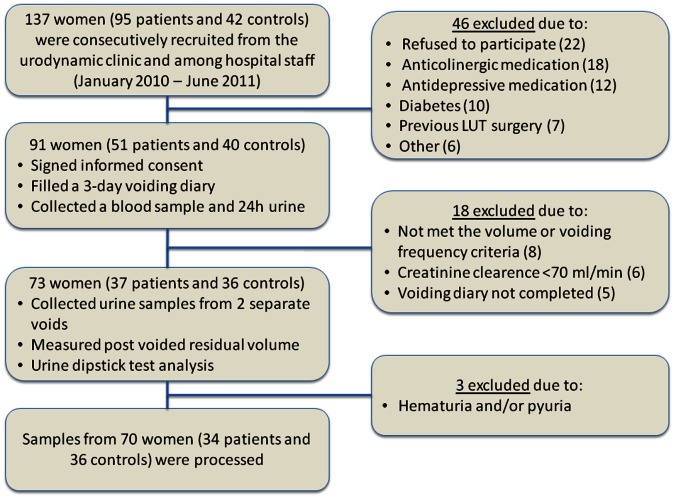
Patients with neurologic diseases, history of malignancy, urinary tract infections or renal impairment (creatinine clearance <70 ml/min) were excluded. All patients completed a 3-day voiding diary, a 24 h urine collection and blood sampling to evaluate creatinine clearance. Urine samples collected during voluntary voids were immediately freeze-preserved for ATP determination by the luciferin-luciferase bioluminescence assay; for comparison purposes, samples were also tested for urinary nerve growth factor (NGF) by ELISA.
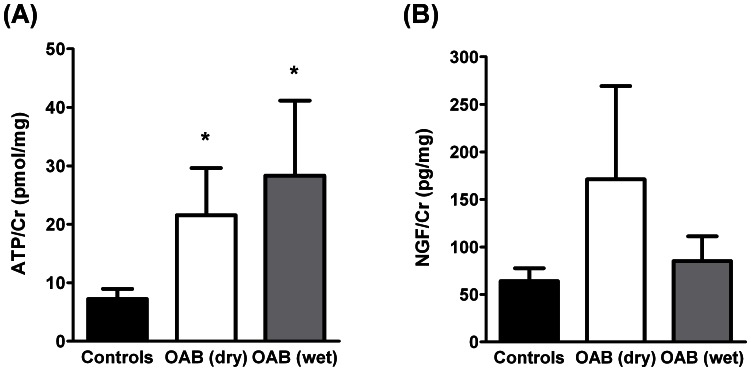
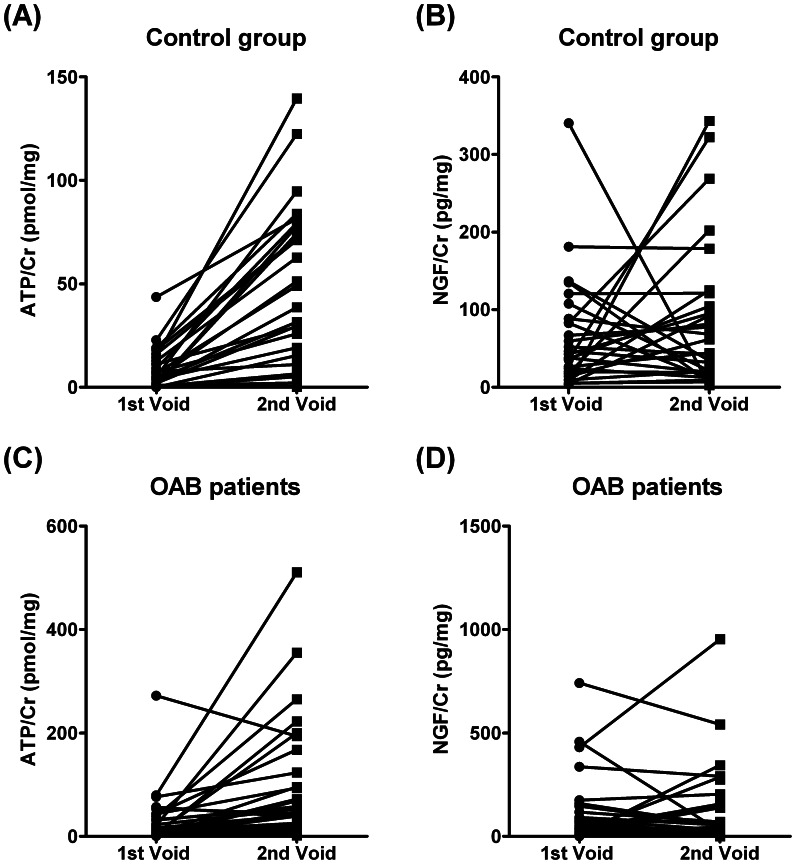
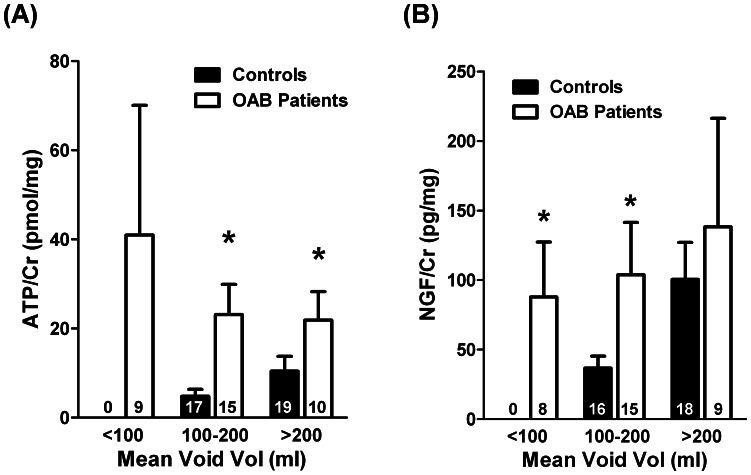
The urinary content of ATP, but not of NGF, normalized to patients' urine creatinine levels (ATP/Cr) or urinary volume (ATP.Vol) were significantly (P<0.05) higher in OAB women with detrusor overactivity (n = 34) than in healthy controls (n = 30). Significant differences between the two groups were still observed by boosting urinary ATP/Cr content after water intake, but these were not detected for NGF/Cr. In OAB patients, urinary ATP/Cr levels correlated inversely with mean voided volumes determined in a 3-day voiding diary.
A high area under the receiver operator characteristics (ROC) curve (0.741; 95% CI 0.62-0.86; P<0.001) is consistent with urinary ATP/Cr being a highly sensitive dynamic biomarker for assessing detrusor overactivity in women with OAB syndrome.
如今,有相当多的证据表明,ATP 在调节人类膀胱功能和逼尿肌过度活动的病理生理学方面起着重要作用。ATP 介导过度活动的膀胱中非肾上腺素能-非胆碱能逼尿肌收缩。体外研究表明,来自过度活动的人膀胱样本(OAB)的尿上皮细胞和胆碱能神经比对照释放更多的 ATP。在这里,我们比较了从患有逼尿肌过度活动的 OAB 女性和年龄匹配的对照者中非侵入性收集的尿液样本中的尿 ATP 浓度。
排除患有神经疾病、恶性肿瘤病史、尿路感染或肾功能不全(肌酐清除率<70ml/min)的患者。所有患者均完成了 3 天的排尿日记、24 小时尿液收集和血液采样以评估肌酐清除率。在自愿排尿期间收集的尿液样本立即通过荧光素-荧光素酶生物发光测定法冷冻保存以测定 ATP;为了比较目的,还通过 ELISA 测定尿液神经生长因子(NGF)。
与健康对照组(n=30)相比,逼尿肌过度活动的 OAB 女性(n=34)的尿 ATP 含量(但不是 NGF)归一化至患者的尿肌酐水平(ATP/Cr)或尿体积(ATP.Vol)明显更高(P<0.05)。两组之间的差异在摄入水后增加尿 ATP/Cr 含量后仍然存在,但未检测到 NGF/Cr。在 OAB 患者中,尿 ATP/Cr 水平与 3 天排尿日记中确定的平均排尿量呈负相关。
高受试者工作特征曲线下面积(0.741;95%CI 0.62-0.86;P<0.001)表明尿 ATP/Cr 是评估 OAB 综合征女性逼尿肌过度活动的高度敏感的动态生物标志物。