Division of Integrative Omics and Bioinformatics, National Cancer Centre, Tokyo, Japan.
Exp Mol Med. 2013 Jun 7;45(6):e26. doi: 10.1038/emm.2013.49.
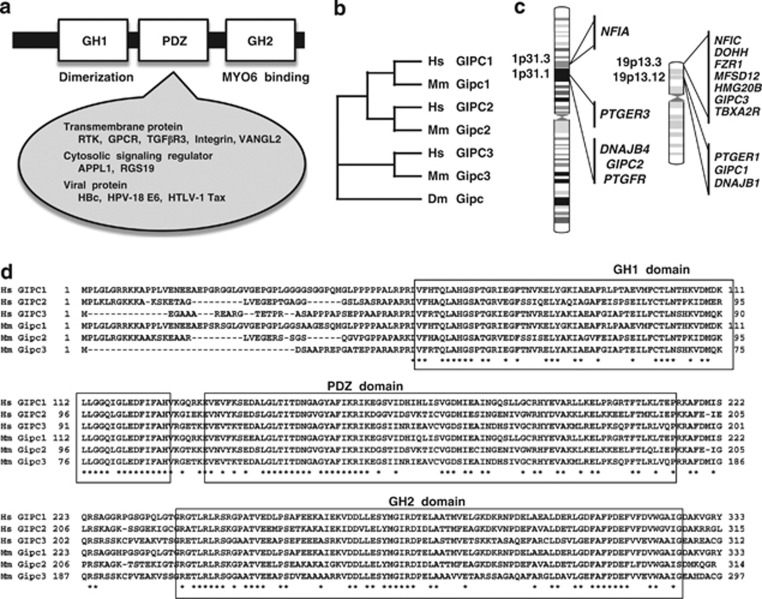
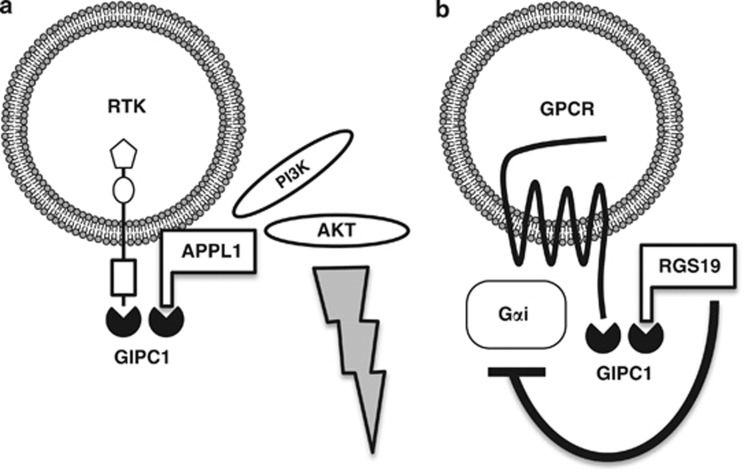
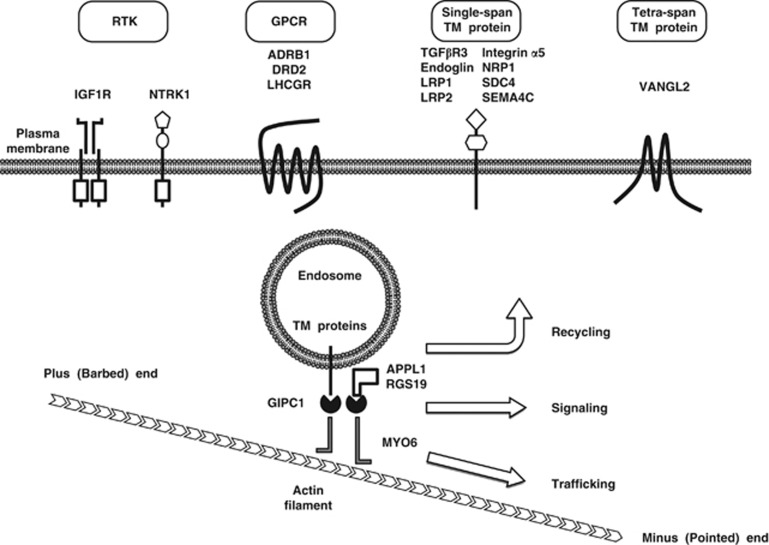
GIPC1, GIPC2 and GIPC3 consist of GIPC homology 1 (GH1) domain, PDZ domain and GH2 domain. The regions around the GH1 and GH2 domains of GIPC1 are involved in dimerization and interaction with myosin VI (MYO6), respectively. The PDZ domain of GIPC1 is involved in interactions with transmembrane proteins [IGF1R, NTRK1, ADRB1, DRD2, TGFβR3 (transforming growth factorβ receptor type III), SDC4, SEMA4C, LRP1, NRP1, GLUT1, integrin α5 and VANGL2], cytosolic signaling regulators (APPL1 and RGS19) and viral proteins (HBc and HPV-18 E6). GIPC1 is an adaptor protein with dimerizing ability that loads PDZ ligands as cargoes for MYO6-dependent endosomal trafficking. GIPC1 is required for cell-surface expression of IGF1R and TGFβR3. GIPC1 is also required for integrin recycling during cell migration, angiogenesis and cytokinesis. On early endosomes, GIPC1 assembles receptor tyrosine kinases (RTKs) and APPL1 for activation of PI3K-AKT signaling, and G protein-coupled receptors (GPCRs) and RGS19 for attenuation of inhibitory Gα signaling. GIPC1 upregulation in breast, ovarian and pancreatic cancers promotes tumor proliferation and invasion, whereas GIPC1 downregulation in cervical cancer with human papillomavirus type 18 infection leads to resistance to cytostatic transforming growth factorβ signaling. GIPC2 is downregulated in acute lymphocytic leukemia owing to epigenetic silencing, while Gipc2 is upregulated in estrogen-induced mammary tumors. Somatic mutations of GIPC2 occur in malignant melanoma, and colorectal and ovarian cancers. Germ-line mutations of the GIPC3 or MYO6 gene cause nonsyndromic hearing loss. As GIPC proteins are involved in trafficking, signaling and recycling of RTKs, GPCRs, integrins and other transmembrane proteins, dysregulation of GIPCs results in human pathologies, such as cancer and hereditary deafness.
GIPC1、GIPC2 和 GIPC3 由 GIPC 同源结构域 1(GH1)域、PDZ 结构域和 GH2 域组成。GIPC1 的 GH1 和 GH2 结构域周围的区域分别参与二聚化和与肌球蛋白 VI(MYO6)的相互作用。GIPC1 的 PDZ 结构域参与与跨膜蛋白[IGF1R、NTRK1、ADRB1、DRD2、TGFβR3(转化生长因子β受体 III)、SDC4、SEMA4C、LRP1、NRP1、GLUT1、整合素α5 和 VANGL2]、细胞质信号调节剂(APPL1 和 RGS19)和病毒蛋白(HBc 和 HPV-18 E6)的相互作用。GIPC1 是一种具有二聚化能力的衔接蛋白,可将 PDZ 配体作为 MYO6 依赖性内体运输的货物加载。GIPC1 是 IGF1R 和 TGFβR3 细胞表面表达所必需的。GIPC1 还需要在细胞迁移、血管生成和胞质分裂过程中进行整合素回收。在早期内体上,GIPC1 组装受体酪氨酸激酶(RTKs)和 APPL1 以激活 PI3K-AKT 信号通路,以及 G 蛋白偶联受体(GPCR)和 RGS19 以减弱抑制性 Gα 信号。在乳腺癌、卵巢癌和胰腺癌中 GIPC1 的上调促进肿瘤增殖和侵袭,而在人乳头瘤病毒 18 感染的宫颈癌中 GIPC1 的下调导致对细胞抑制转化生长因子β信号的抵抗。由于表观遗传沉默,急性淋巴细胞白血病中 GIPC2 的表达下调,而雌激素诱导的乳腺肿瘤中 Gipc2 的表达上调。GIPC2 的体细胞突变发生在恶性黑色素瘤、结直肠癌和卵巢癌中。GIPC3 或 MYO6 基因的种系突变导致非综合征性听力损失。由于 GIPC 蛋白参与 RTKs、GPCR、整合素和其他跨膜蛋白的运输、信号转导和回收,GIPC 失调导致人类病理,如癌症和遗传性耳聋。