UMR INRA-UDS Virus-Vection Group Colmar, France.
Front Plant Sci. 2013 May 24;4:154. doi: 10.3389/fpls.2013.00154. eCollection 2013.
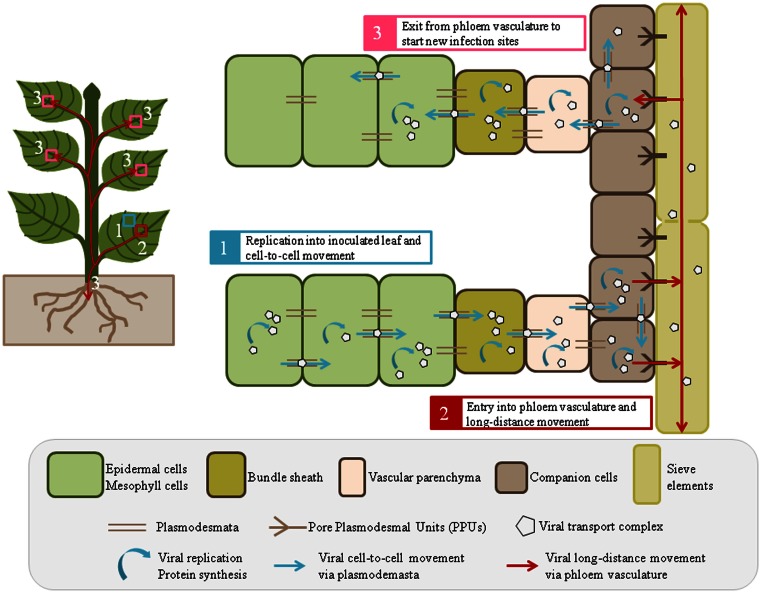
Phloem transport of plant viruses is an essential step in the setting-up of a complete infection of a host plant. After an initial replication step in the first cells, viruses spread from cell-to-cell through mesophyll cells, until they reach the vasculature where they rapidly move to distant sites in order to establish the infection of the whole plant. This last step is referred to as systemic transport, or long-distance movement, and involves virus crossings through several cellular barriers: bundle sheath, vascular parenchyma, and companion cells for virus loading into sieve elements (SE). Viruses are then passively transported within the source-to-sink flow of photoassimilates and are unloaded from SE into sink tissues. However, the molecular mechanisms governing virus long-distance movement are far from being understood. While most viruses seem to move systemically as virus particles, some viruses are transported in SE as viral ribonucleoprotein complexes (RNP). The nature of the cellular and viral factors constituting these RNPs is still poorly known. The topic of this review will mainly focus on the host and viral factors that facilitate or restrict virus long-distance movement.
植物病毒的韧皮部运输是建立宿主植物完整感染的一个必要步骤。在最初的细胞内复制步骤之后,病毒通过叶肉细胞从一个细胞传播到另一个细胞,直到它们到达维管束,在那里它们迅速移动到遥远的部位,以建立对整个植物的感染。这最后一步被称为系统运输或长距离运动,涉及病毒穿过几个细胞屏障:束鞘、维管束薄壁组织和伴细胞,以便将病毒装载到筛管中 (SE)。然后,病毒在光产物的源到汇流中被动运输,并从 SE 卸载到汇组织中。然而,控制病毒长距离运动的分子机制远未被理解。虽然大多数病毒似乎作为病毒颗粒系统性地移动,但有些病毒作为病毒核糖核蛋白复合物 (RNP) 在 SE 中运输。构成这些 RNP 的细胞和病毒因子的性质仍然知之甚少。这篇综述的主题将主要集中在促进或限制病毒长距离运动的宿主和病毒因素上。