Dipartimento di Biologia, Università di Padova, via U. Bassi 58/B, 35131 Padova, Italy.
BMC Microbiol. 2013 Jun 10;13:129. doi: 10.1186/1471-2180-13-129.
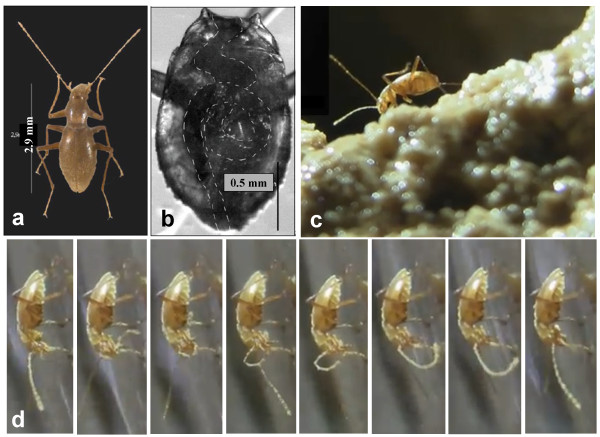
Cansiliella servadeii (Coleoptera) is an endemic troglobite living in deep carbonate caves in North-Eastern Italy. The beetle constantly moves and browses in its preferred habitat (consisting in flowing water and moonmilk, a soft speleothem colonized by microorganisms) self-preens to convey material from elytra, legs, and antennae towards the mouth. We investigated its inner and outer microbiota using microscopy and DNA-based approaches.
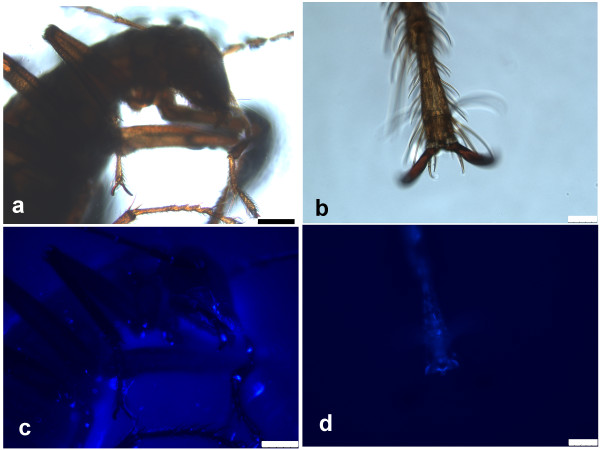
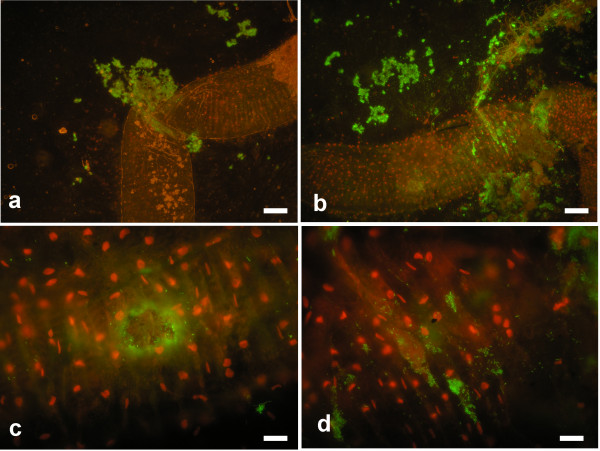
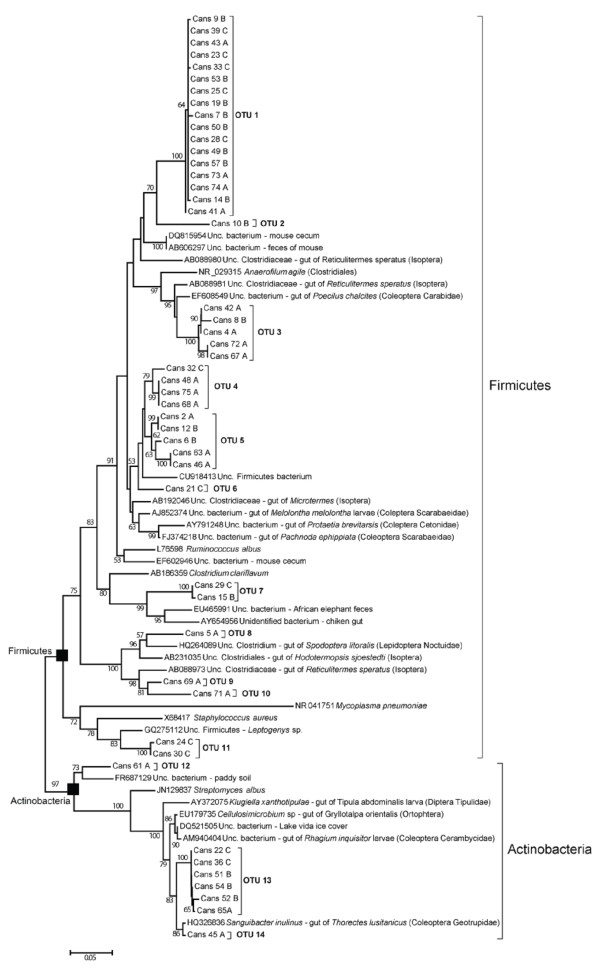
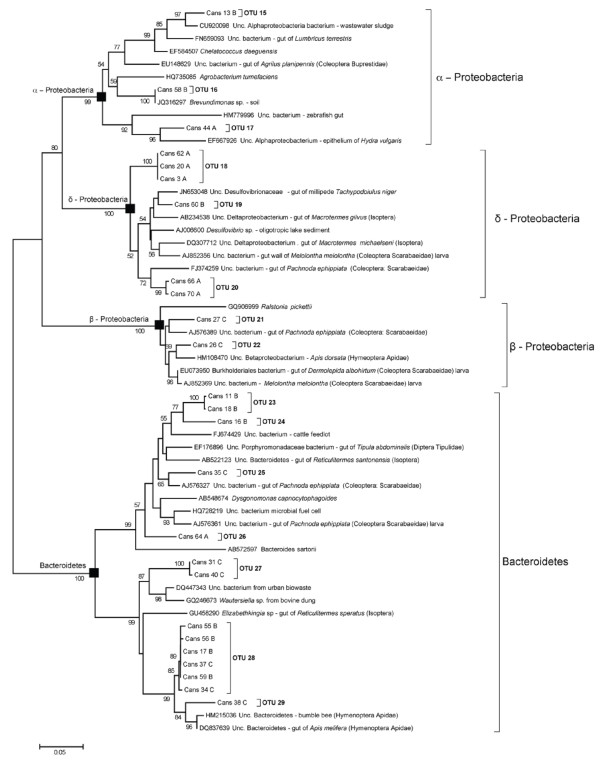
Abundant microbial cell masses were observed on the external appendages. Cansiliella's midgut is fully colonized by live microbes and culture-independent analyses yielded nearly 30 different 16S phylotypes that have no overlap with the community composition of the moonmilk. Many of the lineages, dominated by Gram positive groups, share very low similarity to database sequences. However for most cases, notwithstanding their very limited relatedness with existing records, phylotypes could be assigned to bacterial clades that had been retrieved from insect or other animals' digestive traits.
Results suggest a history of remote separation from a common ancestor that harboured a set of gut-specific bacteria whose functions are supposedly critical for host physiology. The phylogenetic and coevolutionary implications of the parallel occurrences of these prokaryotic guilds appear to apply throughout a broad spectrum of animal diversity. Their persistence and conservation underlies a possibly critical role of precise bacterial assemblages in animal-bacteria interactions.
Cansiliella servadeii(鞘翅目)是一种生活在意大利东北部深层碳酸盐洞穴中的特有地下生物。这种甲虫在其偏好的栖息地(包括流动的水和月乳石,一种由微生物殖民的软石笋)中不断移动和觅食,并用自身的外骨骼、腿和触角将物质传递到嘴部进行自我清洁。我们使用显微镜和基于 DNA 的方法研究了它的内外微生物群。
在外附肢上观察到大量微生物细胞团。Cansiliella 的中肠完全被活体微生物定植,并且非培养分析产生了近 30 个不同的 16S 类群,与月乳石的群落组成没有重叠。许多谱系,以革兰氏阳性群体为主,与数据库序列的相似度非常低。然而,对于大多数情况,尽管它们与现有记录的亲缘关系非常有限,但可以将类群分配给从昆虫或其他动物消化特征中获得的细菌类群。
结果表明,它与共同祖先的关系已经疏远了很长时间,共同祖先拥有一组肠道特异性细菌,这些细菌的功能对宿主生理学至关重要。这些原核菌群平行出现的系统发育和协同进化意义似乎适用于广泛的动物多样性。它们的持续存在和保护是精确细菌组合在动物-细菌相互作用中可能具有关键作用的基础。