Vretzakis George, Georgopoulou Stavroula, Stamoulis Konstantinos, Tassoudis Vassilios, Mikroulis Dimitrios, Giannoukas Athanasios, Tsilimingas Nikolaos, Karanikolas Menelaos
Cardiac Anesthesia Unit, Anesthesiology Clinic, University of Thessaly, Biopolis, Larissa, Greece.
J Cardiothorac Surg. 2013 Jun 7;8:145. doi: 10.1186/1749-8090-8-145.
Blood transfusions are common in cardiac surgery, but have been associated with increased morbidity and long-term mortality. Efforts to reduce blood product use during cardiac surgery include fluid restriction to minimize hemodilution, and protocols to guide transfusion decisions. INVOS is a modality that monitors brain tissue oxygen saturation, and could be useful in guiding decisions to transfuse. However, the role of INVOS (brain tissue oxygen saturation) as part of an algorithm to direct blood transfusions during cardiac surgery has not been evaluated. This study was conducted to investigate the value of INVOS as part of a protocol for blood transfusions during cardiac surgery.
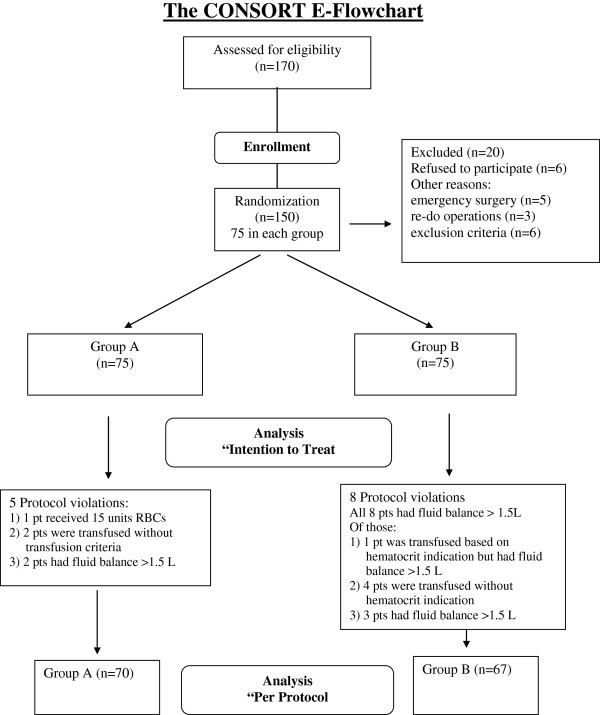
Prospective, randomized, blinded clinical trial, on 150 (75 per group) elective cardiac surgery patients. The study was approved by the Institution Ethics committee and all patients gave written informed consent. Data were initially analyzed based on "intention to treat", but subsequently were also analyzed "per protocol".
When protocol was strictly followed ("per protocol analysis"), compared to the control group, significantly fewer patients monitored with INVOS received any blood transfusions (46 of 70 patients in INVOS group vs. 55 of 67 patients in the control group, p = 0.029). Similarly, patients monitored with INVOS received significantly fewer units of red blood cell transfusions intraoperatively (0.20 ± 0.50 vs. 0.52 ± 0.88, p = 0.008) and overall during hospital stay (1.31 ± 1.20 vs. 1.82 ± 1.46, p = 0.024). When data from all patients (including patient with protocol violation) were analyzed together ("intention to treat analysis"), the observed reduction of blood transfusions in the INVOS group was still significant (51 of 75 patients transfused in the INVOS group vs. 63 of 75 patients transfused in the control group, p = 0.021), but the overall number of units transfused per patient did not differ significantly between the groups (1.55 ± 1.97 vs. 1.84 ± 1.41, p = 0.288).
Our data suggest that INVOS could be a useful tool as part of an algorithm to guide decisions for blood transfusion in cardiac surgery. Additional data from rigorous, well designed studies are needed to further evaluate the role of INVOS in guiding blood transfusions in cardiac surgery, and circumvent the limitations of this study.
输血在心脏手术中很常见,但与发病率增加和长期死亡率相关。减少心脏手术期间血液制品使用的措施包括限制液体摄入以尽量减少血液稀释,以及指导输血决策的方案。INVOS是一种监测脑组织氧饱和度的方法,可能有助于指导输血决策。然而,INVOS(脑组织氧饱和度)作为心脏手术期间指导输血算法一部分的作用尚未得到评估。本研究旨在探讨INVOS作为心脏手术输血方案一部分的价值。
对150例(每组75例)择期心脏手术患者进行前瞻性、随机、盲法临床试验。该研究经机构伦理委员会批准,所有患者均签署了书面知情同意书。数据最初基于“意向性分析”进行分析,但随后也进行了“符合方案分析”。
严格遵循方案时(“符合方案分析”),与对照组相比,使用INVOS监测的患者接受任何输血的人数显著减少(INVOS组70例患者中有46例,对照组67例患者中有55例,p = 0.029)。同样,使用INVOS监测的患者术中接受的红细胞输注单位数显著减少(0.20±0.50对0.52±0.88,p = 0.008),住院期间总体输注单位数也显著减少(1.31±1.20对1.82±1.46,p = 0.024)。当对所有患者的数据(包括违反方案的患者)进行综合分析时(“意向性分析”),INVOS组观察到的输血减少仍然显著(INVOS组75例患者中有51例输血,对照组75例患者中有63例输血,p = 0.021),但两组间每位患者的总体输注单位数无显著差异(1.55±1.97对1.84±1.41,p = 0.288)。
我们的数据表明,INVOS作为指导心脏手术输血决策算法的一部分可能是一种有用的工具。需要来自严格、精心设计研究的更多数据,以进一步评估INVOS在指导心脏手术输血中的作用,并规避本研究的局限性。