Friedland Shai, Shelton Andrew, Kothari Shivangi, Kochar Rajan, Chen Ann, Banerjee Subhas
Department of Medicine, Stanford University, Stanford, CA, USA ; Gastroenterology Section, VA Palo Alto HCS, Palo Alto, CA, USA.
Diagn Ther Endosc. 2013;2013:412936. doi: 10.1155/2013/412936. Epub 2013 May 14.
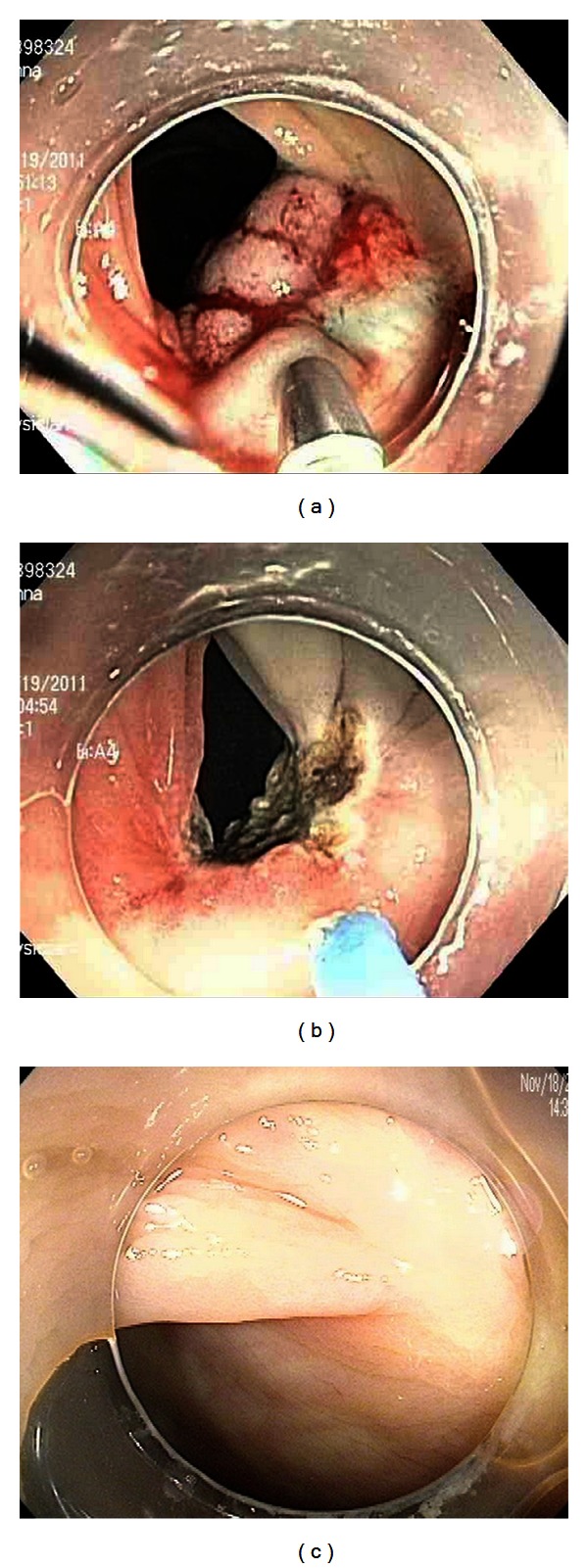
Background and Study Aims. The nonlifting polyp sign of invasive colon cancer is considered highly sensitive and specific for cancer extending beyond the mid-submucosa. However, prior interventions can cause adenomas to become nonlifting due to fibrosis. It is unclear whether nonlifting adenomas can be successfully treated endoscopically. The aim of this study was to evaluate outcomes in a referral practice incorporating a standardized protocol of attempted endoscopic resection of nonlifting lesions previously treated by biopsy, polypectomy, surgery, or tattoo placement. Patients and Methods. Retrospective review of patients undergoing colonoscopy by one endoscopist at two hospitals found to have nonlifting lesions from prior interventions. Lesions with biopsy proven invasive cancer or definite endoscopic features of invasive cancer were excluded. Lesions ≥ 8 mm were routinely injected with saline prior to attempted endoscopic resection. Polypectomy was performed using a stiff snare, followed by argon plasma coagulation (APC) if necessary. Results. 26 patients each had a single nonlifting lesion with a history of prior intervention. Endoscopic resection was completed in 25 (96%). 22 required snare resection and APC. 1 patient had invasive cancer and was referred for surgery. The recurrence rate on follow-up colonoscopy was 26%. All of the recurrences were successfully treated endoscopically. There was 1 postprocedure bleed (4%), no perforations, and no other complications. Conclusions. The majority of adenomas that are nonlifting after prior interventions can be treated successfully and safely by a combination of piecemeal polypectomy and ablation. Although recurrence rates are high at 26%, these too can be successfully treated endoscopically.
背景与研究目的。浸润性结肠癌的非抬举性息肉征象被认为对癌肿浸润超过黏膜下层中部具有高度敏感性和特异性。然而,既往干预措施可因纤维化导致腺瘤变为非抬举性。尚不清楚非抬举性腺瘤能否通过内镜成功治疗。本研究的目的是评估在一个转诊医疗实践中,采用标准化方案尝试对先前经活检、息肉切除术、手术或纹身定位治疗后出现的非抬举性病变进行内镜切除的结果。
患者与方法。对两家医院由一名内镜医师进行结肠镜检查且发现有既往干预后出现的非抬举性病变的患者进行回顾性研究。排除活检证实为浸润性癌或具有明确浸润性癌内镜特征的病变。在尝试内镜切除前,对直径≥8毫米的病变常规注射生理盐水。使用硬圈套器进行息肉切除术,必要时随后进行氩离子凝固术(APC)。
结果。26例患者均有单个既往有干预史的非抬举性病变。25例(96%)完成了内镜切除。22例需要圈套切除和APC。1例患者有浸润性癌,被转诊进行手术。随访结肠镜检查的复发率为26%。所有复发均通过内镜成功治疗。有1例术后出血(4%),无穿孔,也无其他并发症。
结论。大多数既往干预后呈非抬举性的腺瘤可通过分次息肉切除术和消融术联合成功且安全地治疗。尽管复发率高达26%,但这些复发也可通过内镜成功治疗。