Miller Larry E, Reckling W Carlton, Block Jon E
Miller Scientific Consulting Inc, Arden, NC ; The Jon Block Group, San Francisco, CA.
Med Devices (Auckl). 2013 May 29;6:77-84. doi: 10.2147/MDER.S44690. Print 2013.
The sacroiliac joint is a common but under-recognized source of low back and gluteal pain. Patients with degenerative sacroiliitis or sacroiliac joint disruption resistant to nonsurgical treatments may undergo open surgery with sacroiliac joint arthrodesis, although outcomes are mixed and risks are significant. Minimally invasive sacroiliac joint arthrodesis was developed to minimize the risk of iatrogenic injury and to improve patient outcomes compared with open surgery.
Between April 2009 and January 2013, 5319 patients were treated with the iFuse SI Joint Fusion System® for conditions including sacroiliac joint disruption and degenerative sacroiliitis. A database was prospectively developed to record all complaints reported to the manufacturer in patients treated with the iFuse device. Complaints were collected through spontaneous reporting mechanisms in support of ongoing mandatory postmarket surveillance efforts.
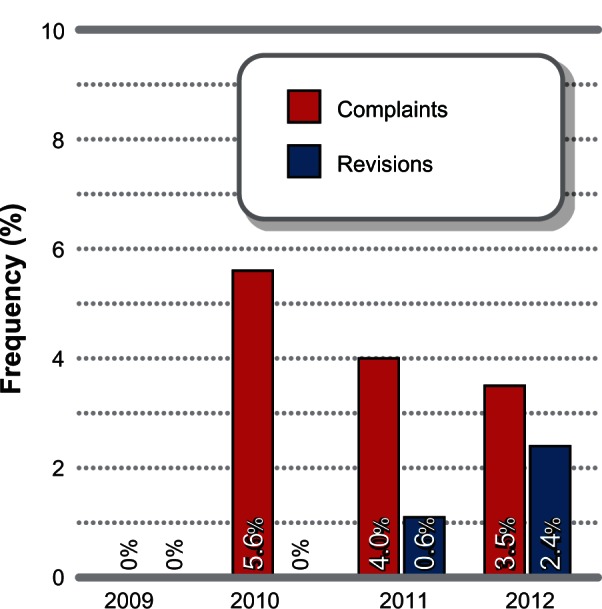
Complaints were reported in 204 (3.8%) patients treated with the iFuse system. Pain was the most commonly reported clinical complaint (n = 119, 2.2%), with nerve impingement (n = 48, 0.9%) and recurrent sacroiliac joint pain (n = 43, 0.8%) most frequently cited. All other clinical complaints were rare (≤0.2%). Ninety-six revision surgeries were performed in 94 (1.8%) patients at a median follow-up of four (range 0-30) months. Revisions were typically performed in the early postoperative period for treatment of a symptomatic malpositioned implant (n = 46, 0.9%) or to correct an improperly sized implant in an asymptomatic patient (n = 10, 0.2%). Revisions in the late postoperative period were performed to treat symptom recurrence (n = 34, 0.6%) or for continued pain of undetermined etiology (n = 6, 0.1%).
Analysis of a postmarket product complaints database demonstrates an overall low risk of complaints with the iFuse SI Joint Fusion System in patients with degenerative sacroiliitis or sacroiliac joint disruption.
骶髂关节是下背部和臀部疼痛常见但未被充分认识的疼痛来源。对于非手术治疗无效的退行性骶髂关节炎或骶髂关节损伤患者,可能会接受骶髂关节融合的开放手术,尽管手术效果不一且风险较大。与开放手术相比,微创骶髂关节融合术旨在将医源性损伤风险降至最低,并改善患者预后。
2009年4月至2013年1月期间,5319例患者接受了iFuse SI关节融合系统®治疗,治疗病症包括骶髂关节损伤和退行性骶髂关节炎。前瞻性建立了一个数据库,记录使用iFuse装置治疗的患者向制造商报告的所有投诉。投诉通过自发报告机制收集,以支持正在进行的强制性上市后监测工作。
使用iFuse系统治疗的患者中有204例(3.8%)报告了投诉。疼痛是最常报告的临床投诉(n = 119,2.2%),最常提及的是神经受压(n = 48,0.9%)和复发性骶髂关节疼痛(n = 43,0.8%)。所有其他临床投诉均很少见(≤0.2%)。94例(1.8%)患者进行了96次翻修手术,中位随访时间为4个月(范围0 - 30个月)。翻修手术通常在术后早期进行,用于治疗有症状的植入物位置不当(n = 46,0.9%)或纠正无症状患者植入物尺寸不当(n = 10,0.2%)。术后晚期进行翻修手术是为了治疗症状复发(n = 34,0.6%)或持续存在病因不明的疼痛(n = 6,0.1%)。
对上市后产品投诉数据库的分析表明,对于退行性骶髂关节炎或骶髂关节损伤患者,iFuse SI关节融合系统的投诉总体风险较低。