Global Research Laboratory, Gwangju Institute of Science and Technology-GIST, Gwangju, Korea.
PLoS One. 2013 Jun 10;8(6):e64953. doi: 10.1371/journal.pone.0064953. Print 2013.
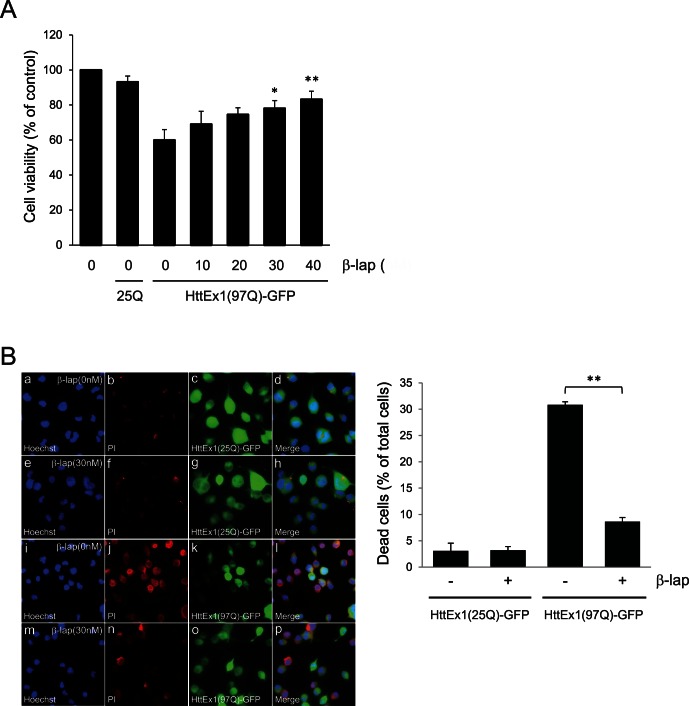
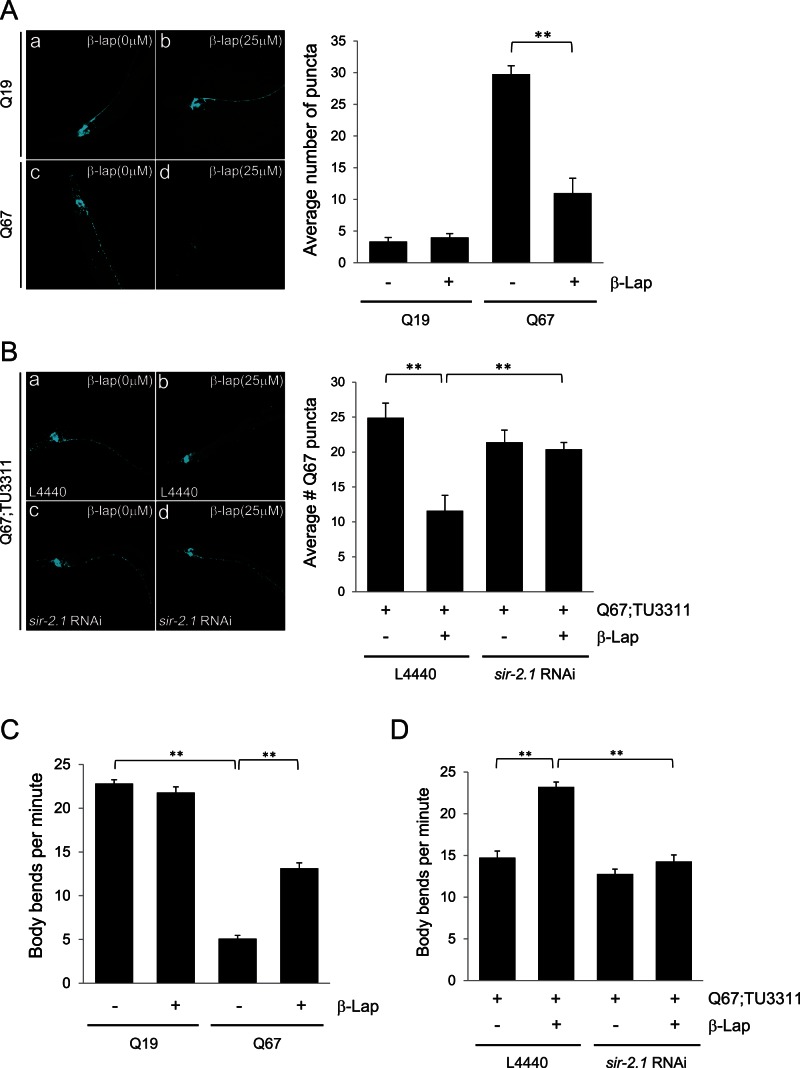
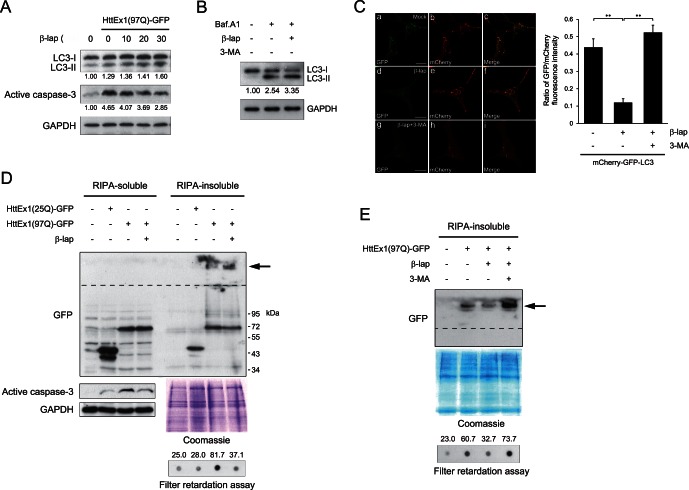
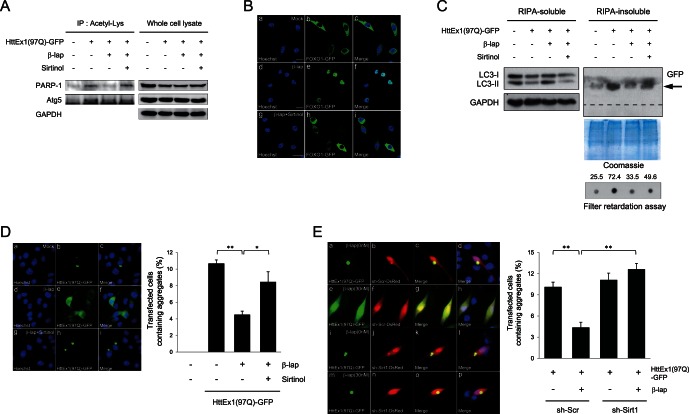
Intracellular accumulation of polyglutamine (polyQ)-expanded Huntingtin (Htt) protein is a hallmark of Huntington's disease (HD). This study evaluated whether activation of Sirt1 by the anti-cancer agent, β-lapachone (β-lap), induces autophagy in human neuroblastoma SH-SY5Y cells, thereby reducing intracellular levels of polyQ aggregates and their concomitant cytotoxicity. Treatment of cells with β-lap markedly diminished the cytotoxicity induced by forced expression of Htt exon 1 containing a pathogenic polyQ stretch fused to green fluorescent protein (HttEx1(97Q)-GFP). β-lap increased autophagy in SH-SY5Y cells, as evidenced by the increased formation of LC3-II and autolysosomes. Furthermore, β-lap reduced HttEx1(97Q)-GFP aggregation, which was significantly prevented by co-incubation with 3-methyladenine, an inhibitor of autophagy. β-lap increased Sirt1 activity, as shown by the increased deacetylation of the Sirt1 substrates, PARP-1 and Atg5, and the nuclear translocation of FOXO1. Both the induction of autophagy and attenuation of HttEx1(97Q)-GFP aggregation by β-lap were significantly prevented by co-incubation with sirtinol, a general sirtuin inhibitor or by co-transfection with shRNA against Sirt1. The pro-autophagic actions of β-lap were further investigated in a transgenic Caenorhabditis elegans (C. elegans) line that expressed Q67 fused to cyanine fluorescent protein (Q67). Notably, β-lap reduced the number of Q67 puncta and restored Q67-induced defects in motility, which were largely prevented by pre-treatment with RNAi against sir-2.1, the C. elegans orthologue of Sirt1. Collectively, these data suggest that β-lap induces autophagy through activation of Sirt1, which in turn leads to a reduction in polyQ aggregation and cellular toxicity. Thus, β-lap provides a novel therapeutic opportunity for the treatment of HD.
细胞内聚谷氨酰胺(polyQ)-扩展亨廷顿蛋白(Htt)的积累是亨廷顿病(HD)的一个标志。本研究评估了抗癌药物β-拉帕醌(β-lap)是否通过激活 Sirt1 在人神经母细胞瘤 SH-SY5Y 细胞中诱导自噬,从而降低细胞内聚 Q 聚集体及其伴随的细胞毒性。用 β-lap 处理细胞可显著减弱融合绿色荧光蛋白(HttEx1(97Q)-GFP)的致病 polyQ 延伸的 Htt 外显子 1 强制表达诱导的细胞毒性。β-lap 增加了 SH-SY5Y 细胞中的自噬,这表现为 LC3-II 和自噬溶酶体的形成增加。此外,β-lap 减少了 HttEx1(97Q)-GFP 聚集,而用自噬抑制剂 3-甲基腺嘌呤共孵育则显著阻止了这一作用。β-lap 增加了 Sirt1 的活性,这表现为 Sirt1 底物 PARP-1 和 Atg5 的去乙酰化增加以及 FOXO1 的核易位。β-lap 诱导的自噬和减轻 HttEx1(97Q)-GFP 聚集都被 Sirtinol (一种通用的 Sirtuin 抑制剂)或 Sirt1 的 shRNA 共转染显著阻止。β-lap 的促自噬作用在表达与青蓝色荧光蛋白融合的 Q67 的转基因秀丽隐杆线虫(C. elegans)系中进一步研究。值得注意的是,β-lap 减少了 Q67 斑点的数量并恢复了 Q67 诱导的运动缺陷,而用 sir-2.1 的 RNAi 预处理(C. elegans 中 Sirt1 的同源物)则大大阻止了这一作用。总之,这些数据表明,β-lap 通过激活 Sirt1 诱导自噬,进而导致聚 Q 聚集减少和细胞毒性降低。因此,β-lap 为治疗 HD 提供了一个新的治疗机会。