Di Jiabo, Massuger Leon F A G, Duiveman-de Boer Tjitske, Zusterzeel Petra L M, Figdor Carl G, Torensma Ruurd
Department of Tumor Immunology; Nijmegen Centre for Molecular Life Sciences; Radboud University Nijmegen Medical Centre; Nijmegen, The Netherlands.
Oncoimmunology. 2013 May 1;2(5):e24271. doi: 10.4161/onci.24271. Epub 2013 Apr 1.
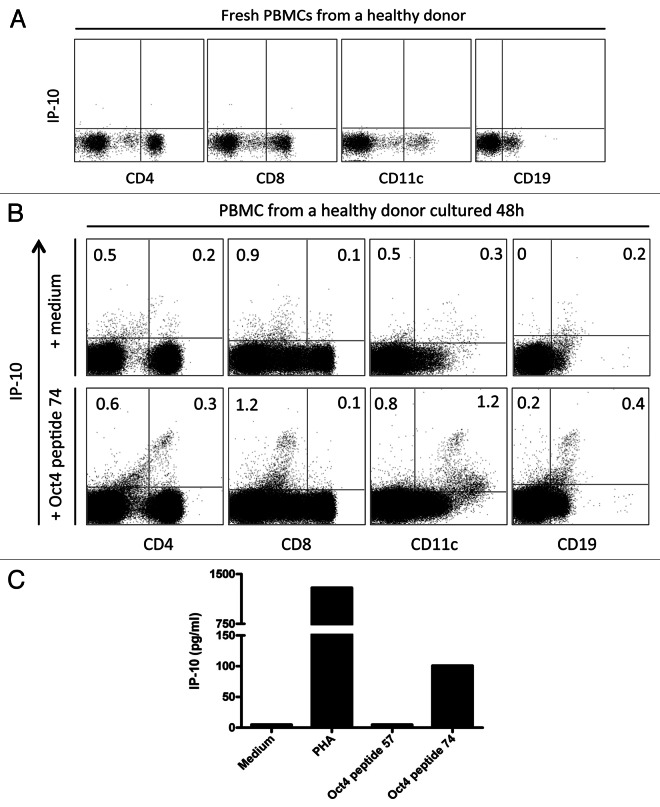
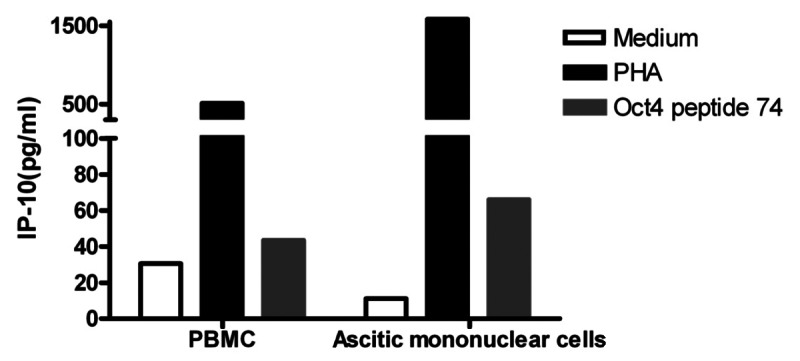
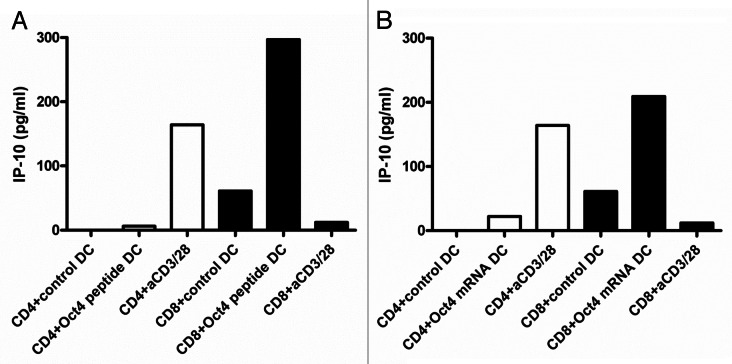
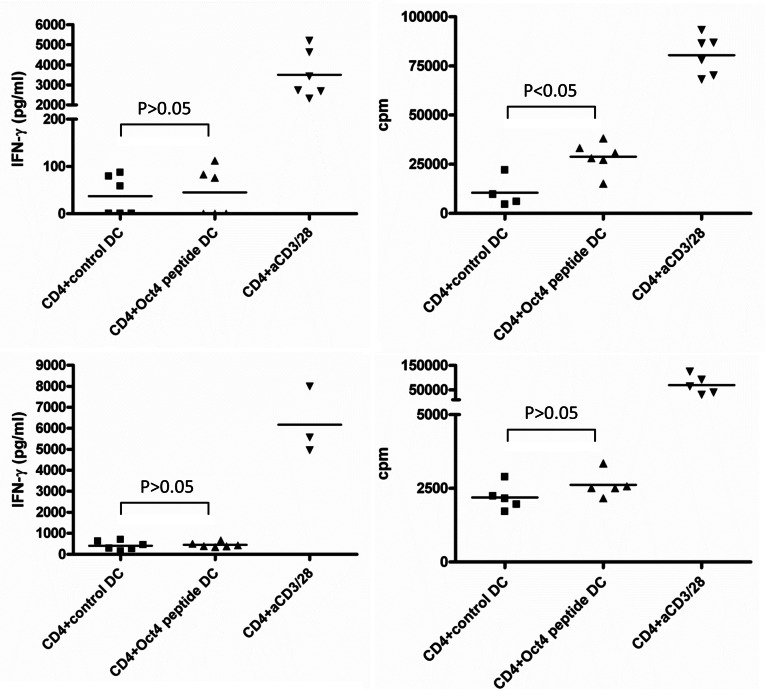
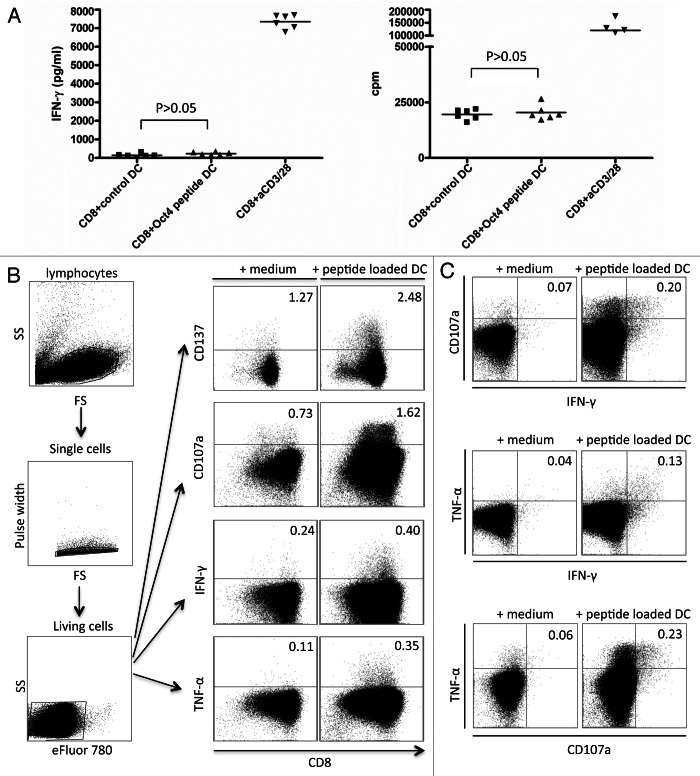
The identification of growth and differentiation pathways that are responsible for the proliferation and survival of cancer stem cells (CSCs) has opened avenues for the discovery of novel therapeutic targets. In the initial phase of an anticancer immune response, T cells specific for tumor-associated antigens develop in patients and, at least under selected circumstances, are able to eliminate malignant cells. However, it remains unknown whether CSC-specific T cells are also operational. We found naturally occurring multifunctional CD4 and CD8 T cells specific for the stem cell marker OCT4 among the peripheral blood mononuclear cells (PBMCs) of both healthy individuals and ovarian cancer patients. Moreover, lymphocytes isolated from the ascites of patients affected by ovarian malignancies also contained OCT4-specific T cells. OCT4-reactive CD4 T cells did not produce interferon γ (IFNγ) and IFNγ-inducible protein 10 (IP-10) but were capable of proliferation upon stimulation with dendritic cells (DCs) loaded with an OCT4-derived peptide or mRNA. OCT4-reactive CD8 cells did not proliferate in response to a similar challenge, yet produced IP-10 as well as sufficient amounts of IFNγ to induce IP-10 . Furthermore, CD8 cytotoxic T cells were able to release their lysosomal components, as indicated by the mobilization of CD107a. These results demonstrate the existence of anti-CSC specific T cells in ovarian cancer patients.
对负责癌症干细胞(CSC)增殖和存活的生长及分化途径的识别,为发现新的治疗靶点开辟了道路。在抗癌免疫反应的初始阶段,针对肿瘤相关抗原的T细胞在患者体内产生,并且至少在特定情况下能够消除恶性细胞。然而,CSC特异性T细胞是否也发挥作用仍不清楚。我们在健康个体和卵巢癌患者的外周血单个核细胞(PBMC)中发现了天然存在的对干细胞标志物OCT4具有特异性的多功能CD4和CD8 T细胞。此外,从卵巢恶性肿瘤患者腹水中分离出的淋巴细胞也含有OCT4特异性T细胞。OCT4反应性CD4 T细胞不产生干扰素γ(IFNγ)和IFNγ诱导蛋白10(IP-10),但在用负载有OCT4衍生肽或mRNA的树突状细胞(DC)刺激后能够增殖。OCT4反应性CD8细胞对类似刺激不增殖,但产生IP-10以及足以诱导IP-10的大量IFNγ。此外,如CD107a的动员所示,CD8细胞毒性T细胞能够释放其溶酶体成分。这些结果证明卵巢癌患者中存在抗CSC特异性T细胞。