Division of Clinical Pharmacology, Department of Medicine, Vanderbilt Center for Bone Biology, Vanderbilt University Medical Center, Nashville, TN, 37232, USA,
Calcif Tissue Int. 2014 Jan;94(1):140-51. doi: 10.1007/s00223-013-9752-4. Epub 2013 Jun 14.
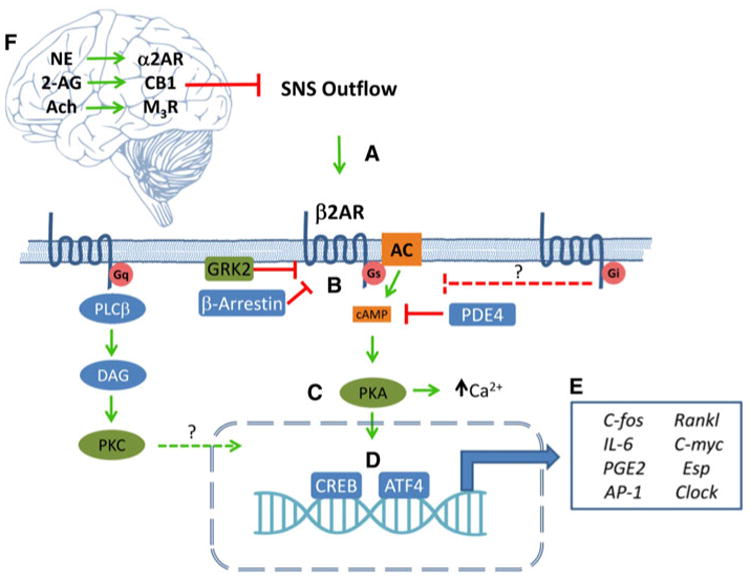
The skeleton is no longer seen as a static, isolated, and mostly structural organ. Over the last two decades, a more complete picture of the multiple functions of the skeleton has emerged, and its interactions with a growing number of apparently unrelated organs have become evident. The skeleton not only reacts to mechanical loading and inflammatory, hormonal, and mineral challenges, but also acts of its own accord by secreting factors controlling the function of other tissues, including the kidney and possibly the pancreas and gonads. It is thus becoming widely recognized that it is by nature an endocrine organ, in addition to a structural organ and site of mineral storage and hematopoiesis. Consequently and by definition, bone homeostasis must be tightly regulated and integrated with the biology of other organs to maintain whole body homeostasis, and data uncovering the involvement of the central nervous system (CNS) in the control of bone remodeling support this concept. The sympathetic nervous system (SNS) represents one of the main links between the CNS and the skeleton, based on a number of anatomic, pharmacologic, and genetic studies focused on β-adrenergic receptor (βAR) signaling in bone cells. The goal of this report was to review the data supporting the role of the SNS and βAR signaling in the regulation of skeletal homeostasis.
骨骼不再被视为一种静态、孤立且主要是结构性的器官。在过去的二十年中,人们对骨骼的多种功能有了更全面的认识,骨骼与越来越多明显不相关的器官的相互作用也变得明显。骨骼不仅对机械负荷、炎症、激素和矿物质的挑战作出反应,而且还自行分泌控制其他组织功能的因子,包括肾脏,可能还包括胰腺和性腺。因此,人们普遍认识到,骨骼除了是一种结构性器官和矿物质储存及造血场所外,本质上还是一种内分泌器官。因此,根据定义,骨稳态必须与其他器官的生物学紧密调节和整合,以维持全身稳态,而揭示中枢神经系统 (CNS) 参与控制骨重塑的数据支持这一概念。基于一些专注于骨细胞β-肾上腺素能受体 (βAR) 信号的解剖学、药理学和遗传学研究,交感神经系统 (SNS) 是 CNS 和骨骼之间的主要联系之一。本报告的目的是综述支持 SNS 和 βAR 信号在骨骼稳态调节中的作用的数据。