Hematology, Department of Clinical and Experimental Medicine, University of Parma, Via Gramsci 14, 43126 Parma, Italy.
Stem Cells Int. 2013;2013:312501. doi: 10.1155/2013/312501. Epub 2013 May 23.
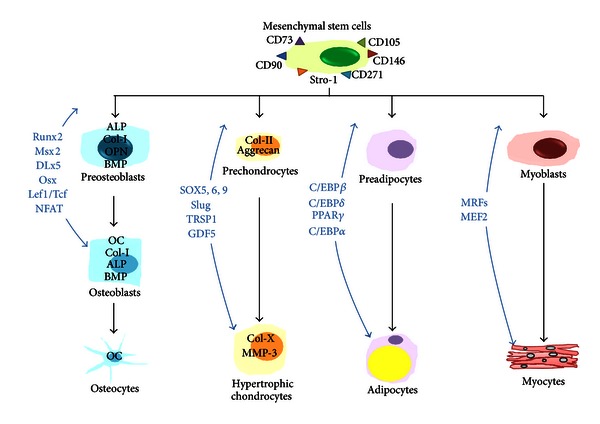
Human mesenchymal stem cells (hMSCs) are pluripotent adult stem cells capable of being differentiated into osteoblasts, adipocytes, and chondrocytes. The osteogenic differentiation of hMSCs is regulated either by systemic hormones or by local growth factors able to induce specific intracellular signal pathways that modify the expression and activity of several transcription factors. Runt-related transcription factor 2 (Runx2) and Wnt signaling-related molecules are the major factors critically involved in the osteogenic differentiation process by hMSCs, and SRY-related high-mobility-group (HMG) box transcription factor 9 (SOX9) is involved in the chondrogenic one. hMSCs have generated a great interest in the field of regenerative medicine, particularly in bone regeneration. In this paper, we focused our attention on the molecular mechanisms involved in osteogenic and chondrogenic differentiation of hMSC, and the potential clinical use of hMSCs in osteoarticular pediatric disease characterized by fracture nonunion and pseudarthrosis.
人骨髓间充质干细胞(hMSCs)是多能成体干细胞,能够分化为成骨细胞、脂肪细胞和软骨细胞。hMSCs 的成骨分化受系统激素或局部生长因子的调节,这些因子能够诱导特定的细胞内信号通路,改变几种转录因子的表达和活性。 runt 相关转录因子 2(Runx2)和 Wnt 信号相关分子是 hMSCs 成骨分化过程中关键的主要因素,而性决定区 Y 相关高迁移率族(HMG)框转录因子 9(SOX9)则参与软骨形成。hMSCs 在再生医学领域引起了极大的兴趣,特别是在骨再生方面。在本文中,我们关注了 hMSC 成骨和成软骨分化涉及的分子机制,以及 hMSC 在以骨折不愈合和假关节为特征的儿童骨关节炎疾病中的潜在临床应用。