Department of Internal Medicine I, University Hospital of Ulm, Albert-Einstein Allee 23, 89081 Ulm, Germany.
Stem Cells Int. 2013;2013:496501. doi: 10.1155/2013/496501. Epub 2013 May 12.
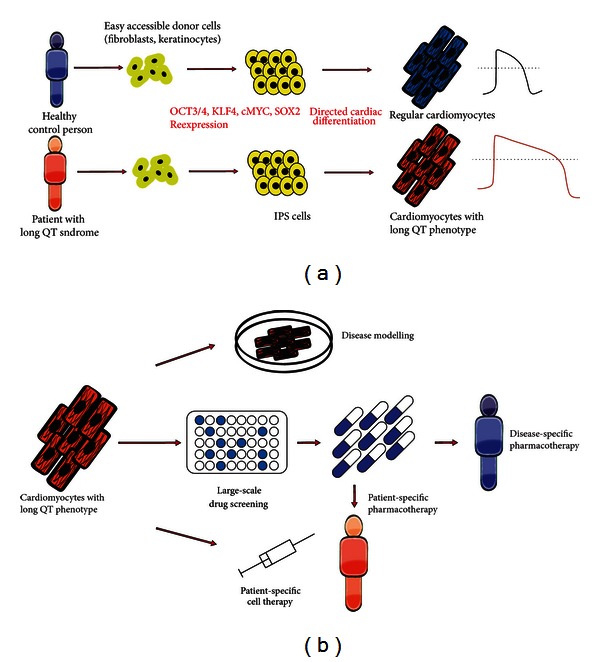
The generation of induced pluripotent stem cells (iPS cells) has pioneered the field of regenerative medicine and developmental biology. They can be generated by overexpression of a defined set of transcription factors in somatic cells derived from easily accessible tissues such as skin or plucked hair or even human urine. In case of applying this tool to patients who are classified into a disease group, it enables the generation of a disease- and patient-specific research platform. iPS cells have proven a significant tool to elucidate pathophysiological mechanisms in various diseases such as diabetes, blood disorders, defined neurological disorders, and genetic liver disease. One of the first successfully modelled human diseases was long QT syndrome, an inherited cardiac channelopathy which causes potentially fatal cardiac arrhythmia. This review summarizes the efforts of reprogramming various types of long QT syndrome and discusses the potential underlying mechanisms and their application.
诱导多能干细胞(iPS 细胞)的产生开创了再生医学和发育生物学的领域。它们可以通过在来源于皮肤或拔下的毛发等易于获取的组织的体细胞核中过表达一组特定的转录因子来产生,甚至可以用人尿来产生。在将该工具应用于分类为疾病组的患者的情况下,它能够生成疾病和患者特异性的研究平台。iPS 细胞已被证明是阐明各种疾病(如糖尿病、血液疾病、特定的神经疾病和遗传性肝病)的病理生理机制的重要工具。最早成功模拟的人类疾病之一是长 QT 综合征,这是一种遗传性心脏通道病,可导致潜在致命的心律失常。本综述总结了对各种类型的长 QT 综合征进行重编程的努力,并讨论了潜在的潜在机制及其应用。