BMC Cancer. 2013 Jun 17;13:292. doi: 10.1186/1471-2407-13-292.
As the incidence of prostate cancer continues to rise steeply, there is an increasing need to identify more accurate prognostic markers for the disease. There is some evidence that a higher modified Glasgow Prognostic Score (mGPS) may be associated with poorer survival in patients with prostate cancer but it is not known whether this is independent of other established prognostic factors. Therefore the aim of this study was to describe the relationship between mGPS and survival in patients with prostate cancer after adjustment for other prognostic factors.
Retrospective clinical series on patients in Glasgow, Scotland, for whom data from the Scottish Cancer Registry, including Gleason score, Prostate Specific Antigen (PSA), C-reactive protein (CRP) and albumin, six months prior to or following the diagnosis, were included in this study.
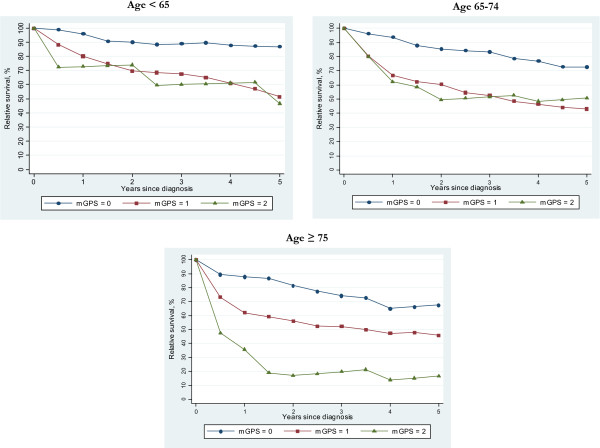
Seven hundred and forty four prostate cancer patients were identified; of these, 497 (66.8%) died during a maximum follow up of 11.9 years. Patients with mGPS of 2 had poorest 5-year and 10-year relative survival, of 32.6% and 18.8%, respectively. Raised mGPS also had a significant association with excess risk of death at five years (mGPS 2: Relative Excess Risk = 3.57, 95% CI 2.31-5.52) and ten years (mGPS 2: Relative Excess Risk = 3.42, 95% CI 2.25-5.21) after adjusting for age, socioeconomic circumstances, Gleason score, PSA and previous in-patient bed days.
The mGPS is an independent and objective prognostic indicator for survival of patients with prostate cancer. It may be useful in determining the clinical management of patients with prostate cancer in addition to established prognostic markers.
随着前列腺癌的发病率持续急剧上升,人们越来越需要找到更准确的疾病预后标志物。有证据表明,改良格拉斯哥预后评分(mGPS)较高可能与前列腺癌患者的生存率较差有关,但尚不清楚这是否独立于其他已确立的预后因素。因此,本研究旨在描述 mGPS 与前列腺癌患者生存的关系,调整其他预后因素后。
回顾性临床系列研究,纳入了苏格兰格拉斯哥的患者数据,包括苏格兰癌症登记处的数据,包括 Gleason 评分、前列腺特异性抗原(PSA)、C 反应蛋白(CRP)和白蛋白,这些数据是在诊断前或诊断后 6 个月内收集的。
共确定了 744 例前列腺癌患者;其中,744 例患者在最长 11.9 年的随访期间死亡。mGPS 为 2 的患者 5 年和 10 年相对生存率最差,分别为 32.6%和 18.8%。mGPS 升高与 5 年(mGPS 2:相对超额风险=3.57,95%CI 2.31-5.52)和 10 年(mGPS 2:相对超额风险=3.42,95%CI 2.25-5.21)的死亡风险显著相关,调整年龄、社会经济状况、Gleason 评分、PSA 和住院天数后。
mGPS 是前列腺癌患者生存的独立和客观预后指标。除了已确立的预后标志物外,它可能有助于确定前列腺癌患者的临床管理。