Suppr超能文献

迷走神经刺激治疗脑肿瘤患者药物难治性癫痫的疗效。使用 VNS 治疗患者结果登记系统的病例对照研究。

Efficacy of vagus nerve stimulation as a treatment for medically intractable epilepsy in brain tumor patients. A case-controlled study using the VNS therapy Patient Outcome Registry.

机构信息

Department of Neurosurgery, Weill Cornell Medical College, New York Presbyterian Hospital, 1300 York Avenue, New York, NY 10065, USA.

出版信息

Seizure. 2013 Oct;22(8):627-33. doi: 10.1016/j.seizure.2013.04.017. Epub 2013 Jun 12.

Abstract

PURPOSE

Vagus nerve stimulation (VNS) therapy is a procedure to control seizure frequency in patients with medically intractable epilepsy. However, there is no data on efficacy in the subset of these patients with brain tumors. The purpose of this study is to evaluate the efficacy of VNS therapy in patients with brain tumor-associated medically intractable epilepsy.

METHODS

Data from the VNS therapy Patient Outcome Registry, maintained by the manufacturer of the device, Cyberonics Inc. (Houston, TX, USA), was queried to characterize the response of patients in whom a brain tumor was listed as the etiology of epilepsy. A case-control analysis was implemented and patient outcome was measured by Engel classification, median seizure response and responder rate (≥50% seizure reduction) using t-tests and chi-squared tests.

RESULTS

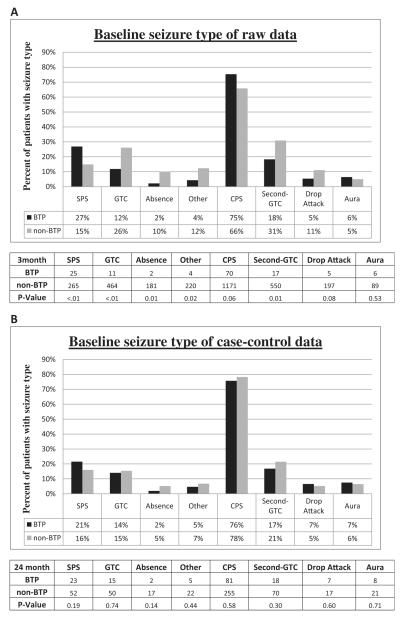
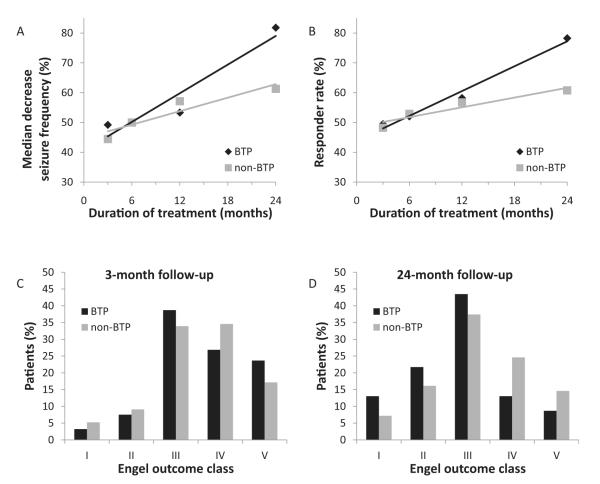
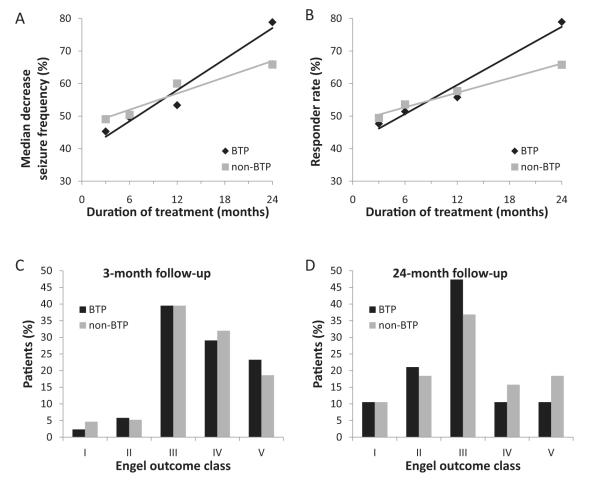
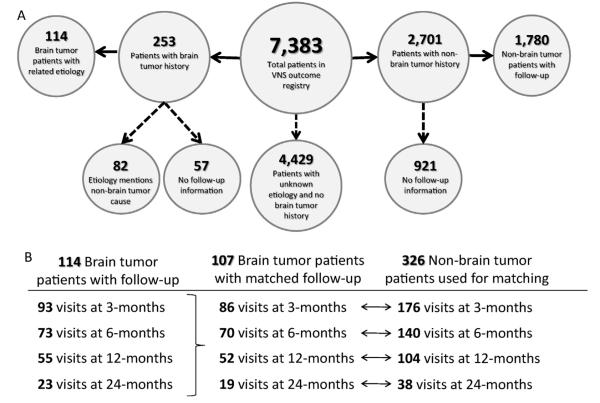
In 107 patients with an epilepsy etiology related to a brain tumor, seizure reduction was 45% at 3 months and 79% at 24 months with a responder rate of 48% at 3 months and 79% at 24 months. There was no statistical difference in seizure reduction compared with 326 case-control patients from the registry without brain tumors. There was no significant difference in anti-epileptic drug (AED) usage from baseline to 24 months post implant in either group.

CONCLUSIONS

VNS therapy is equally effective in patients who suffer seizures secondary to brain tumors as in patients without history of a brain tumor. VNS therapy is a viable treatment option for patients with brain tumor associated medically intractable epilepsy, assuming cytoreductive and other adjuvant therapies have been fully explored.

摘要

目的

迷走神经刺激(VNS)疗法是一种控制药物难治性癫痫患者癫痫发作频率的程序。然而,在这些有脑肿瘤的患者亚组中,没有关于疗效的数据。本研究的目的是评估 VNS 疗法在脑肿瘤相关药物难治性癫痫患者中的疗效。

方法

通过制造商 Cyberonics Inc.(美国休斯顿)维护的 VNS 治疗患者结果注册中心查询数据,以描述将脑瘤列为癫痫病因的患者的反应。实施病例对照分析,通过 Engel 分类、中位癫痫发作反应和应答率(≥50%癫痫发作减少)来衡量患者的预后,使用 t 检验和卡方检验。

结果

在 107 例癫痫病因与脑瘤相关的患者中,3 个月时癫痫发作减少 45%,24 个月时减少 79%,3 个月时应答率为 48%,24 个月时应答率为 79%。与注册中心中 326 例无脑瘤的病例对照患者相比,癫痫发作减少没有统计学差异。两组患者在植入后 24 个月内,抗癫痫药物(AED)的使用量与基线相比均无显著差异。

结论

VNS 疗法对因脑瘤而发作的患者与无脑瘤病史的患者同样有效。VNS 疗法是脑肿瘤相关药物难治性癫痫患者的可行治疗选择,假设已充分探索了减瘤和其他辅助治疗方法。
相似文献

2
Efficacy of vagus nerve stimulation in brain tumor-associated intractable epilepsy and the importance of tumor stability.
J Neurosurg. 2013 Aug;119(2):520-5. doi: 10.3171/2013.3.JNS121890. Epub 2013 Apr 19.
3
Efficacy of vagus nerve stimulation in posttraumatic versus nontraumatic epilepsy.
J Neurosurg. 2012 Nov;117(5):970-7. doi: 10.3171/2012.8.JNS122. Epub 2012 Sep 14.
4
Long-term seizure and psychosocial outcomes of vagus nerve stimulation for intractable epilepsy.
Epilepsy Behav. 2015 Dec;53:31-6. doi: 10.1016/j.yebeh.2015.09.031. Epub 2015 Oct 26.
5
Refractory epilepsy in tuberous sclerosis: vagus nerve stimulation with or without subsequent resective surgery.
Epilepsy Behav. 2009 Nov;16(3):454-60. doi: 10.1016/j.yebeh.2009.08.018. Epub 2009 Sep 19.
7
Long-term outcome of vagus nerve stimulation therapy after failed epilepsy surgery.
Seizure. 2011 Apr;20(3):244-8. doi: 10.1016/j.seizure.2010.12.003. Epub 2010 Dec 31.
9
Rates and Predictors of Seizure Freedom With Vagus Nerve Stimulation for Intractable Epilepsy.
Neurosurgery. 2016 Sep;79(3):345-53. doi: 10.1227/NEU.0000000000001165.

引用本文的文献

1
Asymmetric efficacy of VNS within a single patient with bilateral focal frontal lobe epilepsy: A case report.
Acta Neurochir (Wien). 2025 Aug 26;167(1):228. doi: 10.1007/s00701-025-06653-x.
2
Brain Tumor Related Epilepsy: Pathophysiology and Multimodal Approach to Management.
Curr Oncol Rep. 2025 Jul 12. doi: 10.1007/s11912-025-01705-y.
4
Vagus Nerve Stimulation for Tumor-Related Epilepsy: Does It Make Sense?
Perm J. 2021 Jun 9;25:20.276. doi: 10.7812/TPP/20.276.
5
ReStore: A wireless peripheral nerve stimulation system.
J Neurosci Methods. 2019 May 15;320:26-36. doi: 10.1016/j.jneumeth.2019.02.010. Epub 2019 Mar 5.

本文引用的文献

1
Characteristics and treatment of seizures in patients with high-grade glioma: a review.
Neurosurg Clin N Am. 2012 Apr;23(2):227-35, vii-viii. doi: 10.1016/j.nec.2012.01.009.
3
The pathogenesis of tumor-related epilepsy and its implications for clinical treatment.
Seizure. 2012 Apr;21(3):153-9. doi: 10.1016/j.seizure.2011.12.016. Epub 2012 Feb 1.
4
Epilepsy in patients with a brain tumour: focal epilepsy requires focused treatment.
Brain. 2012 Apr;135(Pt 4):1002-16. doi: 10.1093/brain/awr310. Epub 2011 Dec 13.
5
Extent of surgical resection predicts seizure freedom in low-grade temporal lobe brain tumors.
Neurosurgery. 2012 Apr;70(4):921-8; discussion 928. doi: 10.1227/NEU.0b013e31823c3a30.
6
Factors associated with seizure freedom in the surgical resection of glioneuronal tumors.
Epilepsia. 2012 Jan;53(1):51-7. doi: 10.1111/j.1528-1167.2011.03269.x. Epub 2011 Sep 20.
7
Vagus nerve stimulation for epilepsy: a meta-analysis of efficacy and predictors of response.
J Neurosurg. 2011 Dec;115(6):1248-55. doi: 10.3171/2011.7.JNS11977. Epub 2011 Aug 12.
8
Antiepileptic drugs for treating seizures in adults with brain tumours.
Cochrane Database Syst Rev. 2011 Aug 10;2011(8):CD008586. doi: 10.1002/14651858.CD008586.pub2.
10

文献AI研究员

20分钟写一篇综述,助力文献阅读效率提升50倍。

立即体验

用中文搜PubMed

大模型驱动的PubMed中文搜索引擎

马上搜索

文档翻译

学术文献翻译模型,支持多种主流文档格式。

立即体验