Marie Curie Palliative Care Research Unit, UCL Mental Health Sciences Unit, University College London Medical School, Charles Bell House, 67-73 Riding House Street, London W1W 7EJ, UK.
Trials. 2013 Jun 18;14:179. doi: 10.1186/1745-6215-14-179.
Complex healthcare interventions consist of multiple components which may vary in trials conducted in different populations and contexts. Pooling evidence from trials in a systematic review is challenging because it is unclear which components are needed for effectiveness. The potential is recognised for using recipients' views to explore why some complex interventions are effective and others are not. Methods to maximise this potential are poorly developed.
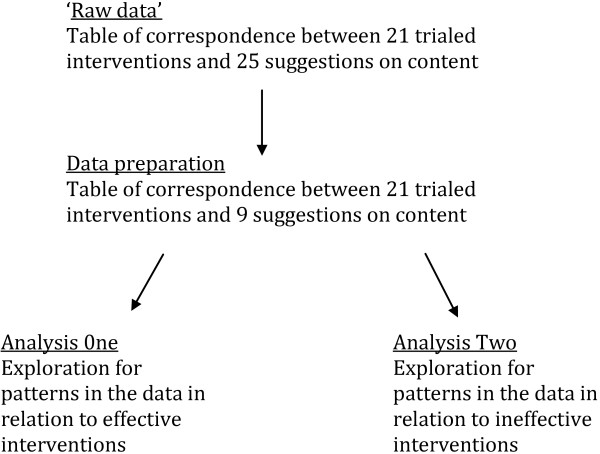
We used a novel approach to explore how patients' views may explain the disparity in effectiveness of complex interventions. We used qualitative comparative analysis to explore agreement between qualitative syntheses of data on patients' views and evidence from trialed interventions to increase adherence to treatments. We first populated data matrices to reflect whether the content of each trialed intervention could be matched with suggestions arising from patients' views. We then used qualitative comparative analysis software to identify, by a process of elimination, the smallest number of configurations (patterns) of components that corresponded with patients' suggestions and accounted for whether each intervention was effective or ineffective.
We found suggestions by patients were poorly represented in interventions. Qualitative comparative analysis identified particular combinations of components corresponding with patients' suggestions and with whether an intervention was effective or ineffective. Six patterns were identified for an effective and four for an ineffective intervention. Two types of patterns arose for the effective interventions, one being didactic (providing clear information or instruction) and the other interactive (focusing on personal risk factors).
Our analysis highlights how data on patients' views has the potential to identify key components across trials of complex interventions or inform the content of new interventions to be trialed.
复杂的医疗干预措施由多个组成部分构成,这些组成部分在不同人群和环境下进行的试验中可能会有所不同。在系统评价中综合来自试验的证据具有挑战性,因为不清楚哪些组成部分对有效性是必要的。人们认识到可以利用接受者的观点来探索为什么一些复杂的干预措施有效,而另一些则无效。但是,最大限度地利用这种潜力的方法还不够完善。
我们使用一种新方法来探讨患者的观点如何解释复杂干预措施有效性的差异。我们使用定性比较分析来探索患者观点的定性综合数据与试验干预措施的证据之间的一致性,以增加对治疗的依从性。我们首先填充数据矩阵,以反映每个试验干预措施的内容是否可以与患者观点提出的建议相匹配。然后,我们使用定性比较分析软件,通过逐步淘汰的过程,确定与患者建议和干预措施有效性或无效性相对应的最小数量的组件配置(模式)。
我们发现患者的建议在干预措施中没有得到很好的体现。定性比较分析确定了与患者建议以及干预措施有效性或无效性相对应的特定组件组合。有效干预有 6 种模式,无效干预有 4 种模式。有效干预有两种类型的模式,一种是说教式(提供明确的信息或指导),另一种是互动式(关注个人风险因素)。
我们的分析强调了患者观点的数据如何有可能在复杂干预措施的试验中确定关键组成部分,或者为新的试验干预措施提供内容。